
-
Canal Visitor Center Closure
Canal Visitor Center will be closed for construction, starting Monday, May 6, 2013. It will reopen with new exhibits in early 2014.
-
Riverview Road Closure
Riverview Rd from the Cuyahoga Falls line north to the Peninsula line will be re-paved, beginning the week of April 22. Expect delays. Flaggers will direct traffic. Work is expected to be completed by Memorial Day weekend.
-
Towpath Trail Closure
NPS has closed the Ohio & Erie Canal Towpath Trail from Hillside Road to Stone Road in Valley View. A section of the trail is not passable due to hazardous conditions caused by erosion. Towpath is expected to be open by Memorial Day, May 27.
-
Bald Eagle Closure in Effect
RR tracks, and 30 foot right of way on either side, are closed to all foot traffic from the Rt. 82 Bridge at Station Rd, north to the RR tracks at. The Cuyahoga R. downstream of the Brecksville Dam to the Fitzwater Rd Bridge is closed to water activities.
Park Basics
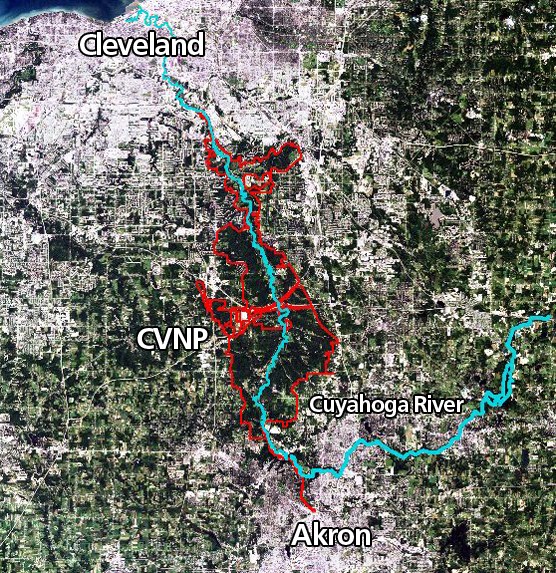
Scenic railroad passes through the valley, beside the Cuyahoga River. NPS/tim fenner The Cuyahoga Valley stretches between two of Ohio’s largest cities—Cleveland and Akron. The valley surrounds the Cuyahoga River as it snakes its way towards the great Lake Erie. Cuyahoga Valley National Park (CVNP) includes more than fifty square miles of thick forest, deep gorges, green wetlands, and rocky waterfalls. There are also historic villages, an old canal towpath, farm fields, a covered bridge, and a sightseeing railroad in the park.
Twenty-two miles of the Cuyahoga River runs through CVNP. American Indians called it “Ka-ih-ogh-ha,” or “crooked river” because of its U-shaped path through northeast Ohio. People have lived in the Cuyahoga Valley for 13,000 years. Prehistoric peoples to pioneers, canal builders, and twentieth century immigrants have left their mark on the valley.
In the early 1970s, park advocates lead bus tours through the valley to spark interest in creating a national park. NPS In the 1960s many Northeast Ohioans felt like water pollution, expanded highways, and other problems of urban sprawl were quickly taking over much of the Cuyahoga Valley. So citizens got together with their members of Congress to save the valley’s scenic and historic places. In 1974 Cuyahoga Valley National Recreation Area became one of a number of urban National Park sites, meant to give people living in cities places for outdoor recreation. In 2000 the park was renamed Cuyahoga Valley National Park to highlight its place within the National Park System.
Kids Asked, We Answered! Click the question to play video of real kids getting answers from park experts. When was the national park founded? National Parks protect America’s treasures. They forever preserve our country’s special places. Some are famously scenic, like Grand Canyon, or famously historic, like Gettysburg. Other National Parks protect unique natural places, like Everglades, and most are great places for outdoor fun. Cuyahoga Valley National Park is all these. It is scenic, historic, and full of nature as well as fun things to do.
Today more than 4 million people live within a half hour drive of CVNP. Visitors come to learn how past generations and long ago cultures lived in the valley and to enjoy and connect with the natural world thriving there today.
Satellite image showing Cuyahoga Valley National Park between Akron and Cleveland. The Cuyahoga
River flows north through the park to Lake Erie. NPS
|
Did You Know?
Early September is the time to watch monarchs feed in Cuyahoga Valley fields rich with goldenrod and New England aster. These places serve as important re-fueling sites for these long distance travelers on their way to oyamel forests near Mexico City more than 2,000 miles away.