An official website of the United States government
Here's how you know
Official websites use .gov A
.gov website belongs to an official government
organization in the United States.
Secure .gov websites use HTTPS A
lock (
) or https:// means you've safely connected to
the .gov website. Share sensitive information only on official,
secure websites.
The Fruita Schoolhouse is nestled below Wingate Sandstone cliffs.
NPS/ Ann Huston
Students in 1935 pose behind the schoolhouse. You can still see the rock with "Fruita Grade School" carved into it today. Please leave no trace of your visit, and do not add any writing or drawing to this historic inscription.
NPS
First Classes
Classes had been conducted for two years before the Fruita Schoolhouse was built, when Elijah Cutler Behunin donated land for a school building in 1896. He and other early Junction (later called "Fruita") settlers constructed the building. Even though only eight families lived in Junction, these farmers had large families. The Behunins raised thirteen children themselves, one of whom, Nettie, became the first schoolteacher, at age twelve. She taught children in the Behunin home before the schoolhouse was built. Nettie's first class had 22 students, three of whom were her siblings.
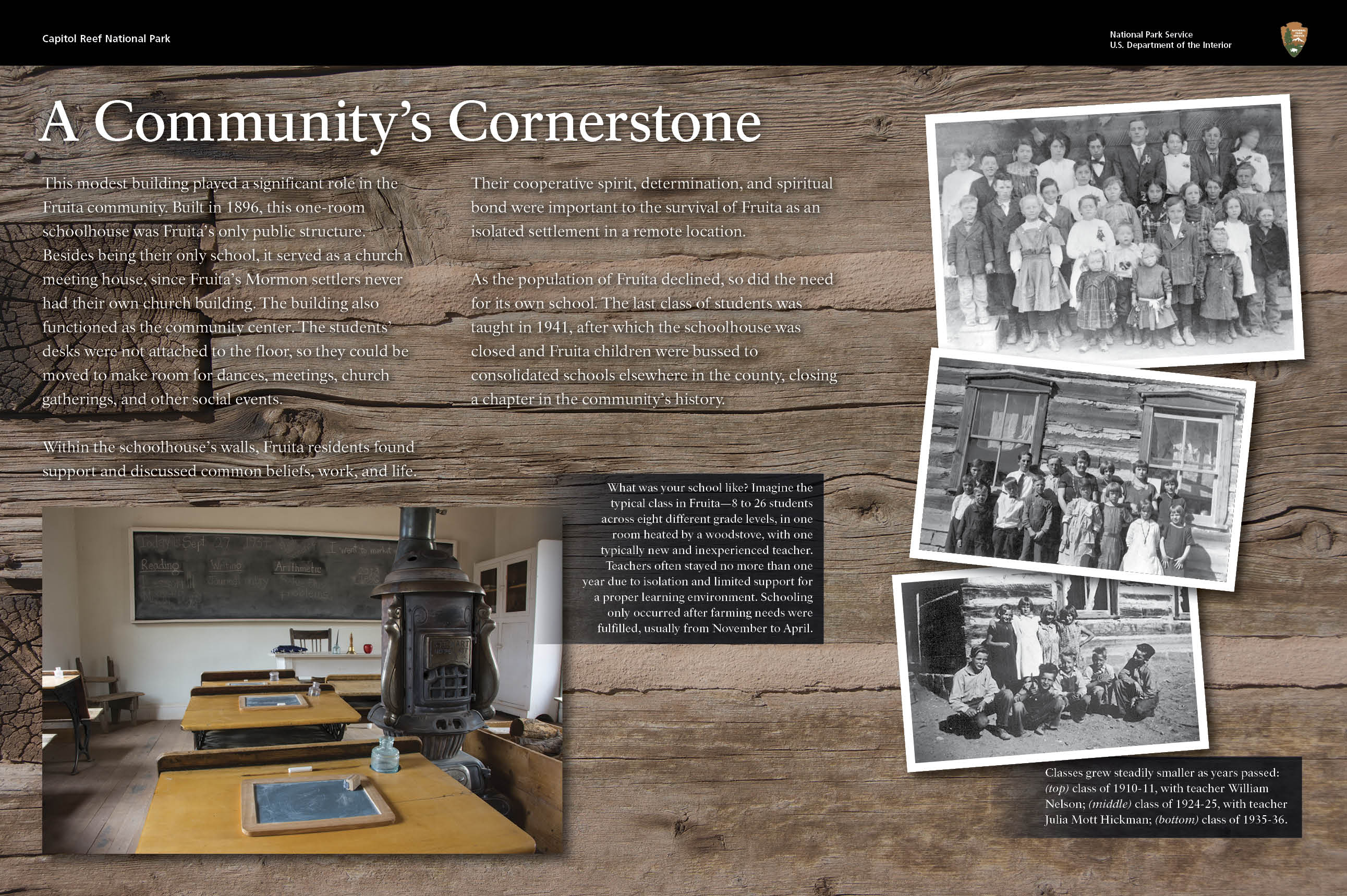
Originally, there was a flat, dirt covered roof on the school. A peaked, shingled roof was added in 1912 or 1913. The interior walls, originally bare and chinked logs, were plastered in 1935. The first desks were homemade, constructed of pine, and seated two students each. These were sometimes used to quiet unruly students. The teacher would seat a troublesome boy with a girl, and the resulting blow to his ego would often bring him under control.
Imagine what it would be like to attend a one room schoolhouse. Would you enjoy having class with children of all ages?
NPS
A Day in the Life of a Teacher
Teachers taught the "three-Rs" to the eight grades at the one-room school. If a teacher felt qualified and had enough textbooks, other subjects such as geography, were added.
Students were full of pranks. To delay the start of class, they often hid the teacher's alarm clock in the woodpile. Lanterns used during night meetings were stored in the school, and a few enterprising students found that dropping a small piece of calcium carbide, taken from a lantern, into an inkwell produced a reaction that would cause the ink to overflow. If the inkwell was tightly capped, it would explode and spatter ink all over the room.
In 1900, the building was loaned to the Wayne County School District for the first county approved classes. Nettie, then 22, was the first authorized teacher. She was paid $70 a month while her male counterparts received $80 per month.
Listen to Janice Oldroyd Torgerson recount her time as a teacher in Fruita in 1934 (below). Classes of varying sizes continued until 1941, when the school was discontinued for lack of students.
The log building also served as a community meeting house and church. Desks were not bolted to the floor, so the room could be cleared for different needs. As late as 1924, the building was also used for dances, town meetings, elections, church youth activities, box suppers, and celebrations.
Janice Torgerson
Being a new teacher at the Fruita schoolhouse wasn’t always easy, as Janice Oldroyd Torgerson reflects on her year teaching in 1934. She was paid $57 a month and moved from her home in Lyman, to live at ‘Tine Olyer’s home. Torgerson describes pranks by her students as well as moonlit walks among the Fruita cliffs.
My name is Janice Oldroyd Torgerson. And I taught here in 1934 as a brand new teacher. I was a native of Wayne County, but Fruita was a rough 25-mile drive from my parent’s home in Lyman. I received $57 a month for a seven-month contract and boarded at ‘Tine Oyler’s home here in Fruita. There was no electricity or indoor plumbing, but Fruita was beautiful. Across the dusty road, were row upon row of grapes, bordered by huge walnut trees. On moonlit nights, the majestic red cliffs seemed gentle and protective.
The school building was badly in need of repair and mud was falling from between the logs. We had only a few old, ragged books. Like many rural children of the day, some of my students were pretty rough-and-tumble. The language I heard was too rugged for me, and I came down hard on that. Then there were the inevitable tricks. One morning I received a dead snake, coiled menacingly on my chair.
I gathered some gentle recollections, too. I especially remember the happy faces of young Lloyd and Fay Gifford, when they gave me a handkerchief at Christmas. It was a pretty rough year for a new teacher, and frankly I was relieved as school end drew near. The folks at Fruita gave me a surprise party the last evening before I left. The Mulfords and Giffords came with food; we played games and danced in the Oyler’s crowded living room. By noon the next day, I was on my way home. Just before Fruita disappeared from view, I stopped, sat down on a rock, and thought about the eventful year just past. I found a lot of happy memories while sitting there, and cried a little, knowing it was over.
The Schoolhouse Today
In 1964, the National Park Service nominated the school to the National Register of Historic Places and subsequently restored the structure to the 1930s period. Today, the school stands in its original location, although Utah Highway 24 was added in 1962. Visitors may peer through the windows into the furnished structure and imagine what school was like, so long ago. Those with a good imagination can still hear that old school bell ring.
435-425-3791
Recorded park information available 24 hours a day. Phones are answered when staff is available. If no one answers, please leave a message, your call will be returned. Questions may also be sent to care_information@nps.gov.