



Last updated: June 7, 2026
Thing to Do
Visit Tuzigoot Pueblo
NPS Photo
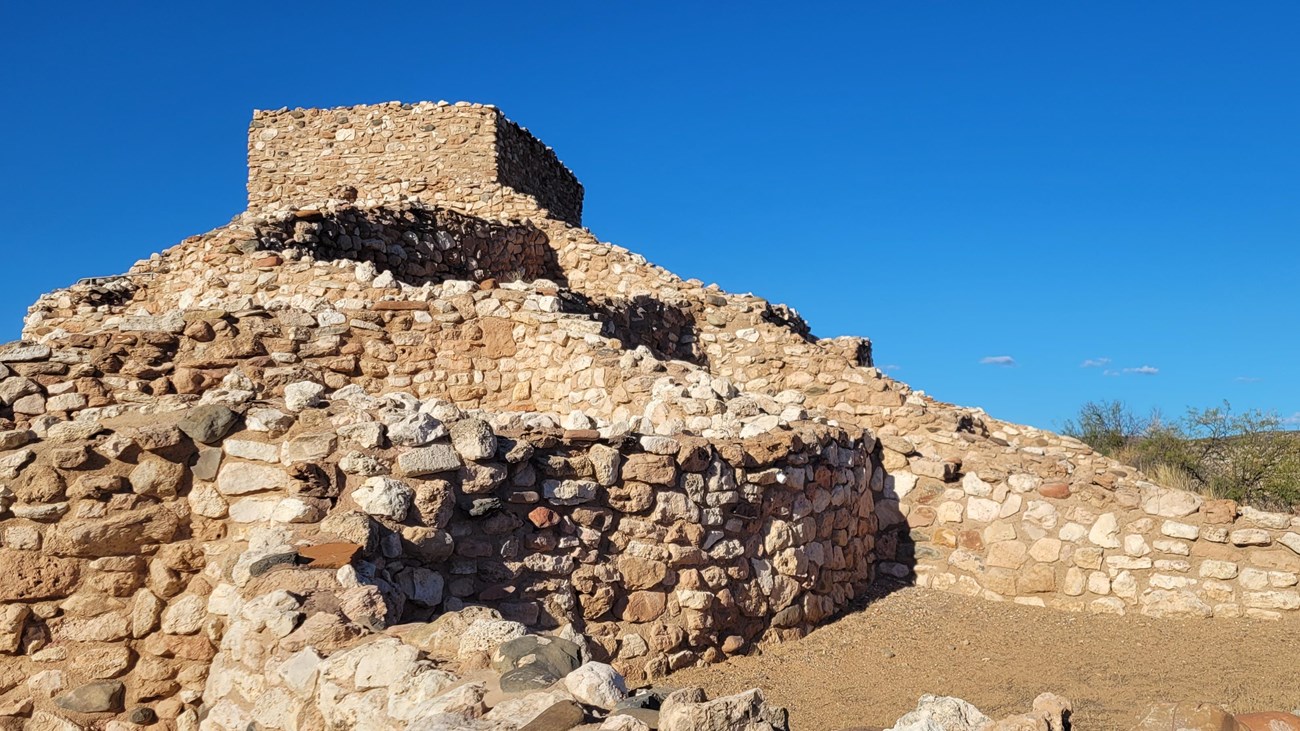
Have you ever wondered what life in the desert would have looked like thousands of years ago? Visitors to Tuzigoot National Monument can look into the lives of the Sinagua, the people who lived here and built the pueblo the park is named for by hiking the Pueblo Trail. The trail is a 0.3 mile (0.5 km) loop that encircles the dwelling and allows an up close look at this incredible testament to community and ancient engineering.
Visitors can also walk into and stand on the roof of one of the pueblo rooms. The tower or citadel provides the opportunity to view the inner structure of a pueblo room and some relief from the intense sun. A set of stairs leads to the roof of the citadel which offers 360-degree views of Tuzigoot.
The pueblo was constructed and expanded in four phases from approximately 1050 CE to 1380. By the end of construction, Tuzigoot held about 110 rooms, 23 of them built on the second story. It's estimated about 225 people could have lived in the pueblo at its peak. It's very likely that women in the community constructed most of the structure while men gathered materials. Tuzigoot was just one of many Sinagua villages in the Verde Valley at the time; there were at least three other villages that were built within sight of Tuzigoot.
This was home to a vibrant, thriving community until the Sinagua left the Verde Valley by about the early 1400s. It's not known exactly why the Sinagua left the area, but it may have been for multiple reasons such as climate change causing hotter, drier conditions in the southwest, competition for resources with other peoples, collapse of trade routes, or disease. Traditional knowledge from some descendants of the Sinagua say the pueblos in the Verde Valley like Tuzigoot were never meant to be permanent settlements and it was just time for their people to move on. However, Tuzigoot is not abandoned and forgotten; it remains a place where people come to connect with their culture and heritage. It is remembered and honored.
Although most of Tuzigoot was reconstructed between 1933 and 1935, the reconstruction was built on the original foundation of the pueblo. Park staff continue to maintain the structure using natural materials and building techniques very similar to what the Sinagua would have used. If you're lucky, you may see cultural resources staff hard at work on this important project.
Safety
- Bring water on your walk. The Pueblo Trail does not have shade and summer high temperatures range from 95° to 115°F (35° to 46°C). The park does not sell bottled water, but water bottles can be purchased from the bookstore and a water bottle refill station and drinking fountain are available at the restrooms.
- From spring through fall, rattlesnakes are seen in the park and may be present on the trails. If you encounter a rattlesnake during your visit, please let a staff member know immediately. Park rangers are specially trained to safely relocate rattlesnakes. Never attempt to handle or move a snake yourself and give all snakes at least six feet of space. Please remember that we are visitors in their home; rattlesnakes and all other park wildlife are protected from harm or harassment by law.
-
Check the forecast ahead of time. From July through mid-September, heavy rainstorms called monsoons are common in the afternoon. Park trails are closed for 30 minutes following any lightning strikes five miles or less from the park.
Regulations
- Never climb or sit on the dwellings or structures. Please refrain from touching dwelling walls.
- Please stay on the trail.
- Drones and other unmanned aircraft are not permitted in the park.
- Please leave all plants, animals, rocks, artifacts, bones, and other items where you find them for others to enjoy. If you find something interesting on the trail, take a photo to share with a ranger.
- Pets are welcome on the trails but must be on a leash no more than six feet at all times. Always clean up after your pet. Never leave your pets in the car.
Details
Duration
30-45 Minutes
Activity
Hiking
Pets Allowed
Yes with Restrictions
Pets must be leashed at all times. Always pick up after your pet.
Activity Fee
Yes
Park entrance fee applies. Please show valid park pass or pay entrance fee at the visitor center before starting your walk.
Reservations
No
Season
Year Round
Time of Day
Day
The pueblo and park trails are only accessible during operating hours. Check park hours before your visit.
Accessibility Information
The Pueblo Trail is entirely paved and generally easy in difficulty, but includes some steeper grades that are not suitable for wheelchairs and may be difficult for those with balance, mobility, or knee issues. Benches are located along the trail, but most of the trail is in the sun for the duration of the day.
The citadel roof is accessed by two sets of stairs and hazards include dim lighting and steep, potentially slippery stairs. Accessing the citadel roof may be difficult for those with vision issues.
The citadel roof is accessed by two sets of stairs and hazards include dim lighting and steep, potentially slippery stairs. Accessing the citadel roof may be difficult for those with vision issues.