An official website of the United States government
Here's how you know
Official websites use .gov A
.gov website belongs to an official government
organization in the United States.
Secure .gov websites use HTTPS A
lock (
) or https:// means you've safely connected to
the .gov website. Share sensitive information only on official,
secure websites.
Superintendent’s Compendium 2026: Designations, Closures, Use and Activity Restrictions, Permit Requirements and Other Regulations
In accordance with the delegated authority provided by regulations as published under Title 36 Code of Federal Regulations (36 CFR), Chapter 1, Parts 1 through 7, authorized by Title 54 United States Code, Sec. 100751, the following regulatory provisions are established for the management, protection, and public use of Walnut Canyon, Sunset Crater Volcano and Wupatki National Monuments, herein referred to as the Flagstaff Area National Monuments.
Unless otherwise stated, these regulatory provisions apply in addition to the requirements contained elsewhere in Title 36 Code of Federal Regulations, Chapter 1, Parts 1 through 7.
The closures and restrictions delineated in this compendium do not apply to official and/or administrative use or applications (36 CFR §1.2(d) and 1.5(a)).
This Compendium supersedes all previous releases. All prior releases are rescinded.
The purpose of the compendium is to provide the public and Monument employees with a document that lists the special designations, closures, public use limits, permit requirements and other restrictions imposed under the discretionary authority of the Superintendent. The Superintendent’s authority to implement these provisions is found in Title 36, Code of Federal Regulations (CFR), § 1.5(a). The compendium is available to the public upon request. The compendium will be reviewed and updated annually or as needed to ensure adequate protection of the Monument’s resources, provide for public safety and enjoyment and to address changes in public use patterns.
The provisions found in this compendium constitute only one of many tools designed to manage and protect Walnut Canyon, Sunset Crater Volcano and Wupatki National Monuments. It is important to utilize this document in conjunction with Title 36, Code of Federal Regulations, which includes the full text of National Park Service regulations, including those authorizing the provisions outlined in this compendium. Chapter 1, Parts 1-7, of Title 36, include sections addressing resource protection, public use, recreation, vehicles and traffic safety, commercial operations, and special regulations. These regulations are applicable on all federally owned lands and waters within the boundaries of Flagstaff Area National Monuments and on lands and waters under the administrative control of the National Park Service. The closures and restrictions delineated in this compendium do not apply to official/administrative use or applications (36 CFR §1.2(d) and 1.5(a)). Interested parties may also wish to review Walnut Canyon, Sunset Crater Volcano and Wupatki National Monuments planning documents, including each Monuments Foundation Document.
The regulatory provisions exist to support the purposes for which each monument was established:
Sunset Crater Volcano National Monument preserves and protects the colorful, 1,000-foot-high cinder cone and surrounding features, including the Bonito Lava Flow, ice cave, cinder fields, spatter cones, lava tubes, and squeeze- ups. This stark, black volcanic landscape, located on the Southern Colorado Plateau, delights visitors, and provides outstanding opportunities for learning and research.
Walnut Canyon National Monument preserves and protects ancient Northern Sinagua cliff dwellings, pit houses, and other cultural resources found in the canyon’s deeply incised and meandering topography. Perched on natural promontories and nestled in alcoves, these resources, of great ethnographic, scientific, and educational importance, provide public inspiration and enjoyment.
Wupatki National Monument preserves and protects thousands of archaeological sites scattered across the stunning landscape of the Painted Desert and the grassland prairies, including several large, prominent pueblos atop fiery red sandstone and black volcanic flows.
_____________________________________________________________________________________
Fines and mandatory court appearances for violations of the regulations set forth in the Superintendent’s Compendium, for all of Flagstaff Area National Monuments, are set by the U.S District Court.
It is the intent of this compendium, in conjunction with Monument brochures, maps, signs and other media, to help provide the public and Monument employees with a clear understanding of Monument rules and regulations. Any questions or requests for additional information should be addressed to the Superintendent.
Flagstaff Area National Monuments
ATTN: Superintendent
6400 N HWY 89
Flagstaff, AZ 86004
CLOSED CAPTIONED TELEVISION (CCTV) MONITORING POLICY
In accordance with National Park Service Law Enforcement Reference Manual 9 (RM-9), notice is hereby given that the Flagstaff Area National Monuments uses Closed-Circuit Television (CCTV) security camera monitoring and recording.
The Monuments use of Closed-Circuit Television (CCTV) for law enforcement and security purposes will be to visually monitor public Monument areas and public activities where no constitutionally protected reasonable expectation of privacy exists. Such CCTV use—which will have adequate privacy and First Amendment safeguards—will be to help ensure public safety and security; facilitate the detection, investigation, prevention, and deterrence of terrorist attack and crime; help ensure the safety of citizens and officers; help assist in the proper allocation and deployment of law enforcement and public safety resources; and help facilitate the protection of the innocent and the apprehension and prosecution of criminals. (RM-9, 26.1)
This policy does not restrict the official use of CCTV in the government administrative areas, including administrative buildings, jail holding facilities (RM-9, 26.3.7), revenue collection sites, etc., where the government may record/monitor its facilities. For example, the government may perform unrestricted video/audio recording at revenue collection points (entrance stations, visitor center counters, etc). This policy does not restrict the use of an Audio/Visual Recording Device (AVRD) in patrol vehicles or officer-worn recording devices used by commissioned rangers (RM-9, 26.1) Operation of CCTV cameras, maintenance of recorded images and use of recorded images will be in accordance with NPS and Department policy and applicable laws and regulations (RM-9, 26.1-26.4). No person will be targeted or monitored merely because of race, religion, gender, sex, disability, national origin, or political affiliation or views (RM-9, 26.4.2).
Nothing in this policy statement is intended to create any rights, privileges, or benefits not otherwise recognized by law.
CODE OF FEDERAL REGULATIONS TITLE 36
36 CFR SECTION 1.5 - CLOSURES AND PUBLIC USE LIMITS
(a)(1) The following public use limits are established for listed portions of the Flagstaff Area National Monuments—Sunset Crater Volcano, Walnut Canyon, and Wupatki (the monuments)—and the following closures are established for all or a portion of the monuments to all public use or to a certain use or activity.
Sunset Crater Volcano Visitor Center
Visiting hours for public use of the Sunset Crater Volcano Visitor Center are daily between 9:00 a.m. and 5:00p.m. unless otherwise authorized by a permit from the superintendent or by authorized special postings. The visitor center is closed on December 25th/Christmas Day and January 1st/ New Year’s Day.
The Monuments roads and trails may be closed to visitors during periods of snow cover. Due to the rugged nature of the trail and sharp surfaces of the lava; this closure is to ensure visitor safety.
Walnut Canyon Visitor Center
Visiting hours for public use of the Walnut Canyon Visitor Center, the Rim Trail, and Island Trail, are daily between 9:00 a.m. and 5:00 p.m. Closure will be confirmed by a locked gate at the entrance to the Walnut Canyon parking area. The monument will be closed on December 25th/Christmas Day and January 1st/New Year’s Day.
The trails may be closed to visitors during periods of snow cover and/or Red Flag Days; this closure is to ensure visitor safety near the high cliffs and steep steps of Walnut Canyon when snowy and icy, and to protect visitors during high fire danger times when evacuations may be required.
Wupatki Visitor Center
Visiting hours for public use of the Wupatki Visitor Center and Wupatki Pueblo are daily between 9:00 a.m. and 5:00 p.m., unless otherwise authorized by a permit from the superintendent or by authorized special postings. This visitor center will be closed on December 25th/Christmas Day and January 1st/New Year’s Day. Public access to these buildings and areas is hereby limited to those days and hours where government employees are available to staff the visitor centers and provide necessary security and oversight of these facilities.
All of the following archaeological sites designated within developed areas are open to public use from dawn to dusk: Citadel, Lomaki, Wukoki and Wupatki. Pueblos are closed from dusk to dawn, including trails leading to the pueblos. The dusk-to-dawn closure of the main archaeological sites at Wupatki is both to protect those cultural resources for which the monument was established and to protect public safety by limiting access to those times when employees are available to respond to accidents and incidents.
Facilities
The following sites are closed to public entry:
• All maintenance & storage areas
• All NPS housing areas
• All sewage lagoons
• All water tanks & water towers Per the Arizona Department of Environmental Quality, public access must be denied to protect the public from potential hazards associated with wastewater treatment. This restriction is necessary for public safety and safety of the public water supply. NPS housing and maintenance areas contain personal property and equipment, that is not appropriate for public to have access to, for the safety of the public, employees and residents.
Backcountry Use
Except by permit or participation in NPS-guided activities, all areas within the monuments' fenced, posted or mapped boundary and beyond developed roads, trails, or facilities, are closed to entry. No foot or vehicle travel off paved developed trails is allowed. These closures are necessary to protect the many archaeological sites within Walnut Canyon and Wupatki National Monuments, and the fragile volcanic and ecological features at Sunset Crater Volcano. Un-escorted public access to these locations has resulted in destruction and damage to sites and features in the past. These closures will remain in effect until a special regulation for closures at each monument can be promulgated.
Unmanned Aircraft
Launching, landing, or operating an unmanned aircraft from or on lands administered by the National Park Service within the boundaries of the monuments is prohibited except as approved in writing by the superintendent. Definition: The term "unmanned aircraft" means a device that is used or intended to be used for flight in the air without the possibility of direct human intervention from within or on the device, and the associated operational elements and components that are required for the pilot or system operator on command to operate or control the device (such as cameras, sensors, communication links).
This term includes all types of devices that meet this definition (e.g. model airplanes, quadcopters, and drones) that are used for any purpose, including for recreation or commerce. The superintendent has determined that unmanaged or unrestricted recreational use of unmanned aircraft within the monuments will conflict with, or impact, a variety of Monument uses including visitor experience of unimpaired view sheds; the disturbance, displacement, or harassment of monument wildlife to include threatened and endangered species; creation of public safety hazards per operation near roadways or large aggregations of visitors; and visual or aural impacts to wilderness character and values within the monuments’ backcountry. Less restrictive measures were not considered sufficient due to the rapidly expanding and evolving use of unmanned aircraft throughout the world. Section 1.5 of NPS Management Policies 2006 provides that a new form of Monument use may be allowed within a Monument only after a determination has been made by the Monument superintendent that it will not result in unacceptable impacts on the monuments’ resources and values.
The National Park Service may use unmanned aircraft for administrative purposes when appropriate and approved by the Regional Director (RD) for that park unit. These purposes may include search and rescue operations, fire operations, and scientific study.
Caves
Public presence, use, and access in all caves, as defined below, is prohibited without a valid permit authorized by the superintendent.
The Federal Cave Resources Protection Act of 1988 defines the term "cave" as any naturally occurring void, cavity, recess, or system of interconnected passages which occurs beneath the surface of the earth or within a cliff or ledge (including any cave resource therein, but not including any mine, tunnel, aqueduct, or other excavation), and which is large enough to allow an individual to enter. Such term shall include any natural pit, sinkhole, or other feature which is an extension of the entrance. This restriction is necessary to protect the features, archaeological resources, and various life forms that may be present in caves within the monuments.
Operation of Vehicles
Vehicle traffic is restricted to maintained and designated Monument roads, including two-track roads. Operation of vehicles off Monument roads and two-tracks destroys delicate natural and cultural resources.
Picnicking
Except for parking areas, picnicking is permitted only in those areas developed and signed for such use. Sunset Crater Volcano
• Picnic area outside the visitor center
• Picnic area at Lava Flow trailhead Walnut Canyon
• Picnic area adjacent to the visitor center Wupatki
• Picnic area outside the visitor center
• Picnic area at Lomaki trailhead
Detailed maps of designated picnic areas are available by request from the superintendent's office and are included in Appendix A of this document. For all other locations or group sizes, a permit is required and can be obtained through the superintendent’s office. Trash and recycling receptacles are provided at permitted picnicking locations. Food, trash, and recyclable materials not properly disposed of will mar the landscape, change the natural environments, and may encourage nuisance or possibly hazardous wildlife behavior.
36 CFR 1.5(a)(2)- Designate Areas for a specific use or activity or impose conditions or restrictions on a use or activity.
Filming, still photography, and audio recording activity may require a permit, consistent with 54 U.S.C. 100905.
o Filming, still photography, and audio recording activity that occurs in closed areas, requires exclusive use of a site or area, or involves a set or staging equipment other than handheld equipment (such as a tripod, monopod, and handheld lighting equipment) requires a permit, unless the activity is affiliated with an activity or event that has been allowed under a written authorization, such as a special use permit.
o Filming, still photography, and audio recording that involves more than eight individuals requires a permit, unless the NPS has specifically notified an individual or group that a permit is not required, or if the activity is affiliated with an activity or event that has been allowed under a written authorization, such as a special use permit.
o If a permit is required for the reasons stated above, or if the NPS otherwise determines and then notifies an individual or group that a permit is required for a filming, still photography, or audio recording activity, then engaging in that activity without a permit is prohibited. Violating a term or condition of a permit issued by the NPS for a filming, still photography, or audio recording activity is prohibited, and may result in the suspension or revocation of the permit, in addition to any penalties that may apply under 36 CFR 1.3.
Federal law at 54 U.S.C. 100905 states that permits and fees are not required for filming, still photography, or audio recording in park areas if certain requirements are met. These requirements address various topics, including, but not limited to, group size, location, equipment, potential impacts to resources and visitors, and the likelihood that the NPS will incur related administrative costs. If any of these requirements are not met, the law allows the Secretary of the Interior, acting through the NPS, to require a permit for the subject activity. Permit requirements are imposed by the superintendent under discretionary authority provided by 36 CFR 1.5(a)(2), which allows the superintendent to impose conditions or restrictions on a use or activity, consistent with applicable legislation, to implement management responsibilities. The general regulations for permits in 36 CFR 1.6 do not apply to permits issued for filming, still photography, and audio recording, which instead are governed by the statutory provisions in 54 U.S.C. 100905. The imposition of permit requirements, on a case-by-case basis, for filming, still photography, or audio recording does not require rulemaking under 36 CFR 1.5(b). Requiring a permit with reasonable terms and conditions in accordance with statutory requirements at 54 U.S.C. 100905 is not highly controversial, will not result in a significant alteration in the public use pattern of the System unit, will not adversely affect the System unit’s natural, aesthetic, scenic or cultural values, or require a long-term or significant modification in the resource management objectives of the System unit, because the permit requirement is limited in time and scope to the specific activities authorized by the permit, which contain terms and conditions that protect the values, resources, and visitors of the System unit, and implements federal law.
36 CFR SECTION 1.6-(f) ACTIVITIES THAT REQUIRE A PERMIT
The following is a compilation of activities requiring a permit from the superintendent:
1.5 (d) Areas Restricted to Public Presence, after hours use and Access by Permit Only (Caves See 36 CFR 1.5 section in the compendium).
2.1(c)(1) Gathering of plant products
2.12 Audio disturbances
2.5 Specimen collection
2.23 Special recreation activities
2.50 Special events, Section a (i.e., weddings, baptisms)
2.51 Public assemblies, meetings (except groups of 25 or fewer)
2.52 Sale or distribution of printed matter
4.10(a) Operating a motor vehicle off designated roads
4.10(a) Driving or parking off a designated road
5.5(a)(b) Commercial filming or photography
5.6(c) Use of commercial vehicles on Monument area roads
5.7 Construction of buildings, facilities, trails, roads, path, structures, etc.
2.5 Scientific research and collection of cultural artifacts, biological, geological, or paleontological specimen.
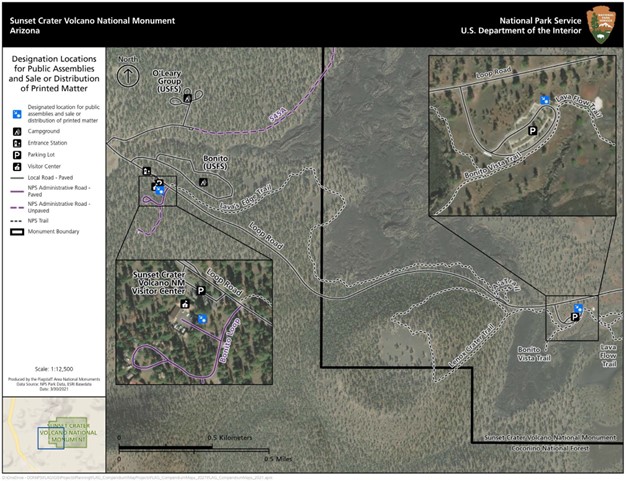
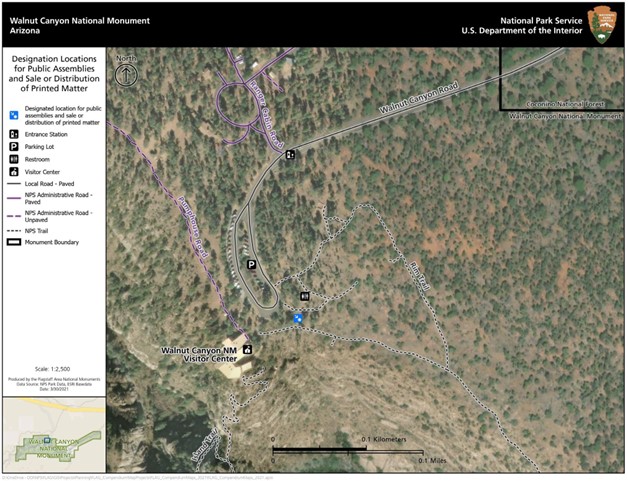
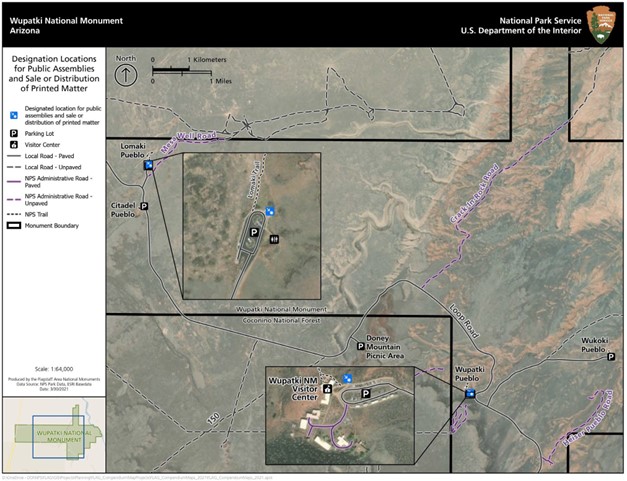
2.52(c)(2) The areas listed below are designated for demonstrations and the sale or distribution of printed matter. These areas may be occupied by groups of 25 or fewer persons without a permit provided that all terms of 36 CFR 2.51 and 2.52 are met.
5.3 Engaging in or soliciting any business
Engaging in or soliciting any business requires a permit, contract, or other written agreement with the United States or must be pursuant to special regulations. Commercial Use Authorizations (CUAs) are required for all commercial visitor services provided by entities not based in the Monument. CUA permits can be issued for such things as commercial tours, guided hiking, photography workshops. Individuals interested in applying for a CUA should contact the Monuments Chief Ranger’s office.
5.5(a)(b) Some filming, still photography, and audio recording (depending upon the facts and circumstances; contact the park for more information). 36 CFR 1.5(a)(2) and 54 U.S.C. 100905.
36 CFR SECTION 1.6-(f) ACTIVITIES THAT REQUIRE A PERMIT
36 CFR 2.1- Preservation of Natural, Cultural and Archeological Resources
(a)(4) The collection of dead and down wood is prohibited anywhere in the monuments.
(a)(5) Scheduled NPS-led interpretive programs will permit public access to selected archaeological, historic, and natural sites.
(c)(l) There are no fruits, berries, nuts, or other items designated for collection within the Flagstaff Area National Monuments.
Exception: collection of elderberries at Walnut Canyon National Monument is permitted for on-site personal consumption. The collection site is limited to the vegetated island in the center of the Walnut Canyon parking lot.
Nominal quantities of these resources are in the monument and therefore public gathering of the above- specified quantities will affect the propagation of the species and deprive the natural wildlife of sustainable browse.
36 CFR 2.2 - Wildlife Protection
(e) All areas of the monuments are closed to the viewing of wildlife with an artificial light. Use of an artificial light for the purposes of viewing wildlife in closed areas is prohibited. Artificial light is defined as a flashlight, handheld spotlight, headlights, exterior vehicle lights, or other light which is emitted from a non-natural source.
This also includes any infrared or similar light used in connection with a scope or electronic viewing device.
Activities such as spotlighting or intentionally illuminating wildlife represent deliberate actions that cause significant disturbance to wildlife and are often associated with the illegal taking (poaching) of wildlife.
36 CFR 2.10 - Camping and Food Storage
(a) Camping and overnight parking of occupied vehicles are prohibited within the boundaries of the monuments.
Unrestricted camping activities may damage sensitive soil, archaeological, cave, and other natural resources. Camping is also not appropriate or esthetically suitable in areas subject to high public use and transit such as trailheads, picnic areas, and parking areas.
36 CFR 2.13 – Fires
(a)(1) A fire may be ignited and maintained only by using fuel sources designed and commonly used for warmth or the preparation of food, such as charcoal briquettes or natural firewood. Lighting or maintaining a fire with other materials including, but not limited to, flammable liquids, garbage, fireworks, plastics, aerosol canisters, batteries, or other manufactured or synthetic materials, is prohibited.
This action is necessary for the maintenance of public health and safety, protection of environmental or scenic values, protection of natural or cultural resources, and the implementation of management responsibilities. Materials other than approved combustibles – especially fire accelerants and substances prone to wind transport or explosion – creates serious risks when used to light or maintain fires. These combustibles can ignite or spread wildfires that directly threaten people and valuable resources and assets. The burning of manufactured or synthetic materials can contribute to air pollution, contaminate soil and water, and be toxic to humans and the environment. Less restrictive measures, such as an education campaign informing visitors of the risks of using certain materials to light or maintain a fire, would not be commensurate with the substantial risks associated with those activities and could lead to adverse outcomes that might be prevented by establishing an enforceable condition
(c) Additional prohibitions of igniting fires/open flames will be consistent with the Coconino National Forests during periods of high/extreme fire danger.
36 CFR 2.15 - Pets
(a)(1) Pets (as defined by 36 CFR 1.4 (a) to be a dog, cat, or other animal that has been domesticated) are prohibited on all trails and in areas off trail and/or off road.
Exception: Leashed pets are allowed on two trails only: the Rim Trail at Walnut Canyon National Monument and the paved portion of the Lava Flow Trail/Bonita Vista Trail at Sunset Crater Volcano National Monument.
(a)(2) Pets must always be restrained by a leash (maximum of six feet), when they are outside of a vehicle in the Monuments.
Properly restrained pets are allowed along public roads and parking areas, generally within 10 feet of the road surface.
Pets are not allowed in government and public buildings, even if carried. This prohibition does not include service animals. A service animal as defined by the Americans with Disabilities Act as a dog that has been individually trained to do work or perform tasks for an individual with a disability. The tasks performed must be directly related to the person’s disability.
(a)(4) Leaving a pet unattended is prohibited.
(a)(5) Pet excrement must be picked up and properly disposed of by the pet owner from all areas.
(e) Monument employees residing in the Monuments may keep pets in accordance with FLAG Areas Housing Management Plan.
Consistent with public health and safety, protection of natural resources and avoidance of conflict among visitor use activities, pets must be restricted. The burden is placed on pet owners to ensure their pets do not destroy Monument values for others in those areas where they are allowed. Pet excrement disposal stations are provided along the Rim Trail at Walnut Canyon National Monument, as well as the Visitor Center and Lava Flow Trail parking lots at Sunset Crater Volcano National Monument for this purpose.
36 CFR 2.19 - Winter Activities
(a) Skiing, snowshoeing, sledding, inner tubing, tobogganing, and similar non-motorized winter sports are prohibited within the boundaries of Flagstaff Area National Monuments.
Exception: Snowshoeing is allowed on trails normally open to the public when snow is of sufficient depth that the snowshoe is not in contact with the trail surface.
Unrestricted off trail activities may damage sensitive soils, and other cultural and natural resources
36 CFR 2.20 - Skating, Skateboards, and Similar Devices
For public safety, the use of skates, skateboards, roller-skis/blades, and similar devices are prohibited within the boundaries of the Flagstaff Area National Monuments.
Residents refer to Housing Management Plan for policy.
Motorized scooters are prohibited on all trails with the exception of Segway’s used by people with mobility impairments. Segway’s can be operated on those areas accessible to regular and motorized wheelchairs.
The terrain encountered at the monuments precludes the safe use of roller- skates, in-line skates, skateboards, and similar devices.
36 CFR 2.21-Smoking
(a) Smoking is prohibited on all monument trails and within 50 feet of government buildings. All federal buildings and structures are closed to smoking pursuant to Executive Order 13058.
Smoking is prohibited at other locations including:
• Within 50 feet of all fuel pumps
• Within 50 feet of fuel/paint storage areas
• Within 50 feet of propane tanks/enclosures
• At all archaeological sites
Seasonal smoking restrictions will be applied for protection of life, property, and Monument resources from wildfire according to Section 2.13 (a)(5) and Section 2.21(a):
Smoking restrictions will be consistent with the Coconino National Forest during periods of high or extreme fire danger. During fire restrictions, the
National Park Service will coordinate with the Coconino National Forest on posting signs on the restrictions in needed areas. Removal of restrictions will occur when fire danger is low.
The inappropriate disposal of cigarette butts negatively impacts natural and cultural resources. The presence of burning smoking materials of any type represents a fire risk.
36 CFR 2.22 - Property
(a)(2) The superintendent may grant permission to leave property (e.g. vehicles, trailers) longer than 24 hours in the following areas:
• All roadside parking areas
• Visitor center parking areas
• All NPS residence areas
• All NPS maintenance areas
• Areas designated for parking for overnight ranger-led hikes or required by researchers under permit of Section2.5
The areas listed are the safest and most appropriate within the Monuments for property to be left. Areas not listed may be subject to a greater risk of theft or vandalism.
36 CFR 2.23 - Recreation Fees
(c) As per the signed Interagency Agreement between the USDOI National Park Service, Flagstaff Area National Monuments, and the U.S. Forest Service, Coconino National Forest, fees will not be charged to visitors who are passing through NPS lands for the sole purpose of accessing U.S. Forest Service lands.
Fees will not be charged to members of American Indian tribes, or traditionally associated groups entering the monuments for traditional, non-recreational activities.
Property owners and guests at Alpine Ranches, Babbitt or Chambers Ranches and Walking Cane Ranches, may access through the Monument at no charge.
The Monument provides the primary access to many residents that live in communities adjacent to them, thus access for their residence or business is necessary and should not incur a fee.
36 CFR 2.35 - Alcoholic Beverages and Controlled Substances
(a)(3)(i) The following areas are closed to the consumption of alcoholic beverages and/or the possession of a bottle, can, or other receptacle containing an alcoholic beverage that is open, or that has been opened, or whose seal is broken, or the contents of which have been partially removed:
• Inside visitor centers and on adjacent patio/porch areas
• At all interpretive activities within NPS jurisdiction
• On all trails
Alcoholic beverages are inappropriate within the visitor centers since they serve as public museums. The educational purpose of the museum is the primary focus.
Alcoholic beverages are allowed outside of the buildings in accordance with applicable state laws.
Alcoholic beverages are prohibited along public trails for the safety of all visitors. Trails are narrow with exposure to cliffs and other hazards.
Consumption of alcoholic beverages poses an increased threat of accidents along trails. Alcoholic beverages are prohibited at interpretive activities within NPS jurisdiction for the safety of all visitors and to keep the experience focused and appropriate.
36 CFR 2.38 (b) - Explosives
Using or possessing fireworks, firecrackers, or other explosives devices within the monuments is prohibited.
Using or possessing fireworks, firecrackers, or other explosives devices is inherently dangerous, constitutes a fire hazard, and is not appropriate within a heavily visited protected natural and cultural resource.
36 CFR 2.62 - Memorialization
(a) The placement of memorials within the monuments is prohibited.
The placement of memorials may cause damage to sensitive physical and biological resources. Increased human activity at such areas may promote adverse effects such as ground compaction, disruption to vehicle traffic flow, damage, or disturbance of archaeological or historic heritage sites, and interference with normal patterns of wildlife behavior or movement.
(b) The scattering of human ashes from cremation is prohibited.
The scattering of human remains, or ashes can conflict with the spiritual or cultural practices of indigenous people traditionally associated with the monuments. In addition, the presence of modern remains could affect the National Park Service's ability to preserve and protect human remains that are themselves cultural resources.
36 CFR Part 4: Vehicle and Traffic Safety
36 CFR 4.21 - Speed Limits
(a)(1) Non posted speed limits: 15 miles per hour within all, roads
picnic areas, parking areas, utility areas, business or residential areas, other places of public assemblage, and at emergency scenes.
(b) Speed limits are designated as posted on roads within the monuments.
The superintendent has determined that these restrictions are necessary to promote traffic and visitor safety, and to reduce wildlife mortalities caused by vehicular collisions.
36 CFR 4.30 – Bicycles
(a) Designated bicycle routes within the monuments include only the public roads. Bicycle use on trails, including paved trails, is prohibited. Bicycle use on dirt roads closed to public vehicle use is prohibited.
The steep terrain and volume of pedestrian traffic encountered on the trail system at the monuments precludes the safe use of bicycles and similar devices.
(b) E Bikes:
The term “e-bike” means a two- or three-wheeled cycle with fully operable pedals and an electric motor of less than 750 watts (1 h.p.)
E-bikes are allowed in all Flagstaff Area National Monuments where traditional bicycles are allowed. E-bikes are prohibited where traditional bicycles are prohibited under section (a) above. Except where use of motor vehicles by the public is allowed, using the electric motor to move an e-bike without pedaling is prohibited.
A person operating an e-bike is subject to the following sections of 36 CFR part 4 that apply to the use of traditional bicycles: sections 4.12, 4.13, 4.20, 4.21, 4.22, 4.23, and 4.30(h)(2)-(5).
Except as specified in this Compendium, the use of an e-bike within Flagstaff Area National Monuments is governed by State law, which is adopted and made a part of this Compendium. Any violation of State law adopted by this paragraph is prohibited.
36 CFR Part 2: Resource Protection, Public Use and Recreation
36 CFR §2.1- Preservation of Natural, Cultural and Archeological Resources
(a)(4) The collection of dead and down wood is prohibited anywhere in the monuments.
(a)(5) Scheduled NPS-led interpretive programs will permit public access to selected archaeological, historic, and natural sites.
(c)(l) There are no fruits, berries, nuts, or other items designated for collection within the Flagstaff Area National Monuments.
Exception: collection of elderberries at Walnut Canyon National Monument is permitted for on-site personal consumption. The collection site is limited to the vegetated island in the center of the Walnut Canyon parking lot.
Nominal quantities of these resources are in the monument and therefore public gathering of the above- specified quantities will affect the propagation of the species and deprive the natural wildlife of sustainable browse.
36 CFR §2.2 - Wildlife Protection
(e) All areas of the monuments are closed to the viewing of wildlife with an artificial light. Use of an artificial light for the purposes of viewing wildlife in closed areas is prohibited. Artificial light is defined as a flashlight, handheld spotlight, headlights, exterior vehicle lights, or other light which is emitted from a non- natural source.
This also includes any infrared or similar light used in connection with a scope or electronic viewing device. Activities such as spotlighting or intentionally illuminating wildlife represent deliberate actions that cause significant disturbance to wildlife and are often associated with the illegal taking (poaching) of wildlife.
36 CFR §2.10 - Camping and Food Storage
(a) Camping and overnight parking of occupied vehicles are prohibited within the boundaries of the monuments. Unrestricted camping activities may damage sensitive soil, archaeological, cave, and other natural resources. Camping is also not appropriate or esthetically suitable in areas subject to high public use and transit such as trailheads, picnic areas, and parking areas.
36 CFR §2.13 – Fires
(a)(1) A fire may be ignited and maintained only by using fuel sources designed and commonly used for warmth or the preparation of food, such as charcoal briquettes or natural firewood. Lighting or maintaining a fire with other materials including, but not limited to, flammable liquids, garbage, fireworks, plastics, aerosol canisters, batteries, or other manufactured or synthetic materials, is prohibited. This action is necessary for the maintenance of public health and safety, protection of environmental or scenic values, protection of natural or cultural resources, and the implementation of management responsibilities. Materials other than approved combustibles – especially fire accelerants and substances prone to wind transport or explosion – creates serious risks when used to light or maintain fires. These combustibles can ignite or spread wildfires that directly threaten people and valuable resources and assets. The burning of manufactured or synthetic materials can contribute to air pollution, contaminate soil and water, and be toxic to humans and the environment. Less restrictive measures, such as an education campaign informing visitors of the risks of using certain materials to light or maintain a fire, would not be commensurate with the substantial risks associated with those activities and could lead to adverse outcomes that might be prevented by establishing an enforceable condition.
(c) Additional prohibitions of igniting fires/open flames will be consistent with the Coconino National Forests during periods of high/extreme fire danger.
36 CFR §2.15 - Pets
(a)(1) Pets (as defined by 36 CFR 1.4 (a) to be a dog, cat, or other animal that has been domesticated) are prohibited on all trails and in areas off trail and/or off road.
Exception: Leashed pets are allowed on two trails only: the Rim Trail at Walnut Canyon National Monument and the paved portion of the Lava Flow Trail/Bonita Vista Trail at Sunset Crater Volcano National Monument.
(a)(2) Pets must always be restrained by a leash (maximum of six feet), when they are outside of a vehicle in the Monuments.
Properly restrained pets are allowed along public roads and parking areas, generally within 10 feet of the road surface.
Pets are not allowed in government and public buildings, even if carried. This prohibition does not include service animals. A service animal as defined by the Americans with Disabilities Act as a dog that has been individually trained to do work or perform tasks for an individual with a disability. The tasks performed must be directly related to the person’s disability.
(a)(4) Leaving a pet unattended is prohibited.
(a)(5) Pet excrement must be picked up and properly disposed of by the pet owner from all areas.
(e) Monument employees residing in the Monuments may keep pets in accordance with FLAG Areas Housing Management Plan. Consistent with public health and safety, protection of natural resources and avoidance of conflict among visitor use activities, pets must be restricted. The burden is placed on pet owners to ensure their pets do not destroy Monument values for others in those areas where they are allowed. Pet excrement disposal stations are provided along the Rim Trail at Walnut Canyon National Monument, as well as the Visitor Center and Lava Flow Trail parking lots at Sunset Crater Volcano National Monument for this purpose.
36 CFR §2.19 - Winter Activities
(a) Skiing, snowshoeing, sledding, inner tubing, tobogganing, and similar non-motorized winter sports are prohibited within the boundaries of Flagstaff Area National Monuments.
Exception: Snowshoeing is allowed on trails normally open to the public when snow is of sufficient depth that the snowshoe is not in contact with the trail surface. Unrestricted off trail activities may damage sensitive soils, and other cultural and natural resources.
36 CFR §2.20 - Skating, Skateboards, and Similar Devices
For public safety, the use of skates, skateboards, roller-skis/blades, and similar devices are prohibited within the boundaries of the Flagstaff Area National Monuments.
Residents refer to Housing Management Plan for policy.
Motorized scooters are prohibited on all trails with the exception of Segway’s used by people with mobility impairments. Segway’s can be operated on those areas accessible to regular and motorized wheelchairs. The terrain encountered at the monuments precludes the safe use of roller- skates, in-line skates, skateboards, and similar devices.
36 CFR §2.21-Smoking
(a) Smoking is prohibited on all monument trails and within 50 feet of government buildings. All federal buildings and structures are closed to smoking pursuant to Executive Order 13058.
Smoking is prohibited at other locations including:
• Within 50 feet of all fuel pumps
• Within 50 feet of fuel/paint storage areas
• Within 50 feet of propane tanks/enclosures
• At all archaeological sites
Seasonal smoking restrictions will be applied for protection of life, property, and Monument resources from wildfire according to Section 2.13 (a)(5) and Section 2.21(a):
Smoking restrictions will be consistent with the Coconino National Forest during periods of high or extreme fire danger. During fire restrictions, the National Park Service will coordinate with the Coconino National Forest on posting signs on the restrictions in needed areas. Removal of restrictions will occur when fire danger is low. The inappropriate disposal of cigarette butts negatively impacts natural and cultural resources. The presence of burning smoking materials of any type represents a fire risk.
36 CFR §2.22 - Property
(a)(2) The superintendent may grant permission to leave property (e.g. vehicles, trailers) longer than 24 hours in the following areas:
• All roadside parking areas
• Visitor center parking areas
• All NPS residence areas
• All NPS maintenance areas
• Areas designated for parking for overnight ranger-led hikes or required by researchers under permit of Section2.5 The areas listed are the safest and most appropriate within the Monuments for property to be left. Areas not listed may be subject to a greater risk of theft or vandalism.
36 CFR §2.23 - Recreation Fees
(c) As per the signed Interagency Agreement between the USDOI National Park Service, Flagstaff Area National Monuments, and the U.S. Forest Service, Coconino National Forest, fees will not be charged to visitors who are passing through NPS lands for the sole purpose of accessing U.S. Forest Service lands.
Fees will not be charged to members of American Indian tribes, or traditionally associated groups entering the monuments for traditional, non-recreational activities.
Property owners and guests at Alpine Ranches, Babbitt or Chambers Ranches and Walking Cane Ranches, may access through the Monument at no charge. The Monument provides the primary access to many residents that live in communities adjacent to them, thus access for their residence or business is necessary and should not incur a fee.
36 CFR §2.35 - Alcoholic Beverages and Controlled Substances
(a)(3)(i) The following areas are closed to the consumption of alcoholic beverages and/or the possession of a bottle, can, or other receptacle containing an alcoholic beverage that is open, or that has been opened, or whose seal is broken, or the contents of which have been partially removed:
• Inside visitor centers and on adjacent patio/porch areas
• At all interpretive activities within NPS jurisdiction
• On all trails Alcoholic beverages are inappropriate within the visitor centers since they serve as public museums. The educational purpose of the museum is the primary focus.
Alcoholic beverages are allowed outside of the buildings in accordance with applicable state laws.
Alcoholic beverages are prohibited along public trails for the safety of all visitors. Trails are narrow with exposure to cliffs and other hazards.
Consumption of alcoholic beverages poses an increased threat of accidents along trails. Alcoholic beverages are prohibited at interpretive activities within NPS jurisdiction for the safety of all visitors and to keep the experience focused and appropriate.
36 CFR §2.38 (b) - Explosives
Using or possessing fireworks, firecrackers, or other explosives devices within the monuments is prohibited. Using or possessing fireworks, firecrackers, or other explosives devices is inherently dangerous, constitutes a fire hazard, and is not appropriate within a heavily visited protected natural and cultural resource.
36 CFR §2.62 - Memorialization
(a) The placement of memorials within the monuments is prohibited. The placement of memorials may cause damage to sensitive physical and biological resources. Increased human activity at such areas may promote adverse effects such as ground compaction, disruption to vehicle traffic flow, damage, or disturbance of archaeological or historic heritage sites, and interference with normal patterns of wildlife behavior or movement.
(b) The scattering of human ashes from cremation is prohibited. The scattering of human remains, or ashes can conflict with the spiritual or cultural practices of indigenous people traditionally associated with the monuments. In addition, the presence of modern remains could affect the National Park Service's ability to preserve and protect human remains that are themselves cultural resources.
36 CFR Part 4: Vehicle and Traffic Safety
36 CFR §4.21 - Speed Limits
(a)(1) Non posted speed limits: 15 miles per hour within all, roads
picnic areas, parking areas, utility areas, business or residential areas, other places of public assemblage, and at emergency scenes.
(b) Speed limits are designated as posted on roads within the monuments. The superintendent has determined that these restrictions are necessary to promote traffic and visitor safety, and to reduce wildlife mortalities caused by vehicular collisions.
36 CFR §4.30 – Bicycles
(a) Designated bicycle routes within the monuments include only the public roads. Bicycle use on trails, including paved trails, is prohibited. Bicycle use on dirt roads closed to public vehicle use is prohibited. The steep terrain and volume of pedestrian traffic encountered on the trail system at the monuments precludes the safe use of bicycles and similar devices.
(b) E Bikes:
The term “e-bike” means a two- or three-wheeled cycle with fully operable pedals and an electric motor of less than 750 watts (1 h.p.)
E-bikes are allowed in all Flagstaff Area National Monuments where traditional bicycles are allowed. E-bikes are prohibited where traditional bicycles are prohibited under section (a) above. Except where use of motor vehicles by the public is allowed, using the electric motor to move an e-bike without pedaling is prohibited.
A person operating an e-bike is subject to the following sections of 36 CFR part 4 that apply to the use of traditional bicycles: sections 4.12, 4.13, 4.20, 4.21, 4.22, 4.23, and 4.30(h)(2)-(5).
Except as specified in this Compendium, the use of an e-bike within Flagstaff Area National Monuments is governed by State law, which is adopted and made a part of this Compendium. Any violation of State law adopted by this paragraph is prohibited.
APPENDIX A
Designated Locations for Public Assemblies and Sale or Distribution of Printed matter - Sunset Crater Volcano
Designated Locations for Public Assemblies and Sale or Distribution of Printed Matter - Walnut Canyon
Designated Locations for Public Assemblies and Sale or Distribution of Printed Matter - Wupatki