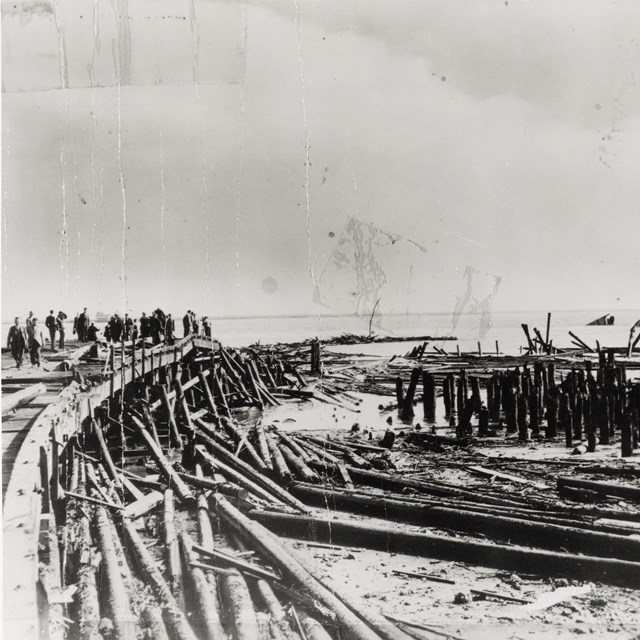
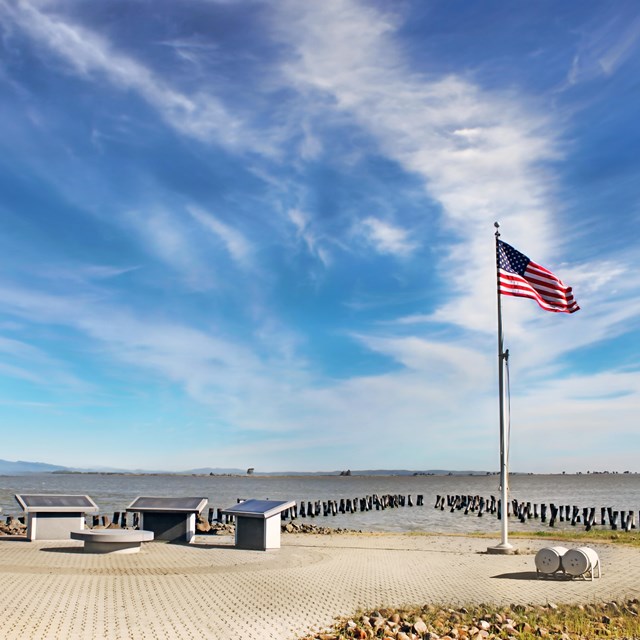
POCH 2.080 320 Americans Killed in WWII Naval Magazine AccidentOn the evening of July 17, 1944, residents in the San Francisco east bay area were jolted awake by a massive explosion that cracked windows and lit up the night sky. At Port Chicago Naval Magazine, 320 men were instantly killed when two ships being loaded with ammunition for the Pacific theater troops blew up. It was WWII's worst home front disaster.Port Chicago Naval Magazine National Memorial preserves the site of the deadliest home front disaster of World War II,honoring those who lost their lives or were affected by the munitions explosion on July 17, 1944. The disaster and its aftermath illuminated the issues of segregation and racial inequality in the military, and today the memorial serves as a spring board for exploring social justice in our society.
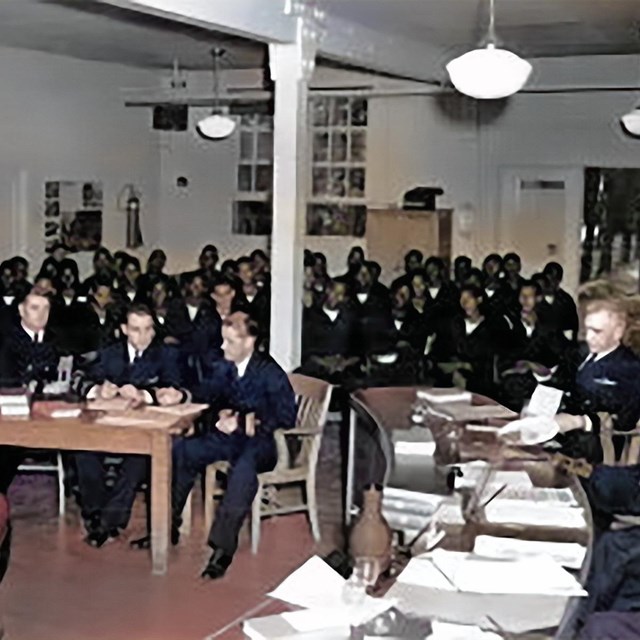
The munitions explosion at Port Chicago Naval Magazine on July 17, 1944, was the largest stateside disaster of World War II. The blast registered 3.4 on the Richter scale,was felt more than 450 miles away and resulted in 320 fatalities and approximately 400 injured. The memorial is located at the site of the explosion, the final resting place for the un-recovered casualties. Following the explosion, as before, surviving sailors received unequal treatment based on their race. Many African American sailors refused to return to work soon after the explosion and 50 were convicted of mutiny in the largest naval trial of its kind in US history. These convictions still stand today despite efforts to overturn them. The Port Chicago explosion, the mutiny trial, and the response of African-American communities to these events exposed the shameful injustices of racism in the military.These events were a catalyst for the Navy, the armed services, and ultimately, the nation to weigh the costs of racial segregation. The memorial serves as a reminder of the ongoing struggles for equality and social justice today. Port Chicago Naval Magazine was the largest ammunition transshipment facility on the West Coast and was essential to the success of the war effort in the Pacific Theater;much of the ammunition and bombs used by US forces in the Pacific passed through the hands of sailors at Port Chicago. This transshipment facility continues to operate today under the US Army.
Remembering the FallenBelow, is a list of those who were killed in the Port Chicago explosion.
S1c Wayland E. Causey
S1c Rudy J. Cebella S1c Robert E. Chase S2c Claude L. Chastain SM3c John J. Gee Lt. (jg) Ralph B. Hartmann S1c Clarence R. Hollandsworth S1c Kenneth H. Muirhead S1c Jesse W. Mulligan S1c Lloyd J. Quick S1c Martin J. Setzer S1c George H. Singer S1c Listern L. Small Elmer A. Andraschko, Cook
Albert A. Arsenian, Seaman William C. Benhart, Oiler Martin M. Cacic, Seaman Ray E. Davis, Wiper Donald L. Dennon, Wiper Thomas E. Dorsey, Seaman George H. Falk, Bos’n Marcus J. Franklin, Engr. Alfred D. Gilbert, Engr. James R. Gilstrap, Seaman Joseph D. Grange, Jr, Engr. Fred Hayes, Seaman Delbert R. Hutchinson, Fireman Peter C. Jepsen, Ch. Engr. Charles A. Johnson, Utilityman Clifford R. Johnson, Utilityman Ralph A. Lantz, Seaman John A. Louis, Engr. Frank C. Malizia, Carpenter Edward Maniago, Messman Harry E. Nathan, Seaman Jesse Porter, Sr., Ch. Cook Richard D. Roberson, Seaman Aaron C. Sangster, Jr., Seaman Ellsworth M. Shaw, Oiler Howard A. Smith, 1st Mate Andrew Suchan, Fireman Robert F. Townsend, 2nd Mate Harding E. White, Messman George H. Witt, Utilityman GM3c Jack L. Albin
GM2c Delbert P. Bergstrom S1c(RM) Jack P. Bowman GM3c John G. Hall S1c George D. Hovland S1c Andy Morrow GM2c William H. Mulryan S1c Henry J. Myers S1c Woodrow A. Riiff S1c Jacob D. Risenhoover S1c William R. Robinson S1c Charles H. Rondell S1c Jay Rose, Jr. S1c Otis K. Ross S1c Woodrow W. Saint S1c Arnold T. Sanders S1c Harold S. Sano Robert D. Bailey, Utilityman
Robert E. Bartlett, Messman John D. Bell, Asst. Purser Frederick E. Bentley, Seaman Donald H. Cheney, Elect. Hugh E. Crawford, Maint. Man Floyd F. Crist, Seaman Albert C. Dinde, Messman Wallace M. Durland, Seaman Kenneth J. Eulrick, Seaman Burke E. Falor, Utilityman Eugene W. Garrett, FiremanRobert K. Henricksen, Seaman Elis Henriksen, Engr. * Johannes H. Justesen, Steward Walter F. Kannberg, Engr. Robert E. Keim, 2nd Mate Joseph B. Koeninger, Seaman Karl L. Mallery, Engr. Lloyd K. McDaniel, Seaman Kenneth M. Moen, 3rd Mate Robert S. Morill, Oiler Isadore E. Narinsky, Seaman Roy L. Nelson, Carpenter David R. Parsons, 3rd Mate Mike Pearson, Oiler Ellis B. Pinson, Engr. Richard V. Potter, Fireman Virgil R. Sandberg, Engr. Albert R. Scott, Ch. Mate Lester S. Skance, Seaman Howard W. Sullivan, Seaman Robert J. Sullivan, Master Glen E. Thompson, Engr. * Louis J. Widner, Messman * John A. Williams, Ch. Engr. Lawrence C. Bustrack, Macco Co. Office Manager *
Gundar Halverson, Macco Co. Timekeeper * Raymond V. Hunnicutt, Brakeman Navy Employee Thomas D. Hunt, Macco Co. Project Engr. * Harry A. Middleton, Engineman Navy Employee Fred Zanarini, Chauffeur Navy Employee * Pvt. Elwin A. Blanke, Marine Corps *
BM1c Peter G. Broda, Coast Guard MM1c William G. Degryce, Coast Guard McMM3c Edward J. Portz, Coast Guard * S1c Charles H. Riley, Coast Guard S2c James C. Sullivan, Coast Guard * | |
Last updated: February 19, 2019