



Last updated: August 14, 2026
Place
Trujillo, Prince & Sena Plazas
NPS/Bruce MacPherson
Quick Facts
Location:
109, 111 & 115 East Palace Avenue, Santa Fe, New Mexico
Significance:
The plazas that date back to the Santa Fe Trail era
MANAGED BY:
Occupied by commercial businesses.
Amenities
4 listed
Accessible Sites, Benches/Seating, Food/Drink - Restaurant/Table Service, Historical/Interpretive Information/Exhibits
Although they are now called Trujillo, Prince, and Sena plazas, the buildings on the 100 block of East Palace Avenue share the same early history. They sit on what was once a valuable piece of land in colonial Santa Fe, home to a spring-fed marsh that supplied water to the plaza. During the Pueblo Revolt of 1680, controlling this water helped the Pueblo people win. Thirteen years later, Spanish forces led by Diego de Vargas used the same strategy to retake the town. A Spanish officer, Diego Arias de Quiros, later received this land as a royal grant for his service.
Arias de Quiros died in 1738, and his widow owned the land until selling it in 1746. Over the next hundred years, the property was sold and divided many times, reflecting the larger changes happening across New Mexico.
By the 1820s, trader Antoine Robidoux bought the western part of the land. In 1879, his widow sold it to L. Bradford Prince, who later became governor of New Mexico Territory. Prince’s family split the land further, keeping 111 East Palace and selling 109 to Severino Trujillo, Jr. By the 1940s, Trujillo Plaza became a check-in site for the secret Manhattan Project in Los Alamos.
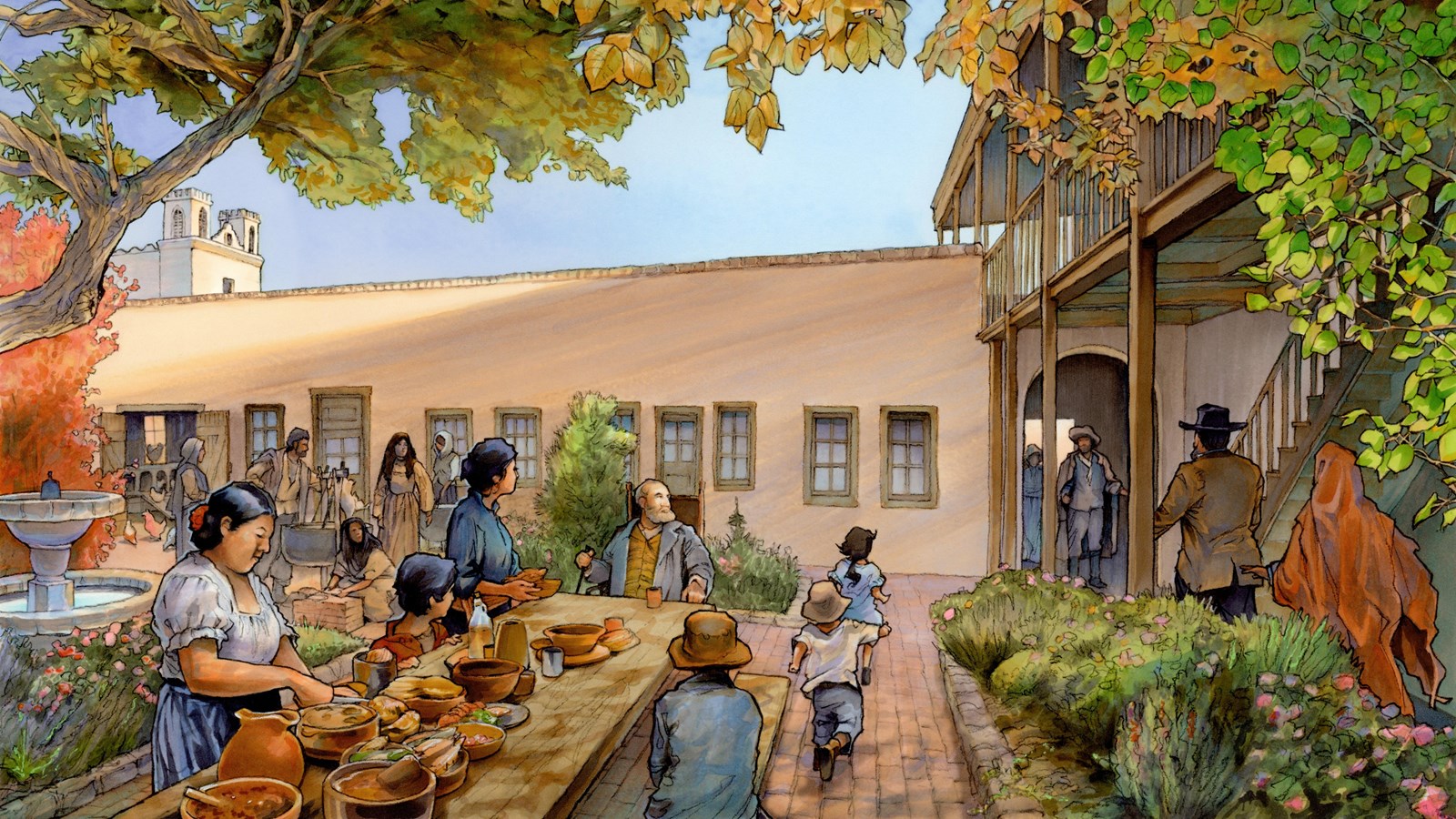
Sena Plaza is on the eastern part of the original land grant. The Sena family bought it in the late colonial period and expanded the home over time, creating a private courtyard. In the mid-1800s, Major José Sena enlarged it again for his growing family. The property eventually reached 33 rooms, including a second-story ballroom. By 1927, owners had fully enclosed the courtyard, forming the space still seen today.
Today, the plazas at 109, 111, and 115 East Palace Avenue are public places with shops and restaurants. Though named for their courtyards, the surrounding buildings once held generations of family life. Many New Mexicans can still trace their heritage back to this well-watered land beside the governor’s mansion in downtown Santa Fe.
Site Information
Location (109, 111 & 115 East Palace Avenue, Santa Fe, New Mexico.)
El Camino Real de Tierra Adentro National Historic Trail
Santa Fe National Historic Trail
Old Spanish National Historic Trail
El Camino Real de Tierra Adentro, Old Spanish Trail, Santa Fe Trail: Santa Fe, New Mexico Itinerary
Santa Fe is the oldest capital city in the US, founded in 1610, and the highest in elevation at 7,000 ft. The city is the historic hub of the southwest, connecting three national historic trails: El Camino Real de Tierra Adentro, the Santa Fe Trail, and the Old Spanish Trail. This tour leads your from the busy plaza and other major tourist locations to lesser known sites along quiet, old Santa Fe streets.