



Last updated: August 22, 2026
Place
Susan Hail (Hale/Haile) Grave
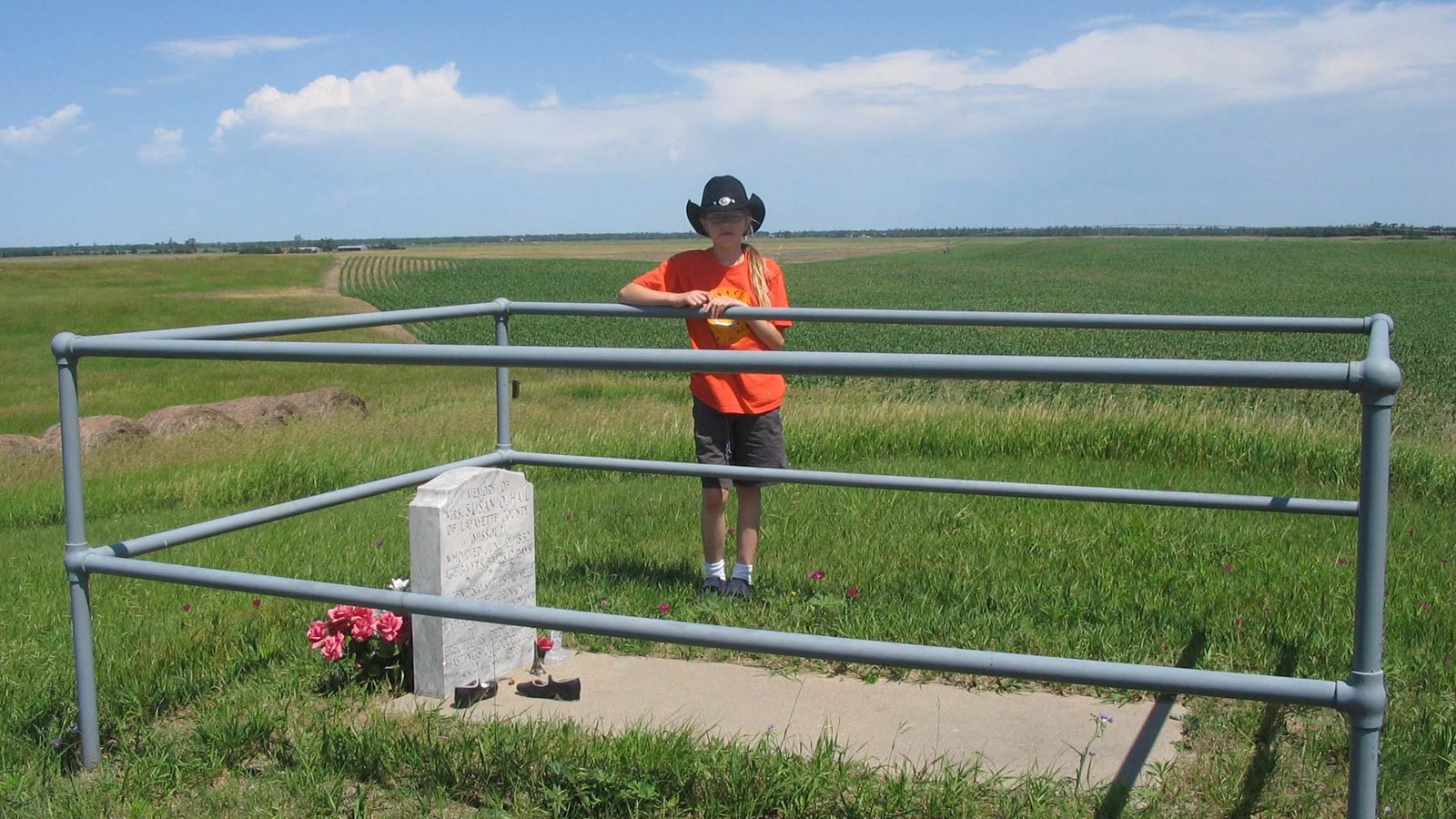
NPS Photo
Quick Facts
Location:
Interpreted Gravesite: About 3.5 miles northwest of Kenesaw on W 70th St, between N Shiloh Ave and 44 Rd/Denman Ave. Address: 21662 W 70th St, Kenesaw, Nebraska. GPS 40.6552666667 -98.7133666667 Nebraska State historical sign turnout: About 3.7 miles northwest of Kennesaw (0.6 miles west of the gravesite) on 44 Rd/Denman Ave. Address: 7000-7938 N 44 Rd/Denman Ave, Kenesaw, Nebraska. GPS 40.6554 -98.7241388889
Significance:
Grave of 1852 cholera victim who had been bound for California
Designation:
Historic site on the California and Oregon National Historic Trails.
MANAGED BY:
Adams County
Amenities
3 listed
Historical/Interpretive Information/Exhibits, Parking - Auto, Scenic View/Photo Spot
Susan and Richard Hail (also spelled Hale and Haile) left Missouri in the spring of 1852 with their six children, ages 3 to 14, bound for California. To the great grief of her family, Susan made it only as far as the Platte River east of Fort Kearny.
The family traveled during one of the peak gold-rush years when the deadly Asiatic cholera ravaged the Oregon-California Trail. Emigrants often became infected after drinking or washing in contaminated waterholes at crowded, unsanitary campsites. The disease could linger for days or kill within hours: a person might fall ill with fever, severe diarrhea, and vomiting in the morning and lie lifeless by suppertime.
Susan died on June 2, 1852, as the Haile wagon party crossed the dry divide between the Little Blue River and the Platte River. No known record states her cause of death, although an old tale claims she drank water poisoned by Indians. Historians conclude that, like many emigrants who perished that year, she almost certainly died from cholera.
Trail lore holds that, after Susan’s death, Richard Hail sent his children on with relatives traveling among the company while he turned back east. At either St. Joseph or Omaha, he sold his horses and used the money to buy an engraved marble headstone. According to the story, Richard loaded the stone into a wheelbarrow and pushed it back to his wife’s grave. Although similar wheelbarrow stories are told of other emigrant graves, in Susan’s case a later traveler actually noted the presence of such a headstone.
“[P]assed many graves,” wrote William Woodhams on May 10, 1854. “One had a nice marble head stone with a woman’s name on it. It stood at the top of a little sandhill, and strange enough was that sad evidence of civilization here in the wilderness, the more so as it bore a woman’s name. Bad enough for man to be buried in this wild region, but a woman’s place seems peculiarly in the comforts of home and friends.”
Richard Hail continued west and reunited with his children in California. Over the years, souvenir hunters gradually chipped away the original stone, and it was last replaced in 1933. The replacement, also marble, includes a reference to the poisoned-water legend.
Visitors today can reach Susah Haile’s grave by turning off unpaved 70th Street, about a half mile west of Shiloh Avenue. A short walk leads to the gravesite, which is protected by a pipe enclosure, and a nearby Oregon-California Trails Association sign provides information about the Haile family.
A state historical sign about Susan Hail stands at a turnout off Denham/44 Road. From the gravesite, drive west for 0.6 mile, turn right (north), and the sign will be on the right.
Site Information
Location (Interpreted Gravesite: About 3.5 miles northwest of Kenesaw on W 70th St, between N Shiloh Ave and 44 Rd/Denman Ave.
Address: 21662 W 70th St, Kenesaw, Nebraska. GPS 40.6552666667 -98.7133666667
Nebraska State historical sign turnout: About 3.7 miles northwest of Kennesaw (0.6 miles west of the gravesite) on 44 Rd/Denman Ave.
Address: 7000-7938 N 44 Rd/Denman Ave, Kenesaw, Nebraska. GPS 40.6554 -98.7241388889 )