


Last updated: November 14, 2026
Place
Soda Springs Complex
Photo/L. Kreutzer
Quick Facts
Location:
A cluster of local sites makes up the Soda Springs Complex. All the sites described here lie between the city of Soda Springs and Oregon Trail Park and Marina, about 2 miles west of town.
Significance:
Almost every emigrant account noted the picturesque scenery and curiosities—such as naturally carbonated springs—of the Soda Springs area in present-day Idaho. Many used the bubbling water to make flavored soda drinks, while others drank it “straight,” thinking it tasted like beer.
Designation:
Historic site on the Oregon and California National Historic Trails.
MANAGED BY:
Mixed public and private
Amenities
9 listed
Benches/Seating, Cellular Signal, Historical/Interpretive Information/Exhibits, Parking - Auto, Parking - Bus/RV, Picnic Table, Restroom, Scenic View/Photo Spot, Water - Drinking/Potable
“My spirits were low till I heard, ‘There is the Soda Springs,’” wrote John Edwin Banks in July 1849 as his party traveled through Idaho’s Bear River Valley. “This acted like electricity. . . .[T]hey are wonderful and deserve a place in the wonders of the earth.”
“The whole valley. . .is the most interesting spot of earth that I ever beheld,” agreed Forty-niner Wakeman Bryarly.
Why were emigrants so excited about the more than 100 springs at present-day Soda Springs, Idaho?
Many of the springs bubbled with naturally carbonated water. Some emigrants thought it tasted like beer, while others mixed it with sugar or syrup to make a kind of frontier soda pop.
“The Sody Spring is aquite a curiosity,” wrote William Scott, bound for Oregon in 1846. “thare is agreat many of them Just boiling rite up out of the groung take alitle sugar and desolve it in alitle watter and then dip up acup full and drink it before it looses its gass it is frristrate [first rate]”.
Hooper and Octagon Springs
Visitors today can “dip up acup” of sparkling water and taste it for themselves at Hooper Springs Park (1805 Government Dam Rd) and Octagon Spring Park (Main St and Hooper Ave). Although emigrants did not visit Hooper Springs, its waters are the same kind of natural soda that pioneers once enjoyed. The water is safe to drink.
Steamboat Spring
Steamboat Spring once spouted several feet high, with chuffing sounds that reminded 19th century observers of a steamboat engine. Emigrants frequently described and sketched it in their journals.
Geyser Park
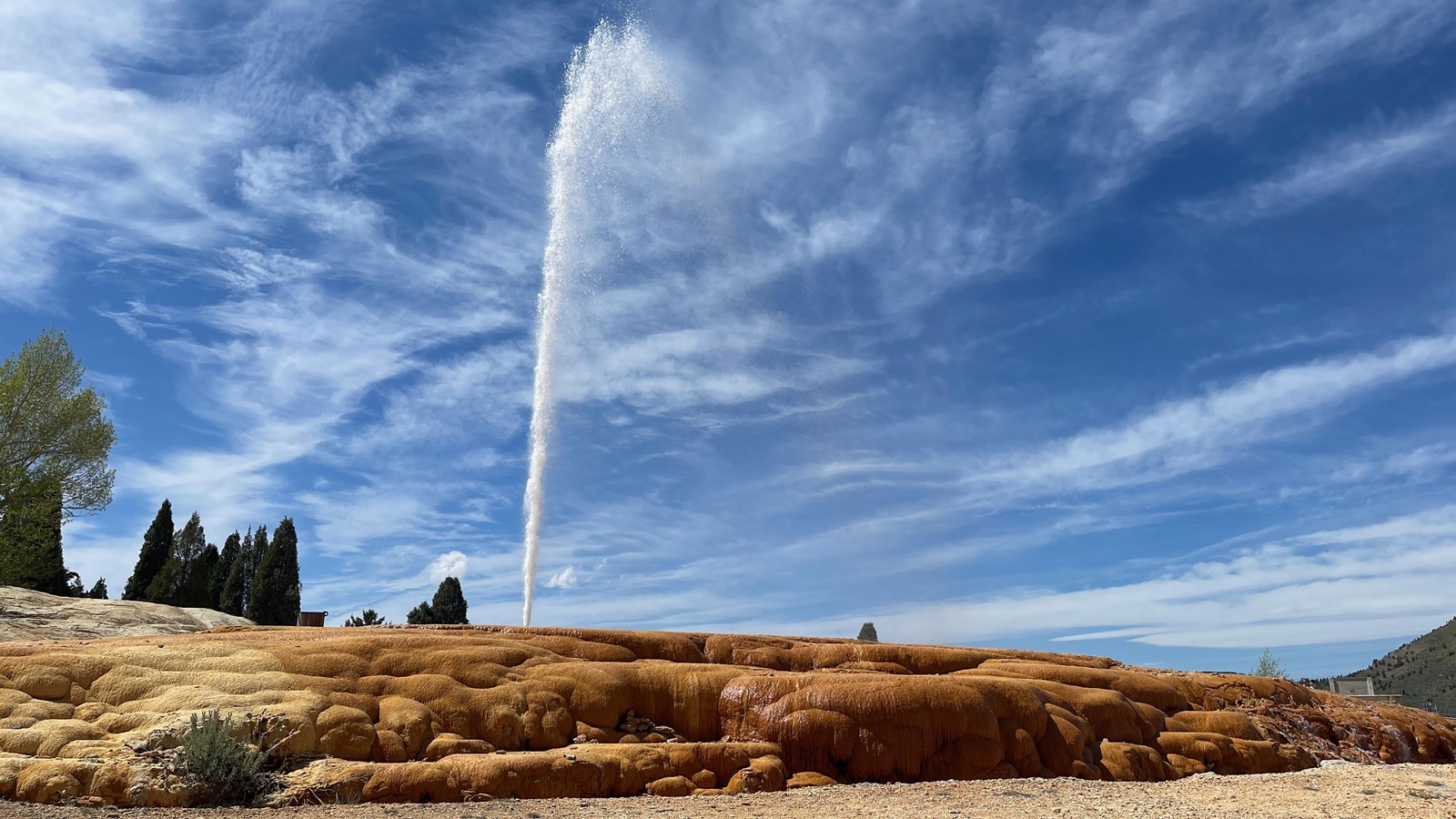
Geyser Park (39 W 1st S) is one of Soda Springs’ most popular attractions, although its geyser did not exist during the overland emigration era. Accidentally created during drilling in 1937, it shoots hot water more than 70 feet into the air every hour. The park also includes a boardwalk, interpretive signage, picnic areas, and a visitor center.
The Wagon Box Grave
Travel along the emigrant trails was not always a pleasure tour. In 1861, an Oregon-bound family of 7, whose names are now unknown, became separated from their wagon company. Camped alone that night, they were killed by Native warriors. Another party found the victims the next morning and buried them together in their wagon box. Theirs became the first grave at Fairview Cemetery and is now marked by a commemorative tombstone and nearby interpretive exhibit near the cemetery entrance at 248 S Main St.
Oregon Trail Park Wagon Swales
Original Oregon Trail swales can be explored at Oregon Trail Park and Marina (2424 US-30, about 2 miles west of Soda Springs). White guideposts and interpretive exhibits mark the historic route. See also https://www.nps.gov/places/000/oregon-trail-park-and-marina.htm.
To plan your visit and learn about additional attractions, visit https://www.visitsodasprings.com/.
Site Information
Location (A cluster of local sites makes up the Soda Springs Complex, including these:
Hooper Springs Park: 1805 Government Dam Rd, a mile north of Soda Springs, Idaho—see Hooper Springs Park (U.S. National Park Service) GPS 42.678985 -111.603534
Octagon Spring Park: 50 N Main, Soda Springs. GPS 42.659542 -111.6033334
Steamboat Spring: View submerged location from Monsanto Pavilion at the Soda Springs Country Club golf course. Approximate GPS 42.65521 -111.63480
Geyser Park: 39 W 1st S, Soda Springs, Idaho. GPS 42.656916 -111.605015
Wagon Box Grave: 248 S Main St, Soda Springs. GPS 42.656440 -111.606364
Oregon Trail Park Wagon Swales: 2424 US-30, Soda Springs—see Oregon Trail Park and Marina (U.S. National Park Service) GPS 42.65847807, -111.6538728)