



Last updated: March 4, 2026
Place
Slab Fork
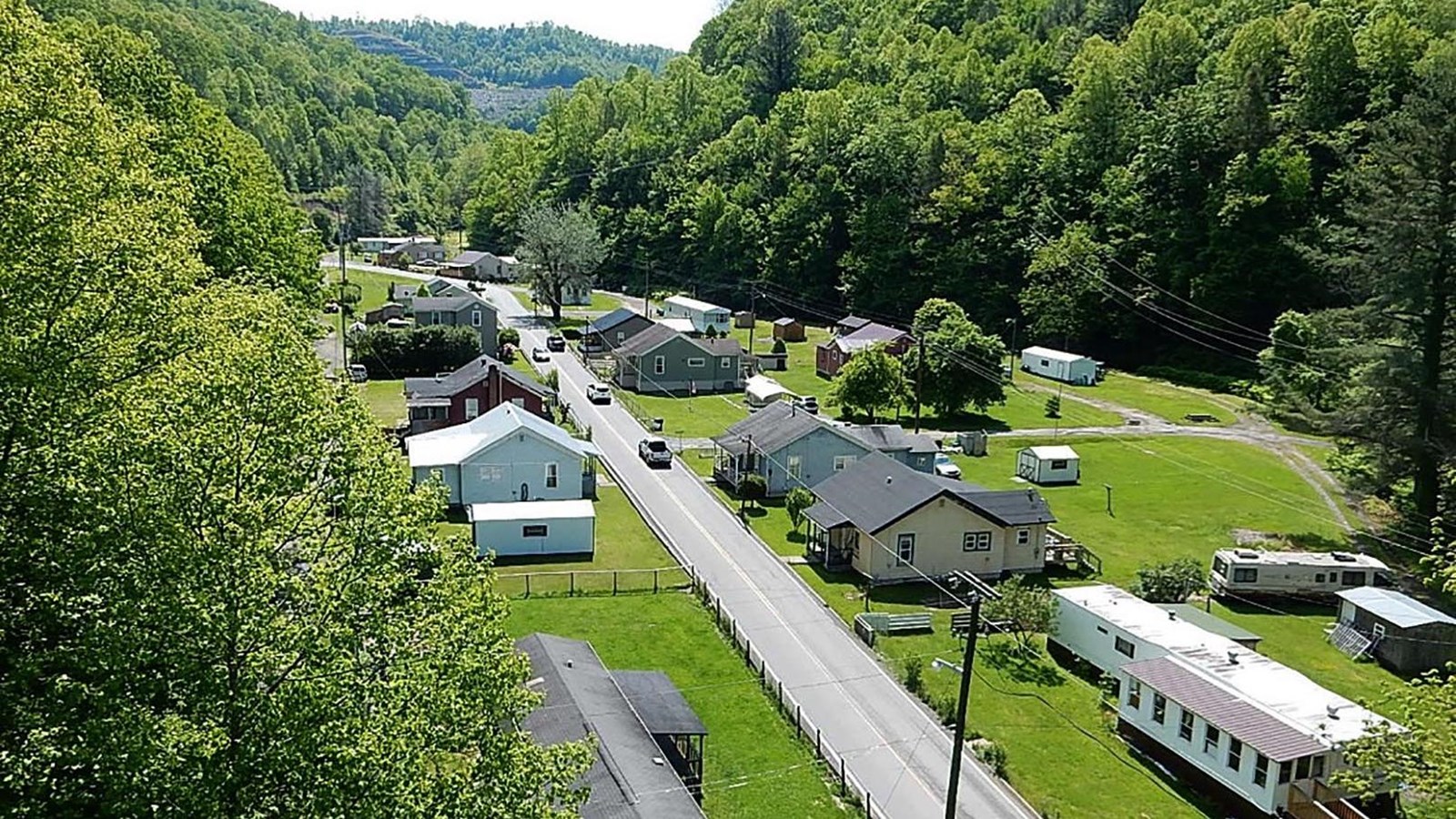
Mark Bollinger
Quick Facts
Location:
Slab Fork, WV
Amenities
2 listed
Historical/Interpretive Information/Exhibits, Parking - Auto
African American Heritage Driving Tour Stop 12: African American Music in West Virginia
If using the NPS app, to listen to the audio narrative, press the green button below or read the audio narrative text below.
This tour stop is not advised for trailers, RVs, or motorhomes due to difficulty turning around.
Audio Narrative
Written by: Mark Bollinger
Narrated by: Doris A. Fields
Song: “Those Who Came Before” by Lady D.“
”Those Who Came Before,” was written and performed by me, Lady D. It tells of my days growing up in West Virginia. Over the years, musicians like myself, Bill Withers, The Swan Silvertones, and many others have kept the essence of African American music alive in West Virginia and the nation.”
“I was born in Kayford, WV. They call me West Virginia’s First Lady of Soul. I am a singer, song writer, and actress, and I perform a variety of soul, blues, jazz, and gospel songs."
Bill Withers, famous for his songs, “Lean on Me” and “Ain’t No Sunshine,” was born in Slab Fork, WV, the youngest of six children. Bill reflects back on his childhood, “We lived right on the border of the black and white neighborhoods. I heard guys playing country music and in church I heard gospel. There was music everywhere.” His song, “Lean on Me,” tells about families and neighbors relying on one another during hard times in West Virginia.
The Swan Silvertones, an African American gospel group, was formed in 1938 by Claude Jeter, a West Virginia coal miner. Known for their sweet harmonic sound with soulful vocals, the group recorded over 100 titles, its most famous being “Mary Don’t You Wait” in 1959.
One of the greatest influences on American music has been the African rhythms and melodies that came to America with black enslaved people. Though the years, the blending of these rhythms and melodies with those from Europe formed new and distinct musical sounds. Today we know these sounds as gospel, ragtime, soul, blues, jazz, and old-time country music.
During the years of slavery, blacks developed songs of work and songs of worship using the rhythms and melodies carried over from Africa. Known as “Negro spirituals,” they expressed the longing of slaves for spiritual and bodily freedom, for safety from harm and evil, and for relief from the hardships of slavery.1 By the 1870s, spirituals began to be seen as music that revealed the beauty and depth of African American culture.2 In the early 1900s, the performance of “Negro spirituals” became a tradition among black singers.3
As African Americans migrated to West Virginia, they brought with them a diverse musical culture passed down from their enslaved ancestry. As they settled into the coal camps and railroad towns, the black community continued to cultivate its rich musical heritage, using oral musical traditions to pass stories and experiences down through generations.
A gifted singer within the black community could be counted on to improvise four-part harmony for the gospel hymns on Sunday morning.4 During the week, African Americans continued to express themselves through a variety of work songs like those used to synchronize the work of railroad track liners.5 Rhythms and melodies were also passed from generation to generation. Many black musicians were self-taught, while others learned as apprentices from the best fiddle player or banjo picker in the community.
Many types of music were enjoyed as part of African American life in company towns. One of the most important was “The Blues.” The Blues, like the spiritual, is a product of slavery developed from African American work songs and European American folk music.6 Other varieties of music included string bands, gospel, quartets, and jazz. In the 1930s, big band jazz and dance music came to West Virginia; it was form of musical entertainment enjoyed by Black Mountaineers. Generally, music was played simply for enjoyment and relaxation. It was performed by musicians and singers who may have dug coal side-by-side during the day and then performed together at their neighbor’s house in the evening.
- Lori Brooks, Berea College, Cynthia Young, The History of African American Music (The Gale Group Inc., 2003), http://www.encyclopedia.com
- Ibid
- Ibid
- Christopher Wildinson, Big Band Jazz in Black West Virginia, 1930-1942, University Press of Mississippi, Jackson. 2012.
- Ibid
- “Blues,” https://en.wikipedia.org/wiki/Blues
Additional Information
Slab Fork, like many company owned coal camps in southern West Virginia, was home to many cultures and ethnicities. The reach of the company town extended beyond employment and a place to live. It was also the organizer of social life in the town. As migrants arrived in the coal company town looking for work, they found a common language in music. From the south, African Americans brought banjos, group harmonies, and spirituals, eastern Europeans brought brass bands and folk tunes, and Scotch-Irish immigrants brought fiddles and ballads. As the sounds mixed in the hills of the West Virginia coal camps Appalachian music was born.
Often considered an Appalachian icon is the singing, dancing, and music surrounding the banjo. African American music was transformed when, in the early 1900s, guitars became readily available and affordable through mail-order catalogs. Music genres such as string band music, bluegrass, and rock ‘n’ roll are the result of the influence of black music in Appalachia.
Slab Fork:
Slab Fork was established as a mining town in the early 1900s by the Slab Fork Coal Company. Taking is name from the Slab Fork, a tributary of the Guyandotte River, it was the first coal mine in the Winding Gulf Coal Field. The mine at Slab Fork opened in 1907 and operated until 1983. The Slab Fork mine was the first mine to ship coal out of the Winding Gulf Coal Field.
Coal at Slab Fork was mined from the Beckley seam, and later from the Pocahontas No. 3 & 4 coal seams. The mine was served by the Virginian Railway which later became a part of the Norfolk & Western Railroad.
For the full story go to: African American Music in West Virginia: Slab Fork
Driving Directions:
Physical Address: 374 Slab Fork Road, Slab Fork, WV 25920
GPS Coordinates: N37.686920 -W81.330368
From Beckley, WV: Travel on I-77 north or south to Exit 42. Follow the exit ramp onto Highway 16 south/97 west toward MacArthur and Sophia, WV. Travel 3 miles on Highway 16 south/97 west. Move to the left lane and continue straight at the split onto Highway 121 (Coalfield Expressway). Travel 4 miles to Slab Fork Road. Turn right onto Stab Fork Road (Route 34) and travel to Slab Fork, WV. Tour Stop #12 and parking is at the old post office on the left coming into Slab Fork.
Directions to the next Tour Stop:
Helen
Physical Address: Tams Highway (Highway 16), Helen WV 25853
GPS Coordinates: N37.636248 -W81.314486
From Slab Fork, return to Hwy 121 (Coalfield Expressway) and turn left. Travel 1.2 miles to McKinney Mountain Road (Route 12/12) and turn right. Travel until the road dead end at Highway 16. Turn right on Highway 16 south and travel approximately 5 miles to Helen. In Helen, turn right on the first road (Route 16/17, Old Delta 60) into the Coal Miners Memorial Park. Tour Stop #13 and parking is at the park.
The requested video is no longer available.