



Last updated: September 22, 2026
Place
Sharpe's Ruts
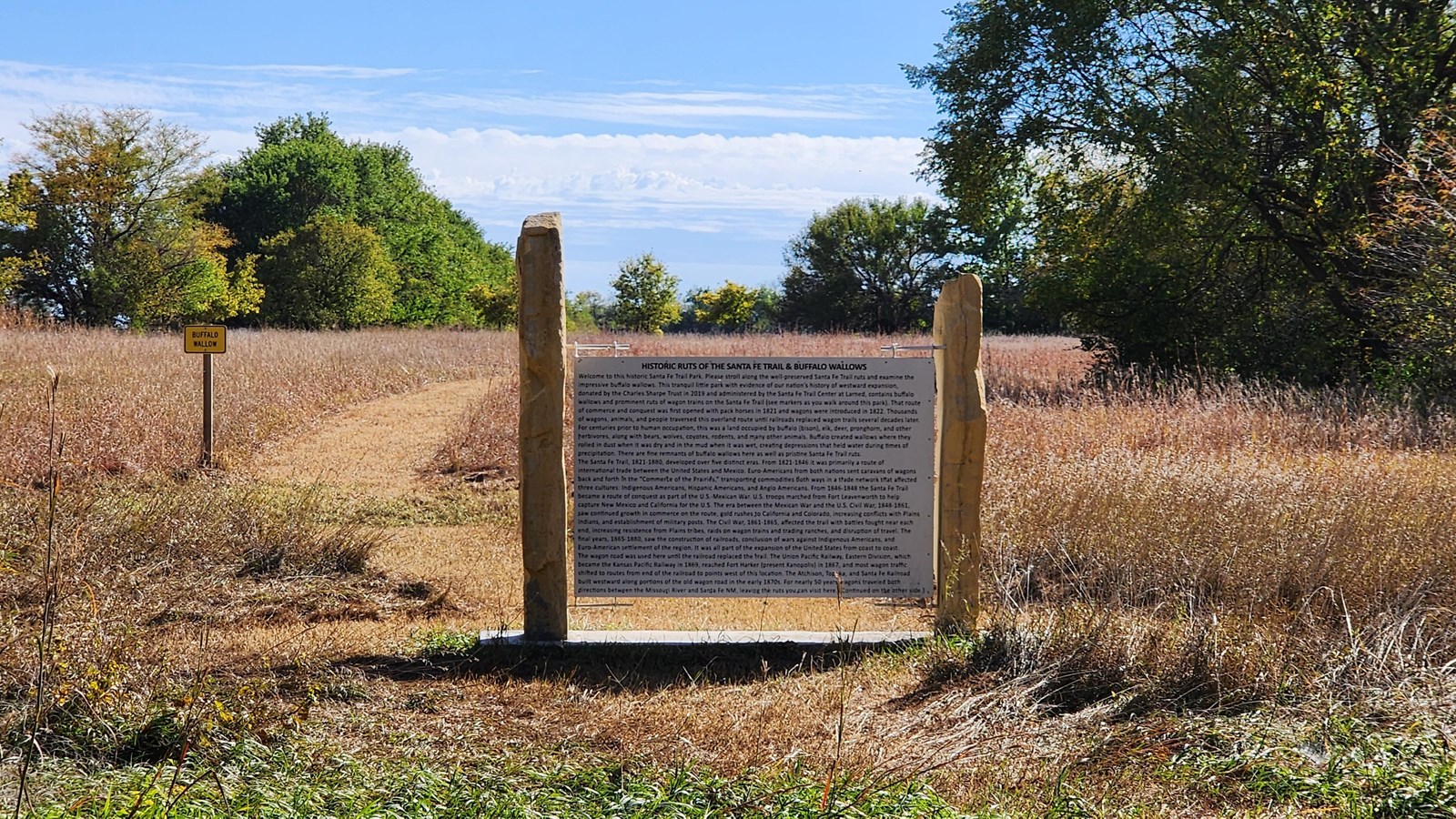
Photo/Santa Fe Trail Association
Quick Facts
Location:
38.3503° N, 98.4285° W
Significance:
The Sharpe Ruts are another example of pristine ruts left by the many wagons that traveled the Santa Fe Trail over two hundred years ago. In addition to the ruts left by the wagons, there are several examples of buffalo wallows which were left by the herds of buffalo that inhabited the area.
Designation:
Historic site on the Santa Fe National Historic Trail
Amenities
2 listed
Historical/Interpretive Information/Exhibits, Parking - Auto
The Sharpe Ruts are significant because they preserve visible evidence of both the Santa Fe Trail and the native prairie landscape through which the Trail passed. Visitors can walk in well-preserved wagon ruts created by decades of Santa Fe Trail traffic and see buffalo wallows—depressions left by the great herds of bison that once occupied the Plains.
The Santa Fe Trail opened as an international trade route between Missouri and Santa Fe in 1821. For decades, thousands of wagons, livestock, traders, soldiers, and other travelers crossed the Plains along the Trail. Repeated wagon traffic gradually wore broad ruts and swales into the prairie. The ruts preserved at this site provide visitors with a tangible connection to those who traveled the Trail during the 19th century.
The site also preserves remnants of buffalo wallows. Bison created these depressions by repeatedly rolling in dry soil or mud. Before settlement transformed the prairie, bison shared this landscape with elk, deer, pronghorn, wolves, coyotes, and many other animals. The surviving wallows help visitors understand what the natural environment was like when Santa Fe Trail travelers passed through this area.
Wagon traffic continued through this region until expanding railroads gradually replaced long-distance freighting by wagon. The Kansas Pacific Railway reached Fort Harker, near present-day Kanopolis, in 1867. The Atchison, Topeka and Santa Fe Railroad then built westward during the early 1870s, much of it following the general corridor of the old Trail. After nearly 50 years of commerce and travel between the Missouri River and Santa Fe, the era of the long-distance wagon trains came to an end.
Today, visitors can walk through the historic prairie, follow the surviving Santa Fe Trail ruts, examine buffalo wallows, and read interpretive signs explaining the site's history. The quiet setting provides an opportunity to experience the landscape on foot and imagine the wagon trains and animals that once crossed this part of Kansas.
The Sharpe Ruts are located along Avenue N, approximately one mile south and one-half mile east of the intersection of U.S. Highway 56 and 8th Road near Chase in Rice County, Kansas. Visitors enter on foot and can walk through the prairie to examine the wagon ruts, buffalo wallows, and interpretive markers at close range.
Site Information
Location (1/2 mile east of the intersection of 8th Avenue and Avenue N south of Chase, Kansas. 38.3503° N, 98.4285° W)
Safety Considerations