



Last updated: August 22, 2026
Place
Sand Hill/Summit Station
NPS Photo
Quick Facts
Location:
3 miles south of Denman, NE corner of W 70th St. and N. Denman St. GPS 40.6554916667 -98.7241388889
Significance:
Pony Express station from July 1, 1861 to Nov. 20, 1861
Designation:
Historic site on the Pony Express National Historic Trail.
Amenities
3 listed
Historical/Interpretive Information/Exhibits, Parking - Auto, Parking - Bus/RV
This Pony Express and Overland Stage station, its exact location uncertain today, was a simple, shallow dugout—a roofed hole gouged into the prairie—along a lonely stretch of sandy road south of the Platte River. The Pony Express called it Gill, Gill’s Sand Hill, or simply Sand Station, but others knew it as Summit Station because it squatted at the highest elevation between the Little Blue and Platte rivers.
In their 1901 reminiscence, The Overland Stage to California, authors Frank Root and William Connelley described the forlorn station as follows:
Surroundings for some distance on either side of the station represented a region of sand-hills, with numerous deep ravines or gullies cut by heavy rains or waterspouts, and dressed smoothly by the strong winds. . . .
Very little in the way of vegetation was noticeable at Summit or in the vicinity. It was a rather dismal-looking spot, uninviting in every particular; seemingly one of the most undesirable places on the line between Atchison and the mountains to build a station. Necessity compelled the stage men to choose this location, however, for the distance from Thirty-two-mile Creek to the Platte, twenty-five miles, was over a somewhat rough and hilly road, and it was too much of a pull for one team. Therefore the stage managers put in a station as near as possible at the half-way point, and the very appropriate name of Summit was given it.
Overland Stage historian John Townely reported that the station keeper worked with Indians to steal emigrants’ livestock and then sell the animals back to stranded wagon trains. One cheated party discovered the scheme and threatened to hang him.
Sand Hill Station served the Pony Express as a relay station, where riders changed horses, from July 1 until November 20, 1861, when the service shut down. The Overland Stage continued to use the site for several years more but abandoned the station following an Indian raid in August 1864.
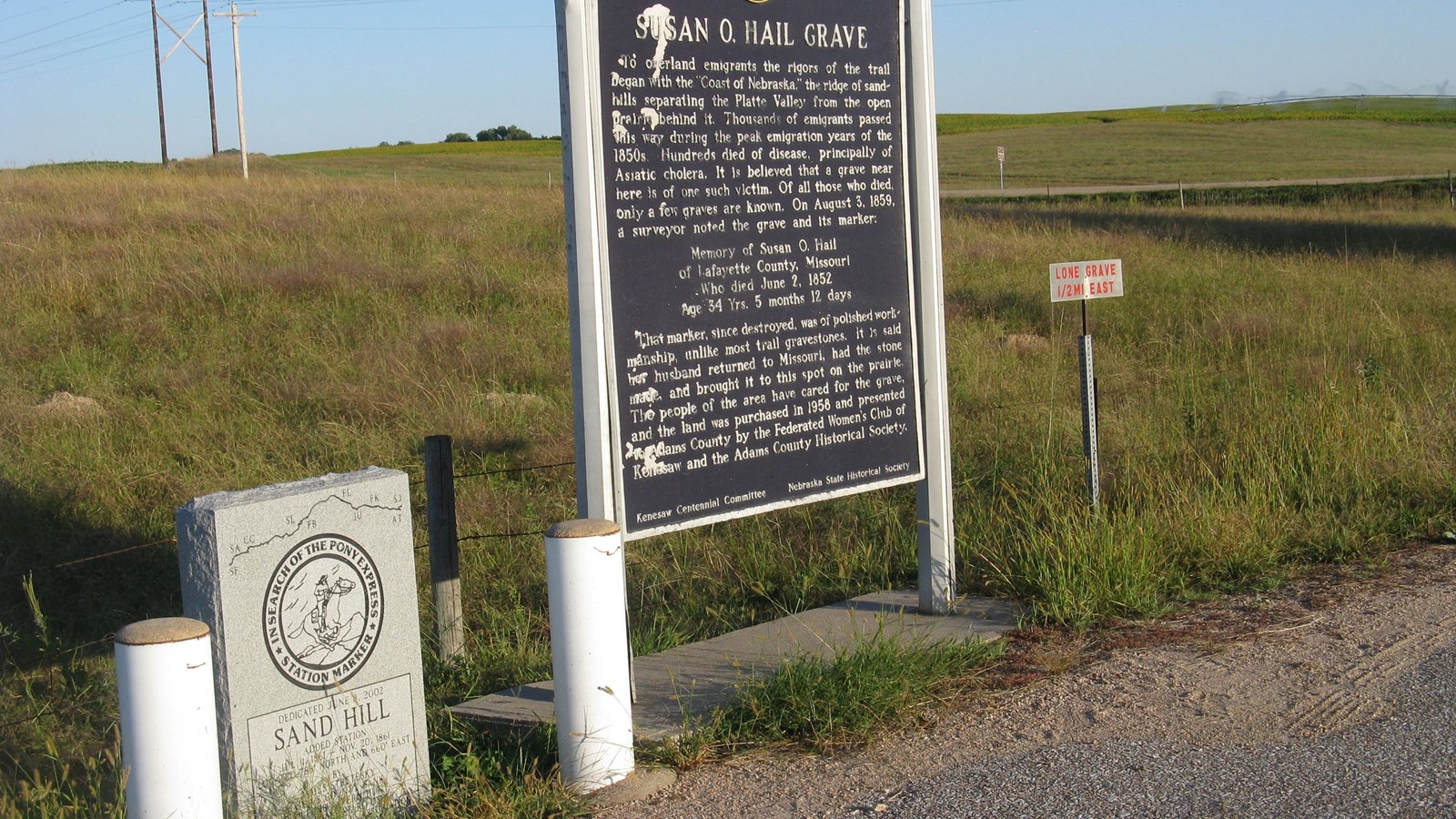
Today, satellite imagery show that the once-bleak landscape has been transformed into a patchwork of irrigated squares and circles in shades of green and gold. A simple granite marker at a roadside pullout south of Denman now commemorates the station. Beside the marker stands a Nebraska state historical marker for the nearby grave of 1852 emigrant Susan Haile, who died of cholera on her way to California.
Site Information
Location (3 miles south of Denman, NE corner of W 70th St. and N. Denman St. GPS 40.6554916667 -98.7241388889)