



Last updated: April 7, 2026
Place
Natchitoches Parish Convention and Visitors Bureau
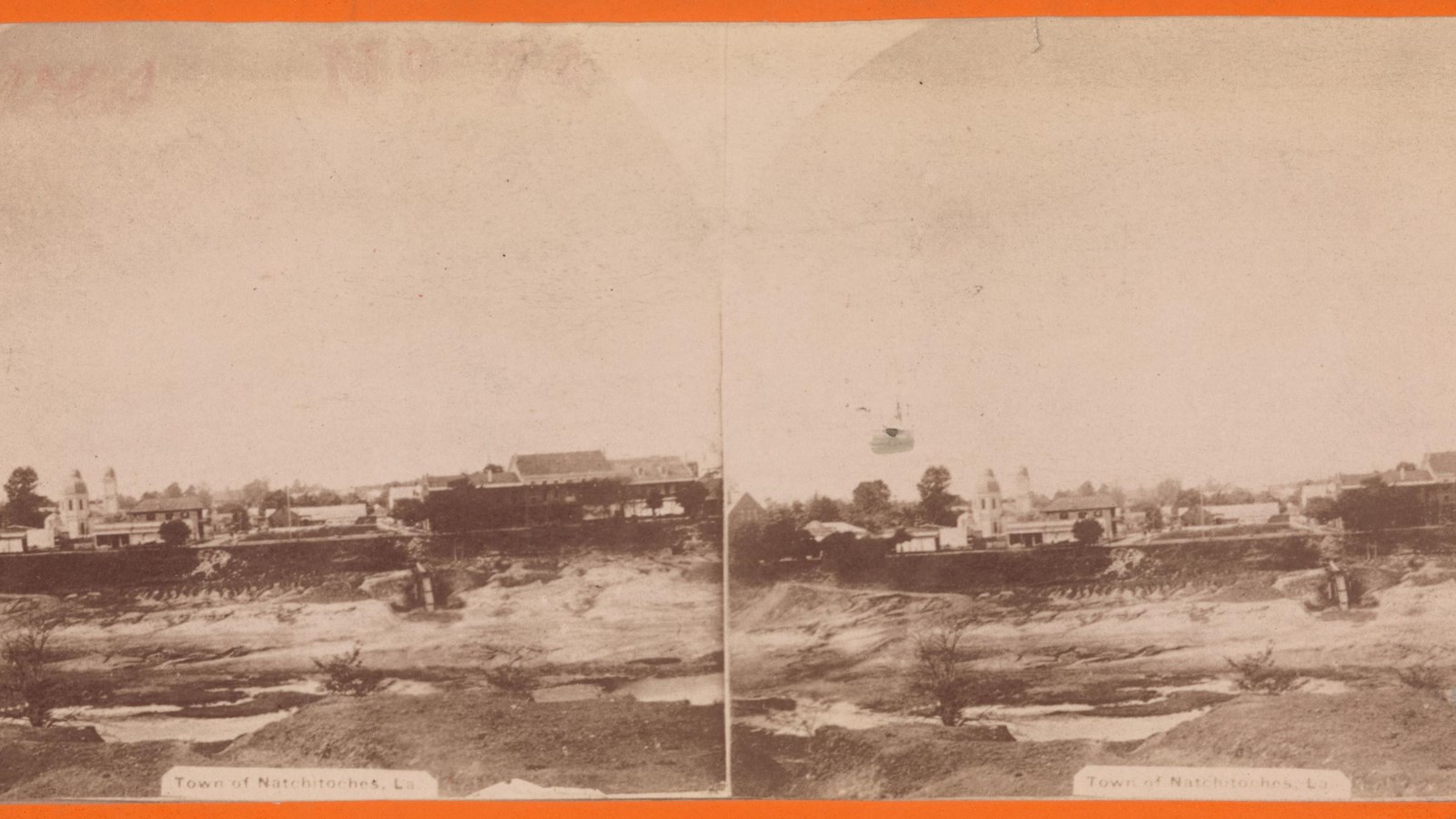
Photo/Library of Congress
Quick Facts
Location:
780 Front St STE 100, Natchitoches, LA 71457
Significance:
A one-stop shop for visitor information.
MANAGED BY:
Amenities
2 listed
Historical/Interpretive Information/Exhibits, Information
Located in Louisiana at the eastern terminus of El Camino Real de los Tejas, the city of Natchitoches boasts a long, complex, and engaging history. The city’s Visitor Information Station, sponsored and staffed by the Natchitoches Area Convention and Visitors Bureau, provides an entry point for visitors looking to learn more about this part of Louisiana and its connections to the camino.
Natchitoches lies within the traditional homeland of the Natchitoches confederacy, a Caddoan people whose territory stretched from the Red River west into Texas.[1] Trails used and built by the Natchitoches, which created long-distance trade routes and connected their communities and ceremonial sites, would eventually become part of El Camino Real de los Tejas.[2]
In the winter of 1713-1714, while travelling from present-day Alabama to Mexico, explorer Louis Juchereau de St. Denis established a trading post at a Caddo village along the Red River. This post grew into the town of Natchitoches, the first permanent European settlement in French Louisiana.[3] Sieur Charles Claude Dutisné and a company of soldiers arrived in the area two years later. They built Fort St. Jean Baptiste to guard against any attempts by the Spanish Empire to expand eastward into territory claimed by France.[4]
Spanish colonizers responded in 1716 by establishing a Catholic mission, San Miguel de los Adaes, twelve miles west of Natchitoches.[5] Since the nearest supply post was over 800 miles away, the people living at Los Adaes frequently traded with people in Natchitoches. Although officially prohibited by both the Spanish and French crowns, French settlers and soldiers in Natchitoches welcomed the trade, as well as the weekly religious services held by the Spanish missionaries.[6] Nearby Caddo communities were an important lifeline for Natchitoches, trading fur and food for items such as guns, horses, and metal tools.[7] Fort St. Jean Baptiste served as a military garrison and commercial trade center until 1762, when France ceded Louisiana to Spain after the conclusion of the Seven Years’ War.
Located near a massive log jam on the Red River, Natchitoches became an important transportation center in the Spanish colonial era. Known as the Great Raft, the log jam may have started to form in the 1100s as debris built up in the Red River. By the early 1800s, huge logs blocked portions of the river for over 100 miles, making it impossible to navigate the river upstream from Natchitoches.[8] This turned out to be a blessing in disguise for Natchitoches, as trade goods, livestock, deer hides, salt, and crops such as indigo and tobacco that arrived by land had to stop in the city to be loaded onto boats bound for New Orleans. Overland connections, with the Natchez Trace to the east and El Camino Real to the south and west, also made Natchitoches an important gateway for settlers and merchants heading to Texas.[9]
Following the Louisiana Purchase in 1803, Anglo-Americans arriving in the area ignored old treaties between France, Spain, and Indigenous groups and settled on Caddoan land. Increasingly dispossessed of their territory and suffering from the influx of European diseases, the Natchitoches Caddo lived north of the town.[10] A removal treaty signed with the United States on July 1, 1835, required the Caddo who still lived in Louisiana to leave the United States for Mexico. They relocated to Texas, which was then part of Mexico. After Texas became part of the United States in 1845, the U.S. government forced the Caddo to move first to the Brazos Reservation in West Texas, and then, in 1859, to relocate to Indian Territory in what is now Oklahoma.[11]
During this period, in the early- to mid-1800s, Natchitoches remained a hub of trade, but new technologies and changes to the environment altered how people traveled to and from the area. Starting in the 1830s, the United States Army Corps of Engineers began the removal of the Great Raft, a process which took several decades but ultimately made travel along the length of the river possible.[12] Likewise, the arrival of the railroad in 1887 largely replaced traffic on El Camino Real.[13]
To this day, the legacy of El Camino Real de los Tejas is evident in the communities of Natchitoches Parish. The Natchitoches Area Convention and Visitors Bureau provides resources for exploring the area, including maps, recommendations, and visitor guides. Family-friendly walking tours of the city’s downtown historic district provide a general overview of Natchitoches and the Cane River area, telling the stories of Indigenous people, the French and Spanish colonial period, antebellum plantation culture, Reconstruction and tenant farming, and Creole history and culture.[14]
Site Information
Location (780 Front St STE 100, Natchitoches, LA 71457)
More site information
El Camino Real de los Tejas National Historic Trail
[1] Phil Cross, “El Camino Real de los Tejas: A Caddo Road,” in, Tribes of the Trail: El Camino Real de los Tejas National Historic Trail, Dayna Bowker Lee (ed.) (National Park Service, 2017); “Caddo Nation-The Sacred Landscape,” National Park Service, https://www.nps.gov/articles/000/caddo-nation-introduction.htm (accessed on December 10, 2024); “Who we are,” Caddo Nation, https://mycaddonation.com/history-1 (accessed on December 10, 2024).
[2] Cross, “El Camino Real de los Tejas: A Caddo Road,” PDF pg. 4; “Caddo Nation-The Sacred Landscape,” National Park Service.
[3] “Fort St. Jean Baptiste State Historic Site,” Louisiana State Parks, https://www.lastateparks.com/historic-sites/fort-st-jean-baptiste-state-historic-site (accessed on October 18, 2024).
[4] “Fort St. Jean Baptiste State Historic Site,” Louisiana State Parks.
[5] James L. McCorkle, Jr., “Los Adaes,” Texas State Historical Association, https://www.tshaonline.org/handbook/entries/los-adaes (accessed on October 10, 2024).
[6] McCorkle, Jr. “Los Adaes.”
[7] Timothy K. Perttula, “Caddo Indians,” Texas State Historical Association, updated October 8, 2020, https://www.tshaonline.org/handbook/entries/caddo-indians (accessed on December 10, 2024); “Trade with the Caddo,” Louisiana Division of Archaeology, https://www.crt.state.la.us/dataprojects/archaeology/losadaes/_html/2_10_00.htm (accessed on December 10, 2024).
[8] Glen Roberson, “Red River Raft,” Oklahoma Historical Society, https://www.okhistory.org/publications/enc/entry?entry=RE009 (accessed on December 10, 2024); Judy Watson, "The Red River Raft," East Texas Historical Journal 5, Iss. 2, Article 8 (1967), pp. 105-6, https://scholarworks.sfasu.edu/cgi/viewcontent.cgi?article=1132&context=ethj; Terry Jones, “The Great River Raft,” Country Roads: Cultural Reporting from the Mississippi Delta to the Louisiana Coast, February 19, 2019, https://countryroadsmagazine.com/outdoors/knowing-nature/the-great-river-raft/
[9] “Louisiana and Texas: El Camino Real de los Tejas National Historic Trail,” National Park Service, June 10, 2024, https://www.nps.gov/articles/delostejas.htm (accessed on October 21, 2024).
[10] Clarence H. Webb and Hiram F. Gregory, “The Caddo Indians of Louisiana,” Louisiana Department of Culture, Recreation and Tourism, 2nd ed, pdf pp. 17-18, 20-22, https://www.crt.state.la.us/Assets/OCD/archaeology/discoverarchaeology/virtual-books/PDFs/Caddo.pdf (accessed on December 10, 2024).
[11] “Treaty with the Caddo, 1835,” Oklahoma State: Tribal Treaties Database, https://treaties.okstate.edu/treaties/treaty-with-the-caddo-1835-0432 (accessed on October 21, 2024); Howard Meredith, “Caddo (Kadohadacho),” Oklahoma Historical Society, https://www.okhistory.org/publications/enc/entry?entry=CA003 (accessed on December 10, 2024).
[12] Edith Mccall, “The Attack on the Great Raft,” American Heritage Invention & Technology: The Magazine of Innovation, Vol. 3. no. 3, (Winter 1988), https://www.inventionandtech.com/content/attack-great-raft-1.
[13] “Texas and Pacific Railway Depot,” National Park Service, https://www.nps.gov/cari/learn/historyculture/texas-and-pacific-railway-depot.htm (accessed on December 10, 2024).
[14] Cane River National Heritage Area, Walking Tours, https://www.canerivernha.org/walking-tours (accessed on December 10, 2024); NPS, Natchitoches Parish Convention and Visitors Bureau, https://www.nps.gov/places/natchitoches-parish-convention-and-visitors-bureau.htm (accessed on December 10, 2024); Natchitoches Convention and Visitors Bureau, About Us, https://natchitoches.com/about-us/ (accessed on December 10, 2024).