



Last updated: June 5, 2026
Place
La Parroquia Site (Cathedral Basilica of St. Francis of Assisi)
NPS Image/Bruce MacPherson
Quick Facts
Location:
131 Cathedral Place, Santa Fe, New Mexico.
Significance:
Slowly enveloped La Parroquia (the parish church), a Santa Fe Trail landmark that was dismantled starting in 1884.
Designation:
Historic site on the Old Spanish, Santa Fe, and El Camino Real de Tierra Adentro NHTs.
MANAGED BY:
Amenities
1 listed
Historical/Interpretive Information/Exhibits
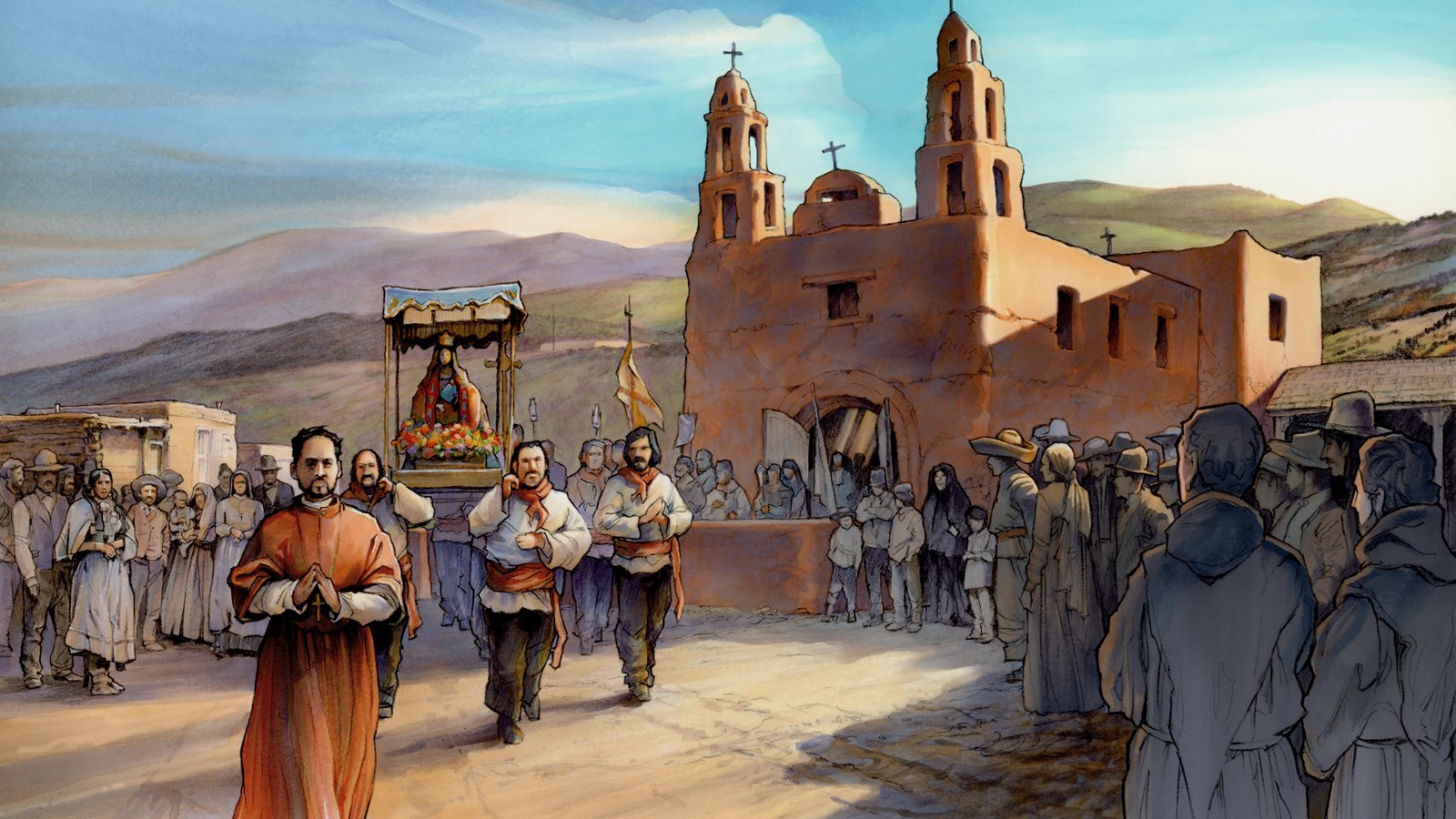
Imagine Santa Fe’s Cathedral Basilica of St. Francis as not just one church, but a sequence of churches. An earlier church on the same site was destroyed during the Pueblo Revolt in 1680. Following that, La Parroquia (the parish church) was built in the 1710s, primarily of adobe. The remains of the pre-1680 church were rebuilt into a side chapel where La Conquistadora (The Conqueror), a Spanish statue of the Virgin Mary that traveled north from Mexico City along El Camino Real de Tierra Adentro, is still kept today. Annual processions of the very same statue, rooted in celebrations of the 1692 reconquest, have been occurring in Santa Fe since the 1700s.
Santa Fe’s architecture gained greater visibility as increasing numbers of Americans arrived, first as Santa Fe Trail traders in the 1820s and then as occupying troops in the 1840s. For the most part, the region’s low adobe buildings did not impress them, but La Parroquia—and New Mexican Catholicism in general—held greater interest. After the Mexican-American War, the Catholic Church transferred New Mexico to United States jurisdiction and appointed an energetic young Frenchman named Jean-Baptiste Lamy to oversee the rapidly changing territory. He arrived in Santa Fe in 1851.
While nearby buildings increasingly mimicked American architectural styles, Lamy had other influences in mind. He began by renovating the existing church, adding Gothic touches like adobe crenelations drawn from the cathedrals he had known as a young priest in Europe. La Parroquia was small, as adobe and timber structures tended to be. For someone accustomed to massive medieval churches, it simply was not a proper cathedral. Lamy’s true goal was a new cathedral, made of stone. He hired architects from France and stone masons from France and Italy. In 1869 the masons laid the Cathedral of St. Francis’ foundations around the existing church, which remained in use during construction.
Gradually a massive structure of brown and beige stone emerged, fed by shipments from local quarries at Arroyo Sais, Lamy Junction, and the top of La Bajada Mesa. Mirroring the 11th and 12th-century cathedrals of Lamy’s homeland, St. Francis was built in the Romanesque style—with particular emphasis on thick walls and repeating arches. By 1884 construction had progressed enough that most of La Parroquia was demolished, its adobe remains used to fill in surrounding streets. Lamy passed away four years later. After a succession of architects and many stoppages in work, the cathedral was finally consecrated in 1895—with many planned features still unbuilt.
The Cathedral Basilica of St. Francis underwent major renovations in the 1930s and 1960s, but the legacy of La Parroquia—in the form of La Conquistadora chapel—has survived intact. Today, the basilica is both an impressive structure unto itself and a reminder of churches past. Lamy’s great cathedral is a testament to Santa Fe’s far-flung influences, rendered in New Mexican soil and stone.
Site Information
Location (131 Cathedral Place, Santa Fe, New Mexico.)
More Site Information
El Camino Real de Tierra Adentro National Historic Trail
Santa Fe National Historic Trail
Old Spanish National Historic Trail
El Camino Real de Tierra Adentro, Old Spanish Trail, Santa Fe Trail: Santa Fe, New Mexico Itinerary
Santa Fe is the oldest capital city in the US, founded in 1610, and the highest in elevation at 7,000 ft. The city is the historic hub of the southwest, connecting three national historic trails: El Camino Real de Tierra Adentro, the Santa Fe Trail, and the Old Spanish Trail. This tour leads your from the busy plaza and other major tourist locations to lesser known sites along quiet, old Santa Fe streets.