



Last updated: April 9, 2026
Place
Goliad State Park and Mission Espiritu Santo State Historic Site
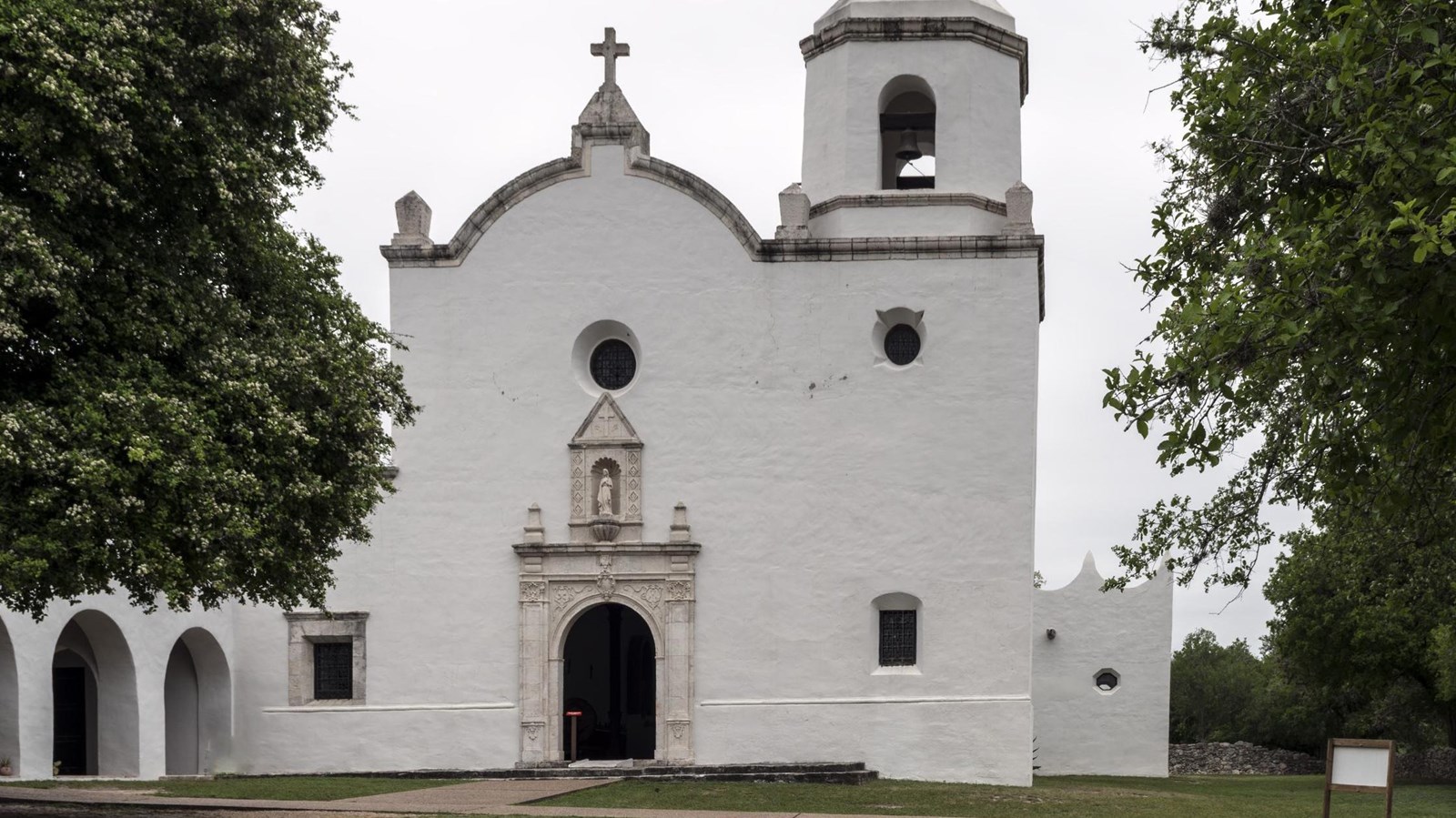
Photo/The Lyda Hill Texas Collection of Photographs
Quick Facts
Location:
108 Park Road 6, just west of US highways 77 and 183 and State Highway 239, ¾ mile south of Goliad
Significance:
Native Americans, Spanish explorers and missionaries, Texian soldiers and early settlers walked the land of what is now Goliad State Park and Historic Site in southeast Texas. Follow in their footsteps and peek into Texas’ past. There are four sites to explore!
Designation:
Certified site; State Historic Site
MANAGED BY:
Amenities
1 listed
Historical/Interpretive Information/Exhibits
Commonly known as Mission Espíritu Santo or Mission La Bahía, Misión Nuestra Señora de la Bahía del Espíritu Santo de Zúñiga was established in the 1700s along El Camino Real de los Tejas. Relocated multiple times over its 100-year history, Mission Espíritu Santo shaped the histories of Indigenous, Spanish, and Anglo American communities in South Texas.
Spanish Franciscan priests founded Mission Espíritu Santo to convert the Karankawa, an Indigenous nation that migrated seasonally between the coast and points inland, to Christianity. Spaniards also hoped the mission would deter the French from encroaching on Spanish-claimed territory. In 1685, 180 French colonists of the La Salle Expedition, led by French explorer Robert Cavelier, sieur de La Salle, had established Fort St. Louis along Matagorda Bay in Karankawa territory. The Karankawa destroyed the French settlement around 1688, but the Spanish Crown wanted to prevent any further incursions by the French. Spanish soldiers occupied the former La Salle site in 1721. The following year, Mission Espíritu Santo and Presidio (fortified garrison) La Bahía were built on the ruins of Fort St. Louis.[1] The mission’s Franciscan priests hoped the Karankawa would be receptive to conversion, but attempts to entice them failed. In less than four years, the priests recommended relocating the mission to an area with “friendlier” Indigenous communities who might be more willing to convert.[2]
Heeding their request, the Spanish Crown ordered the relocation of Mission Espíritu Santo and Presidio La Bahía to present-day Mission Valley along the Guadalupe River. There, the mission operated for 26 years. The Franciscans promised to feed and protect members of the Aranama and Tamique tribes but had to turn some away when supplies ran short. The priests also trained Native people in farming, ranching, and other vocations as part of the religious conversion process. Toiling in the fields, the Aranamas and Tamiques produced crops using dry farming techniques.[3] Like most Spanish missions, Mission Espíritu Santo acted as both a religious community and a self-sufficient agricultural society. It traded corn, hay, cattle, and horses to nearby settlements, and developed into one of the first cattle ranches in Texas.[4]
In 1747, Spanish colonizer and military commander José de Escandón recommended that Mission Espíritu Santo and Presidio La Bahía move again. The new site, along the San Antonio River in present-day Goliad, would stop further French and English encroachment into Texas and provide better protection for travelers on El Camino Real.[5] By October 1749, Mission Espíritu Santo had relocated for the final time. At first, its inhabitants lived in jacales, temporary structures made from woven branches and natural mud plaster. Eventually, the mission’s Indigenous and Spanish residents erected stone buildings—the church and friary by 1758 and Indigenous housing by the late 1760s.[6] Around 1767, about 300 men, women, and children from the Aranama, Tamique, Tawakoni, and Tonkawa nations lived at the mission, though they might not all have been permanent residents. Evidence suggests that some Native Americans may have left the mission for several months or years at a time because of dwindling food supplies and a lack of protection from Apache raiders. Mission Espíritu Santo also hosted up to 40,000 cattle and was one of the first successful large-scale cattle ranches in Texas.[7]
Internal clashes and raids by the Lipan Apache, combined with the loss of thousands of head of cattle, led to a dwindling of the mission’s resources in the late 1770s. By the mid-1790s, the Spanish Crown, no longer seeing a colonial or religious need for missions in Texas, determined that all Texas missions should close and leave their land to the remaining Indigenous residents.[8] The governor of Texas, Manuel Muñoz, asked Spanish authorities in Mexico for an extension, claiming the current “backward condition of the Indians at Espíritu Santo” should prevent this transition. Mission Espíritu Santo survived under difficult conditions, including raids and sieges, collapsing buildings, and a lack of support from the Franciscan order, until it finally closed in 1830.[9] The Goliad city council approved the disposition of the mission in 1846 and 1847. Some of the remaining structures were used by Hillyer Female College and Aranama College. The city of Goliad eventually took ownership of the property, and it gradually fell into disrepair.[10]
In the 1930s, the Civilian Conservation Corps researched and reconstructed Mission Espíritu Santo’s main buildings. The Texas Parks and Wildlife Department conducted additional work on the structures in the 1970s. It was placed on the National Register of Historic Places in 1977.[11]
Today, Mission Espíritu Santo is part of Goliad State Historic Park. Visitors can learn about the site’s history and its connections to El Camino Real by exploring the restored chapel, discovering the mission’s archeological artifacts, and visiting park exhibitions.
Site Information
Location (108 Park Road 6, just west of US highways 77 and 183 and State Highway 239, ¾ mile south of Goliad)
The four sites that comprise the park have park amenities such as restrooms and picnic areas, outdoor recreation opportunities on trails and water, and offer historic buildings to experience a step back in time and contextualize the formation of Texas.
- Mission Nuestra Señora del Espíritu Santo de Zúñiga
- Mission Nuestra Señora del Rosario
- El Camino Real Visitor Center
- Zaragoza Birthplace
More site information
El Camino Real de los Tejas National Historic Trail
[1] Walter, Tamra Lynn, Espíritu Santo de Zúñiga: A Frontier Mission in South Texas (University of Texas Press 2007), 8, 12; United States Department of the Interior, “National Register of Historic Places: Historic Resources of El Camino Real de los Tejas National Historic Trail,” October 2011, https://npshistory.com/publications/elte/nr-historic-resources.pdf; Fort St. Louis, Texas Beyond History, accessed October 23, 2024, https://www.texasbeyondhistory.net/stlouis/index.html; Weddle, Robert S., “La Salle’s Texas Settlement,” Handbook of Texas Online, accessed October 23, 2024, https://www.tshaonline.org/handbook/entries/la-salles-texas-settlement
[2] Walter, Espíritu Santo, pg. 12
[3] Ibid.
[4] Roell, Craig H., “Nuestra Señora del Espíritu Santo de Zúñiga,” Handbook of Texas Online, accessed August 16, 2024, https://www.tshaonline.org/handbook/entries/nuestra-senora-del-espiritu-santo-de-zuniga-mission; “Changing Lifeways: Mission Espíritu in the Mission Valley,” Texas Beyond History, accessed October 23, 2024, https://www.texasbeyondhistory.net/espiritu/victoria.html
[5] Roell, “Nuestra Señora del Espíritu Santo de Zúñiga”; García, Clotilde P., “Escandon, Jose de,” Handbook of Texas Online, accessed October 23, 2024, https://www.tshaonline.org/handbook/entries/escandon-jose-de
[6] Ulrich, Kristi, et. al., “Archeological Investigations at Mission Espíritu Santo (41GD1), Goliad County, Texas,” Texas Archeological Research Laboratory, 2005, https://colfa.utsa.edu/_documents/car/asr-300/asr-356.pdf.
[7] Ulrich, et. al., “Archeological Investigations.”; Roell, “Nuestra Señora”.
[8] Ibid; Dary, David, “Cattle Brands,” Handbook of Texas Online, accessed October 23, 2024, https://www.tshaonline.org/handbook/entries/cattle-brands; “The Mission in its Final Location,” Texas Beyond History, accessed October 23, 2024, https://www.texasbeyondhistory.net/espiritu/goliad.html
[9] Ulrich, et. al., “Archeological Investigations.”; Roell, “Nuestra Señora”; Habig, Marion A., “Muñoz, Manuel,” Handbook of Texas Online, accessed October 23, 2024, https://www.tshaonline.org/handbook/entries/munoz-manuel
[10] Ulrich, et. al., “Archeological Investigations.”; Roell, “Nuestra Señora”.
[11] Ulrich, et. al., “Archeological Investigations”; Roell, “Nuestra Señora”.