



Last updated: April 7, 2026
Place
Nuestra Señora de Rosario Mission
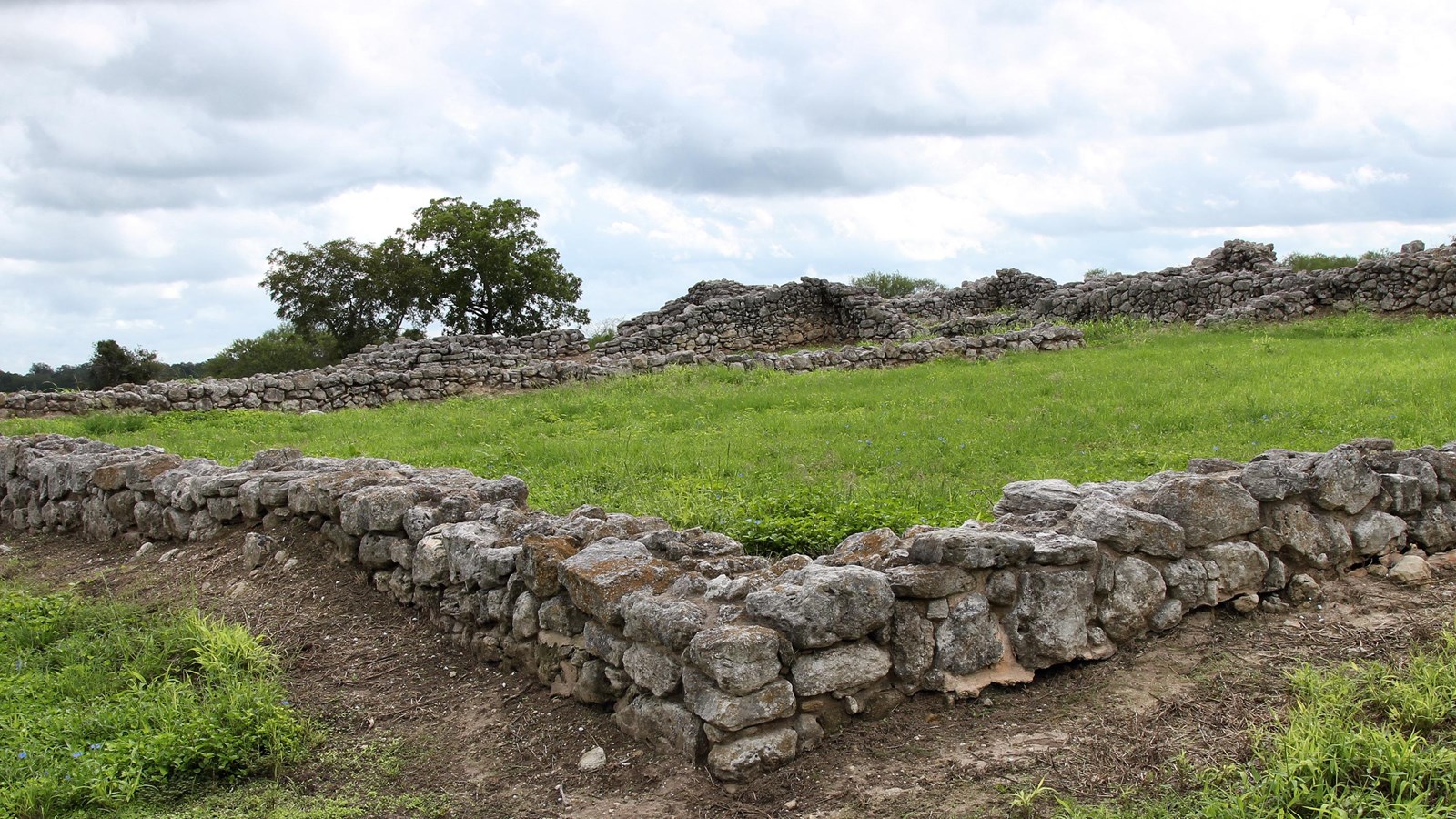
Photo/Larry D. Moore
Quick Facts
Location:
Open by appointment only; four miles west of Goliad, Texas, just southwest of where US Highway 59 crosses the San Antonio River
Significance:
The mission site highlights Spanish difficulties convincing American Indian populations to adopt Christianity and a sedentary lifestyle--traits that many Europeans considered essential parts of "civilized" life.
Designation:
Certified Site; State Archeological Site; National Register of Historic Places
MANAGED BY:
Amenities
1 listed
Historical/Interpretive Information/Exhibits
Along the banks of the San Antonio River just west of the town of Goliad, Texas, lie the ruins of Mission Nuestra Señora de Rosario de los Cujanes, also known as Mission Rosario, one of several missions located along El Camino Real de los Tejas. Founded in November 1754, Spanish officials hoped to use the mission as a place to convert the local Karankawa population to Catholicism and force their assimilation into Spanish colonial society.[1]
Karankawa, or its Spanish spelling, Carancagua, refers to several tribes that belonged to the same language group, including the Cujanes, Cocos, and Copanes.[2] Karankawa society revolved around hunting and fishing. Bands moved towards the coast in warmer weather to capture fish and headed inland during the winter to hunt large game, such as bison.[3] In 1528, a shipwrecked Spanish expedition reached a small island off the Texas coast inhabited by Karankawas, the first recorded contact between Europeans and Native Americans in Texas.[4]
In 1721, Spanish governor José de Azlor y Virto de Vera—commonly known as the Marqués de Aguayo—launched an expedition to reestablish Spanish control of East Texas after a French invasion in 1719 prompted the abandonment of the region’s presidios and missions. Aguayo established four presidios and ten missions in East Texas, San Antonio, and La Bahía to convert Indigenous people to Catholicism and make them loyal Spanish subjects. Among these, Mission Espíritu Santo de Zúñiga focused on converting the Karankawa to Christianity.[5] Many years later, Father Juan de Dios Camberos established Mission Nuestra Señora del Rosario in 1754 as part of this effort. Yet Spanish missionary efforts to convert the Karankawa were only minimally successful. From 1754 to 1768, priests at Mission Rosario baptized only around 200 Karankawa. Most Karankawa bands preferred to limit their interaction with the mission and made only occasional visits.[6] To sustain themselves, the missionaries and the small number of Karankawa converts at the site raised sheep, goats, and cattle.
By the late 1770s, Mission Rosario was still in operation, but relations with the Karankawa had deteriorated, in part due to the forcible imprisonment of Karankawa “neophytes” by Spanish missionaries and military officials. In 1778, a band of Karankawa led by Chief José Maria attacked the mission and rescued about 10 families.[7] Although a Spanish relief force saved the building and its occupants, the event highlighted the failure of the missionaries’ conversion efforts and the Spanish Crown’s tenuous hold on the area. Spanish officials seized this as an opportunity to crush the Karankawa and gain complete control over the Texas coast. The Karankawa-Spanish War weakened the mission even further. By 1781, most of the missionaries had abandoned Mission Rosario.[8]
In 1789, weary after a decade of war and concerned with increasing raids by the Comanche and Lipan Apache, several Karankawa groups decided to make peace with the Spanish Empire. Spanish sources indicate that the Karankawa demanded the reopening of Mission Rosario, possibly for the protection offered by its fortifications. However, the Karankawa continued to resist efforts by the missions to control their lives and movements, and Spanish missionaries continued to be frustrated by the Karankawas’ refusal to convert.
Spanish authorities eventually established a new mission, Nuestra Señora del Refugio, closer to the Karankawa heartlands in 1792. While Mission Rosario remained in operation until around 1804, the number of inhabitants dwindled as the mission’s infrastructure deteriorated and the Karankawa relocated to Mission Refugio.[9] In the 1800s, the mission’s buildings and land were transferred from church ownership to private ownership.
In 1935, the property owner donated the site to the Goliad State Park Commission. At that time, very little of the mission remained aboveground. Archeological excavations, however, have provided clues about the mission’s layout, while also uncovering Spanish and Karankawa artifacts.
Today, what remains of Mission Rosario is part of the Goliad State Park and Historic Site managed by the Texas Department of Parks and Wildlife. An interpretive sign summarizes the site’s history. Visitors may follow the interpretive trail and view the ruins from a distance. Anyone wishing to pass the fence that surrounds the site and view the ruins up close must make an appointment with Goliad State Park interpretive staff.[10]
Site Information
Location (four miles west of Goliad, Texas, just southwest of where US Highway 59 crosses the San Antonio River)
The mission's ruins sit atop a small rise in the San Antonio River valley. Although we cannot know for sure, archeologists think that the site consisted of a chapel, bell tower, sacristy, and residence.
Safety Considerations
Access
Closed to the public. This site is still being studied and can be visited only by appointment.
Exhibits
Historical marker along the road adjacent to the site.
More site information
El Camino Real de los Tejas National Historic Trail
[1] Kathleen Kirk Gilmore, “Nuestra Senora del Rosario Mission,” Texas State Historical Association, accessed July 15, 2024, https://www.tshaonline.org/handbook/entries/nuestra-senora-del-rosario-mission.
[2] Herbert E. Bolton, “The Founding of Mission Rosario: A Chapter in the History of the Gulf Coast,” Quarterly of the Texas State Historical Association, Vol. 10, No. 2 (Oct. 1906), pp. 113-139; accessed on JStor, 30 July 2024.
[3] Ibid.
[4] Carol A. Lipscomb, “Karankawa Indians,” Texas State Historical Association, accessed September 20, 2024, https://www.tshaonline.org/handbook/entries/karankawa-indians
[5] Ibid.; Lewis W. Newton, “Aguayo, Marqués de San Miguel de,” Texas State Historical Association, accessed September 20, 2024, https://www.tshaonline.org/handbook/entries/aguayo-marques-de-san-miguel-de; Charles W. Hackett, “Aguayo Expedition,” Texas State Historical Association, accessed September 20, 2024, https://www.tshaonline.org/handbook/entries/aguayo-expedition
[6] Foster Todd Smith, From Dominance to Disappearance: The Indians of Texas and the Near Southwest, 1786-1859, (University of Nebraska Press, 2008), pg. 17; Kathleen Kirk Gilmore, “Nuestra Señora del Rosario Mission,” Texas State Historical Association, accessed September 20, 2024, https://www.tshaonline.org/handbook/entries/nuestra-senora-del-rosario-mission
[7] Smith, From Dominance to Disappearance, pg. 23.
[8] Smith, From Dominance to Disappearance, pg. 23; Lipscomb, “Karankawa Indians”; Gilmore, “Nuestra Señora del Rosario Mission”
[9] Gilmore, “Nuestra Senora del Rosario Mission.”
[10] Email correspondence with Angela Skinner-Hernandez, Goliad State Park.