


Last updated: November 14, 2026
Place
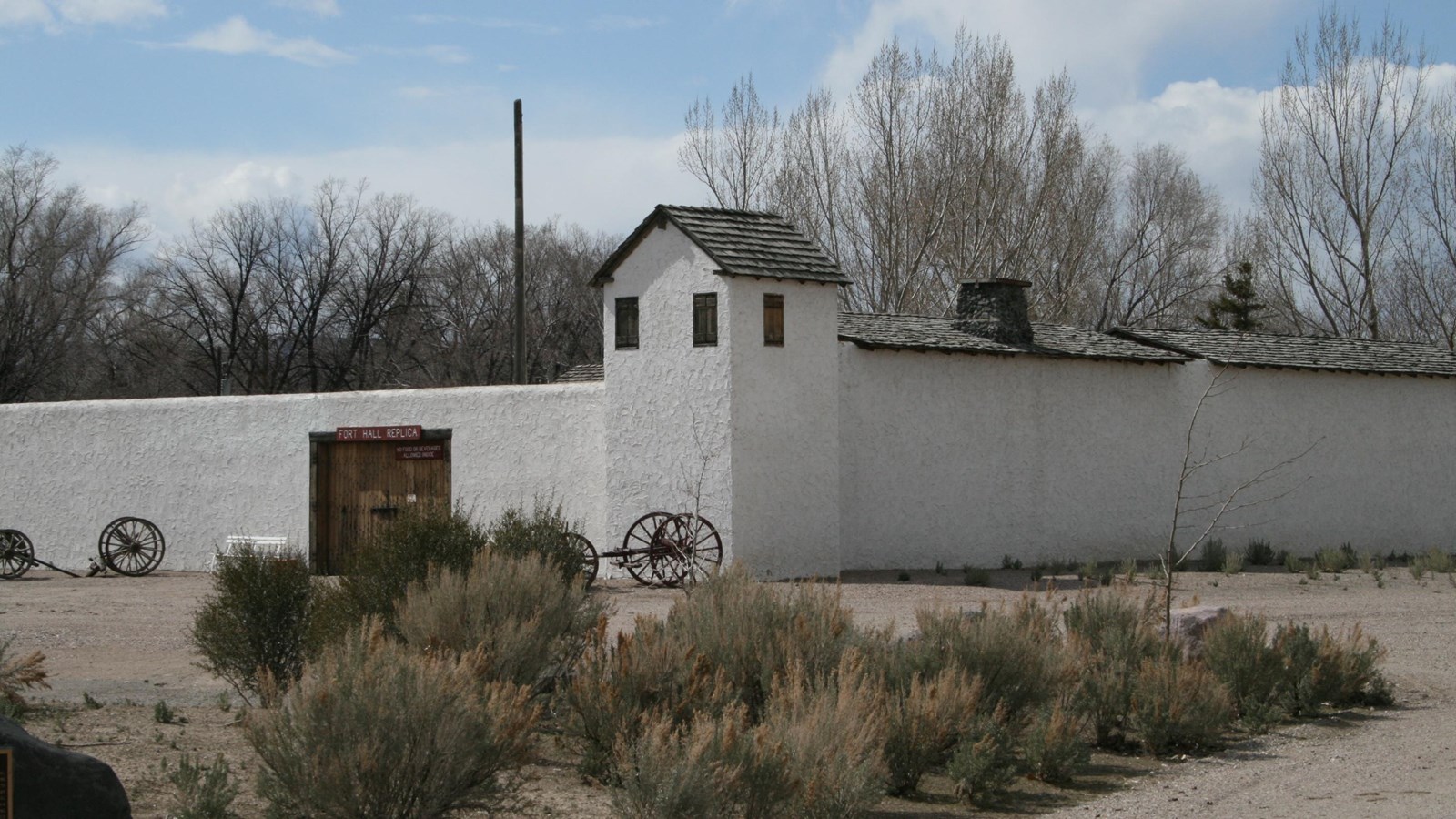
Fort Hall National Historic Landmark and Fort Hall Replica
NPS Photo
Quick Facts
Location:
Fort Hall National Historic Landmark is located on the Fort Hall Indian Reservation, 11 miles west of Fort Hall, Idaho. Fort Hall Replica is part of the Bannock County Historical Complex, accessed via 3000 Avenue of the Chiefs, Pocatello, Idaho. GPS 42.843936843819, -112.41952768519
Significance:
Fort Hall (1834-1856) was an important center of the Rocky Mountain fur trade and a heavily used camping and trading station on the Oregon-California Trail. A historically accurate reconstruction of the fort in present-day Pocatello, Idaho, educates visitors about Fort Hall’s significance in the history of the American West.
Designation:
Historic site on the Oregon and California National Historic Trails.
Amenities
14 listed
Benches/Seating, Cellular Signal, Gifts/Souvenirs/Books, Historical/Interpretive Information/Exhibits, Information - Ranger/Staff Member Present, Parking - Auto, Parking - Bus/RV, Picnic Table, Playground, Restroom, Restroom - Accessible, Scenic View/Photo Spot, Water - Drinking/Potable, Wheelchair Accessible
Fort Hall, built beside the Snake River by New England businessman Nathaniel Wyeth in 1834, was the first permanent American trading post between the Rocky Mountains and the Pacific Coast. Hardball business tactics by fur trade rival Hudson’s Bay Company (HBC) forced Wyeth to sell the post to the powerful British-owned corporation just 3 years later.
HBC encased Wyeth’s cottonwood-pole post within adobe walls, the model for the modern reconstruction of Fort Hall, and appointed the kindly Scottish trader Captain Richard Grant to manage it. Fort Hall prospered under Grant’s leadership, thanks largely to a growing stream of emigrants on the Oregon-California Trail. As the beaver-pelt trade collapsed in the early 1840s, emigrant travel quickly replaced trapping as the fort’s primary source of business. Americans regarded Grant fondly for his honesty and generosity, and their purchases of supplies and services helped sustain Fort Hall for another 15 years.
The fort became an important rest and resupply stop along the trail. Emigrants camped nearby while resting livestock, repairing wagons and equipment, and purchasing expensive provisions shipped from Fort Astoria on the Oregon Coast. Camping conditions on the buggy, boggy river bottoms around the post could be miserable:
We camped four miles from the fort [Hall] amongst a million of mosquitos they would not let you rest a moment and after swallowing a cup of tea and about fifty of them with it I bundled up head and ears and let them sing me to sleep.
--Joseph Hackney, 1849
Mosquitos were as thick as flakes in a snowstorm. The poor horses whinnied all night, from their bites, and in the morning blood was streaming down their sides.
--Margaret Frink, 1850
The opening of the Hudspeth Cutoff in mid-1849 diverted much California gold rush traffic away from Fort Hall, but summer business remained steady. The costs of shipping supplies from Fort Astoria and increasing conflict with local Shoshone and Bannock groups led HBC to close the post in 1856. The fort's adobe walls, damaged by repeated floods, fell to ruin until the river swept away the last remains in 1863. Emigrants continued to camp among the abandoned buildings until floods swept away the last remains in 1863.
Today, the original site is a National Historic Landmark, an empty field with a stone monument to commemorate Fort Hall’s historical significance. Located within the Fort Hall Indian Reservation, the site lies on lands that are home to the Shoshone-Bannock Tribes, whose ancestors once traded at the fort. It is not open to public visitation.
The Fort Hall Replica, about 16 miles southeast of the original site, was constructed with public donations between 1963 and 1967 as part of Idaho’s Territorial Centennial celebration. At the request of the Shoshone-Bannock Tribes, it was built outside reservation boundaries rather than at the original location. Reconstructed from original HBC floor plans, the replica can be visited today at the Bannock County Historical Complex in Pocatello.
Site Information
Location (Fort Hall National Historic Landmark is located on the Fort Hall Indian Reservation, 11 miles west of Fort Hall, Idaho. Fort Hall Replica is part of the Bannock County Historical Complex, accessed via 3000 Avenue of the Chiefs, Pocatello, Idaho. GPS 42.843936843819, -112.41952768519)