



Last updated: May 14, 2026
Place
Exchange Hotel Site (La Fonda)
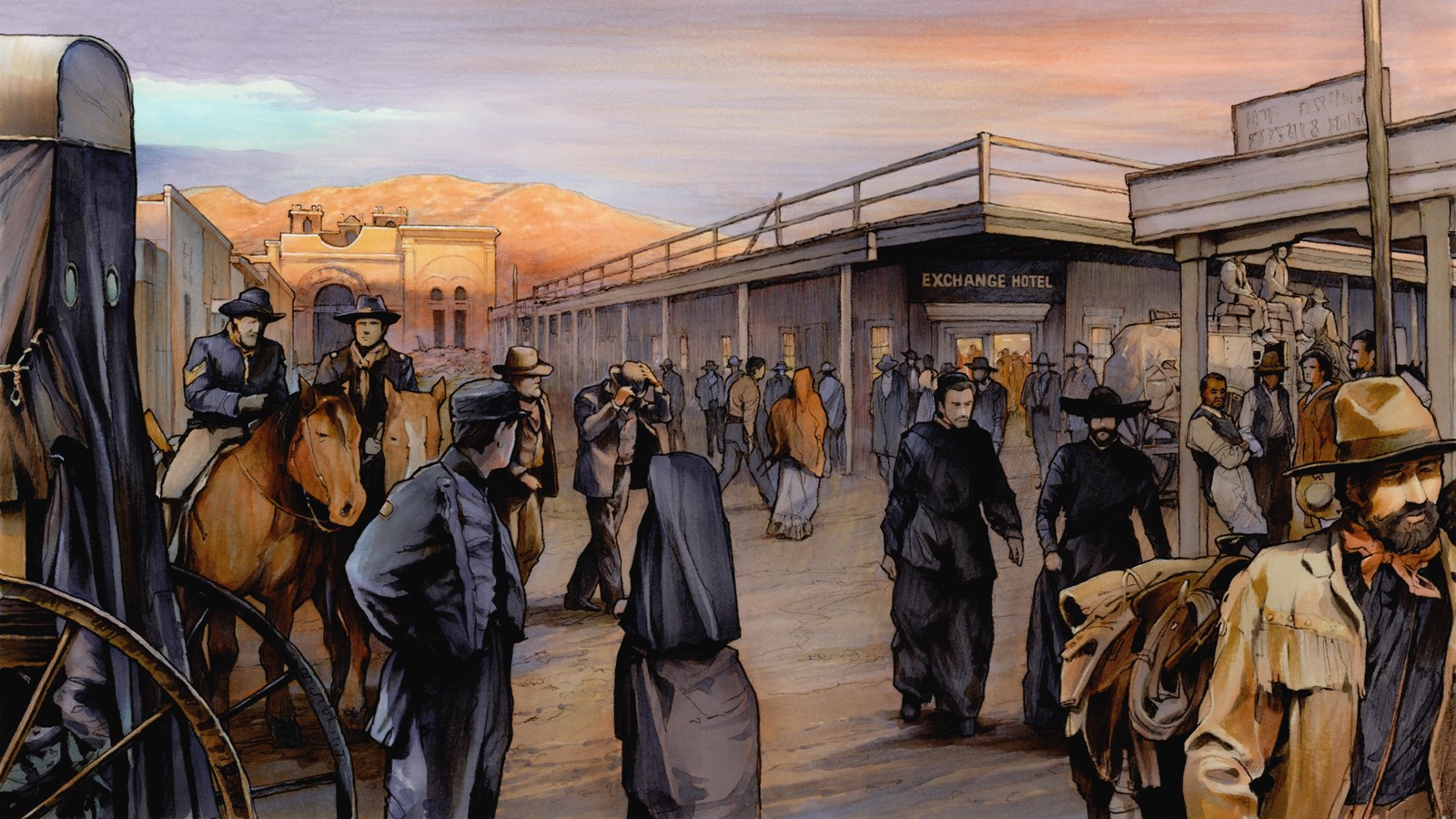
NPS Image/Bruce MacPherson
Quick Facts
Location:
100 E San Francisco St., Santa Fe, New Mexico.
Significance:
William and Mary Dodson Donoho, who crossed the Santa Fe Trail from Missouri, operated an inn here.
Designation:
Historic site on the Santa Fe, Old Spanish, and El Camino Real de Tierra Adentro NHTs.
MANAGED BY:
Amenities
1 listed
Historical/Interpretive Information/Exhibits
There has been a fonda—an inn of some type—on the southeast corner of Santa Fe Plaza for a very long time. The earliest establishments, possibly dating as far back as the 1600s, may have hosted wayward French trappers, traveling bishops, and visiting Spanish officials.
In 1833, however, after the property was purchased by Mary and William Donohom of Missouri, it took on a new role. Known subsequently as “La Fonda Americana” or “The American Fonda,” the inn became a gathering place for Santa Fe Trail traders, for whom it offered a few nights rest and relaxation after the hard journey across the plains. It was also a place to blow off steam. In the well-known barroom, traders could gamble on billiards or the favorite local card game of monte. Conflicts in this environment could turn ugly, and gun violence was common.
When the Donoho’s decamped for Texas in 1837, the inn became the Santa Fe House. In 1848, following the American conquest, the building was again renamed, first as the U.S. Hotel and then, in 1851, as the Exchange Hotel. “The Exchange” soon gained notoriety as “the most noted hostelry between Denver and the City of Mexico.”1 Those known to have visited include Billy “The Kid” Bonney, Kit Carson, “Buffalo” Bill Cody, and future presidents Rutherford B. Hayes and Ulysses S. Grant.2 Countless others—trail traders, army officers, speculators, travelers, gamblers, and more—passed through its doors.
The Exchange was a prime example of New Mexico Territorial architecture, a style that emerged with the rise of the Santa Fe Trail in the 1820s. The style—featuring traditional Spanish-Pueblo adobe construction with Gothic and Greek Revival details—was a blend of practicality and Anglo aesthetics. The Exchange, for example, featured adobe walls with milled window casings, a flat roof accented by a classical cornice, and the portal porch and interior courtyard typical of New Mexican houses.
The arrival of the Atchison, Topeka, & Santa Fe Railroad in 1880 was the beginning of the end for the Exchange. Despite a renovation in 1881, newer hotels brought increasing competition that proved too much. Its ultimate destruction, in 1919, came courtesy of a WWI victory bond rally. For every $100 bond purchased, a small tank known as “The Mud Puppy” would knock down a portion of the old hotel’s adobe walls. What remained after the rally was little more than a pile of rubble.
Today, the same site is occupied by a new iteration of “La Fonda.” Completed in 1922, the hotel was leased to the Fred Harvey Company, and Harvey’s chief architect, the renowned Mary Colter, renovated the structure into its present form. Today, La Fonda is considered a fine example of Pueblo Revival architecture. Still in the southeast corner, it continues to operate as the only hotel on Santa Fe Plaza.
Site Information
Location (100 E San Francisco St., Santa Fe, New Mexico.)
More Site Information
El Camino Real de Tierra Adentro National Historic Trail
Old Spanish National Historic Trail
Santa Fe National Historic Trail
El Camino Real de Tierra Adentro, Old Spanish Trail, Santa Fe Trail: Santa Fe, New Mexico Itinerary
Santa Fe is the oldest capital city in the US, founded in 1610, and the highest in elevation at 7,000 ft. The city is the historic hub of the southwest, connecting three national historic trails: El Camino Real de Tierra Adentro, the Santa Fe Trail, and the Old Spanish Trail. This tour leads your from the busy plaza and other major tourist locations to lesser known sites along quiet, old Santa Fe streets.