



Last updated: April 9, 2026
Place
Rio Grande Overlook at Arroyo San Francisco
Photo/Birding Hotspots
Quick Facts
Location:
Off of Highway 83
Significance:
Expansive view of the Rio Grande River provides the backdrop to a discussion of the nations that claimed Texas as theirs and how the river was then an obstacle but today it is an international border.
MANAGED BY:
Texas Department of Transportation
Amenities
2 listed
Historical/Interpretive Information/Exhibits, Picnic Shelter/Pavilion
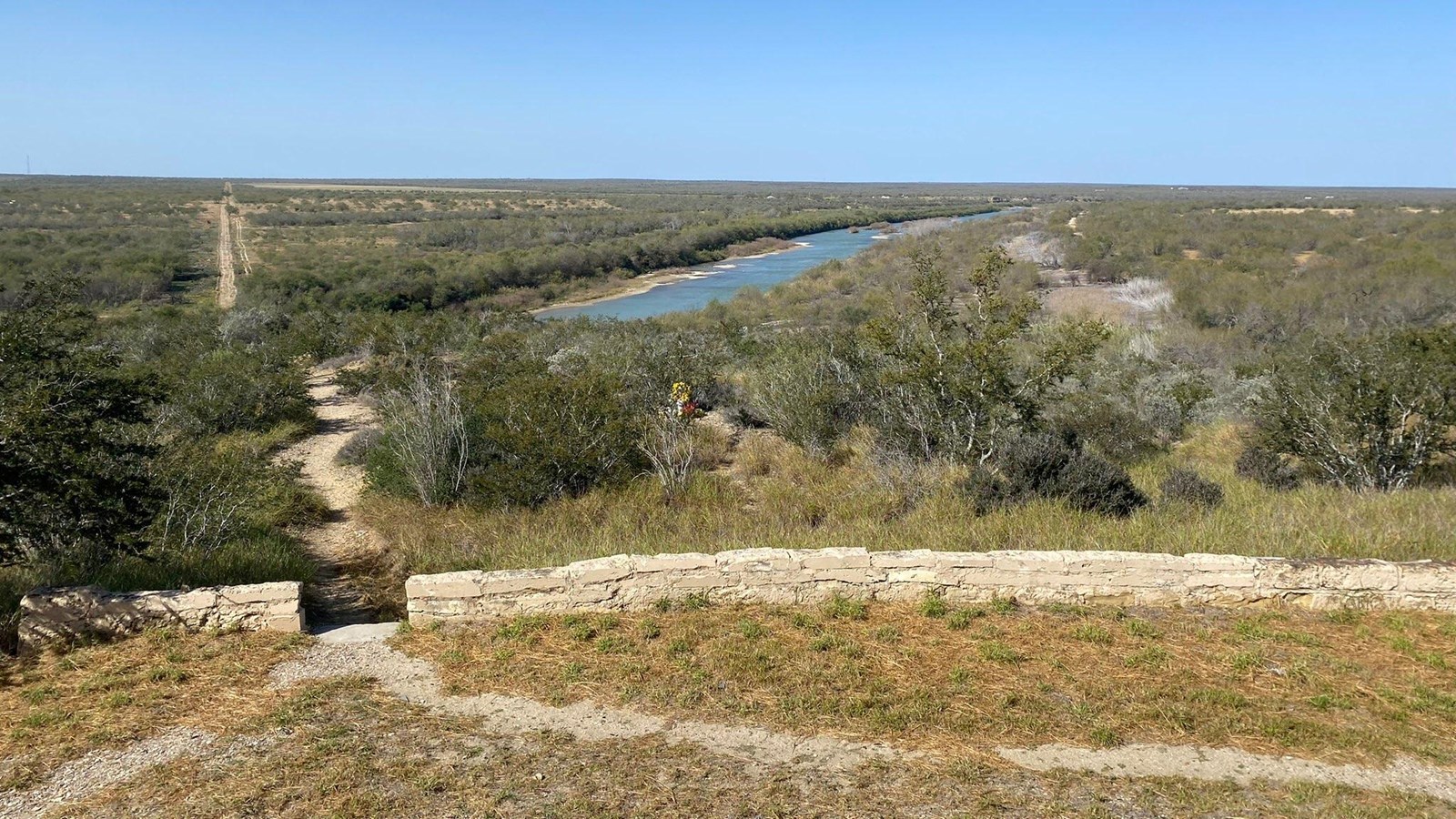
Along El Camino Real de los Tejas, just north of the U.S.-Mexico border, sits the Drexel Rio Grande Overlook at Arroyo San Francisco. Located hundreds of feet above the Rio Grande in Zapata County, the overlook offers visitors the chance to consider the river’s history as they take in expansive views of the surrounding country. Long before the river became the international boundary between the United States and Mexico, this portion of the Rio Grande was both a hindrance and a resource for travelers along El Camino Real.[1]
For thousands of years, Indigenous groups lived along the banks of the Rio Grande. The river provided a source of water, fish, and edible plants – resources which helped sustain the communities that grew up around it.[2] Historians continue to study the area’s Indigenous inhabitants, but the vague terminology used in firsthand accounts complicates the task. Spaniards used the term “Coahuiltecan” to refer to all the Indigenous people who lived in south Texas and northeastern Mexico, making it difficult to identify the numerous Indigenous peoples who called the region home. Today, researchers understand that the earliest people in the area spoke a variety of languages, including Coahuiltecan dialects, Comecrudo, Cotoname, Aranama, Solano, and Sanan.[3]
The arrival of Spanish soldiers, missionaries, officials, and settlers, along with bands of Apache and Comanche from the north, forced many Coahuiltecan bands into missions or out of the region entirely. As the area around the Drexel Rio Grande Overlook became part of the expanding Spanish Empire, traffic on the camino increased.[4] Ranchos and missions grew, and new settlements were established near the Drexel Rio Grande overlook. The Spanish Crown gave land grants to ranchers such as José Vázquez Borrego, who in 1750 founded Nuestra Señora de los Dolores Hacienda, considered by some to be the first Spanish colonial settlement on the north bank of the Rio Grande.[5] After experiencing widespread Indigenous resistance in 1818, however, the settlers abandoned Hacienda Dolores. In 1830, residents of Revilla (now Nuevo Guerrero, Tamaulipas) reoccupied the site. Jesús Treviño established a fort and ranch, which grew into the town of San Ygnacio.[6] While many of the European settlers who lived near the Rio Grande raised cattle and other livestock, some became merchants, providing goods and trading with travelers passing through the area.[7]
For travelers on the camino, rivers like the Rio Grande served as both opportunities and obstacles. On the one hand, the river provided a source of water and food. On the other, fording the river could be time-consuming and treacherous, especially after heavy rainfall.[8] Travelers needed to locate appropriate crossing points to travel across safely. In 1753, José Vázquez Borrego established a ferry on the Rio Grande, serving those traveling to San Antonio and other locations in northern New Spain.[9] Over time, the addition of ferries and bridges made river crossings safer.
In 1836, Texas declared independence from Mexico, but areas around the overlook remained contested territory. Tumultuous geopolitics, Indigenous raids, and economic decline led residents of the area to declare a new nation in 1840, the Republic of the Rio Grande, with Laredo as its capital.[10] The republic failed to win international support, however, and its leaders surrendered to the Mexican government on November 6, 1840.[11] Border disputes and violence along the river continued throughout the Mexican-American War of 1846 to 1848. After the war, the Treaty of Guadalupe Hidalgo established the Rio Grande as the boundary between the United States and Mexico.[12]
Today, the Drexel Rio Grande Overlook allows visitors to take in the scenic landscape and reflect on all of those who may have used the overlook to survey the surrounding country. Visits to the overlook are self-guided and there is no wheelchair access. A nearby picnic pavilion is available for public use. Interpretive panels at the pavilion discuss the river and its connection to El Camino Real de los Tejas.
Site Information
Location (Off of Highway 83)
Expansive view of the Rio Grande River provides the backdrop to a discussion of the nations that claimed Texas as theirs and how the river was then an obstacle but today it is an international border.
Safety Considerations
El Camino Real de los Tejas National Historic Trail
[1] “Rio Grande Overlook at Arroyo San Francisco,” National Park Service, updated January 24, 2023, https://www.nps.gov/places/drexel-rio-grande-overlook.htm (accessed on December 9, 2024).
[2] “Who Were the Coahuiltecans?” Texas Beyond History, September 18, 2006, https://www.texasbeyondhistory.net/st-plains/peoples/coahuiltecans.html (accessed on October 18, 2024); “Coahuiltecan Indians,” Texas State Historical Association, September 26, 2019, https://www.tshaonline.org/handbook/entries/coahuiltecan-indians (accessed on October 17, 2024).
[3] “Who Were the Coahuiltecans?” Texas Beyond History; “Coahuiltecan Indians,” Texas State Historical Association; “Native Peoples of the South Texas Plains During Early Historic Times,” Texas Beyond History, https://www.texasbeyondhistory.net/st-plains/peoples/index.html (accessed on December 9, 2024).
[4] “Native Peoples of the South Texas Plains During Early Historic Times,” Texas Beyond History; “Rio Grande Overlook at Arroyo San Francisco,” National Park Service.
[5] John Hazelton, “Nuestra Señora de los Dolores Hacienda,” Texas State Historical Association, updated August 11, 2020, https://www.tshaonline.org/handbook/entries/nuestra-senora-de-los-dolores-hacienda (accessed on December 9, 2024); “El Camino Real de los Tejas National Historic Trail: Comprehensive Management Plan/Environmental Assessment,” National Park Service, Appendixes, September 2011, p. 182.
[6] “El Camino Real de los Tejas National Historic Trail: Comprehensive Management Plan/Environmental Assessment,” National Park Service, p. 182
[7] Alica A. Garza and Christopher Long, “Zapata County,” Texas State Historical Association, updated April 7, 2021, https://www.tshaonline.org/handbook/entries/zapata-county (accessed on December 9, 2024)
[8] Leon C. Metz, “Rio Grande,” Texas State Historical Association, updated June 13, 2020, https://www.tshaonline.org/handbook/entries/rio-grande (accessed on December 9, 2024).
[9] Alica A. Garza and Christopher Long, “Zapata County”; John Hazelton, “Nuestra Señora de los Dolores Hacienda.”
[10] David Vigness, “Republic of the Rio Grande,” Texas State Historical Society, October 1, 1995, https://www.tshaonline.org/handbook/entries/republic-of-the-rio-grande (last accessed September 19, 2024).
[11] “Republic of the Rio Grande,” Webb County Heritage Foundation, https://www.republicoftheriogrande.org/ , (last accessed October 18, 2024).
[12] “Treaty of Guadalupe Hidalgo (1848),” National Archives, https://www.archives.gov/milestone-documents/treaty-of-guadalupe-hidalgo (last accessed October 20, 2024).