



Last updated: July 25, 2026
Place
Cutler's Park
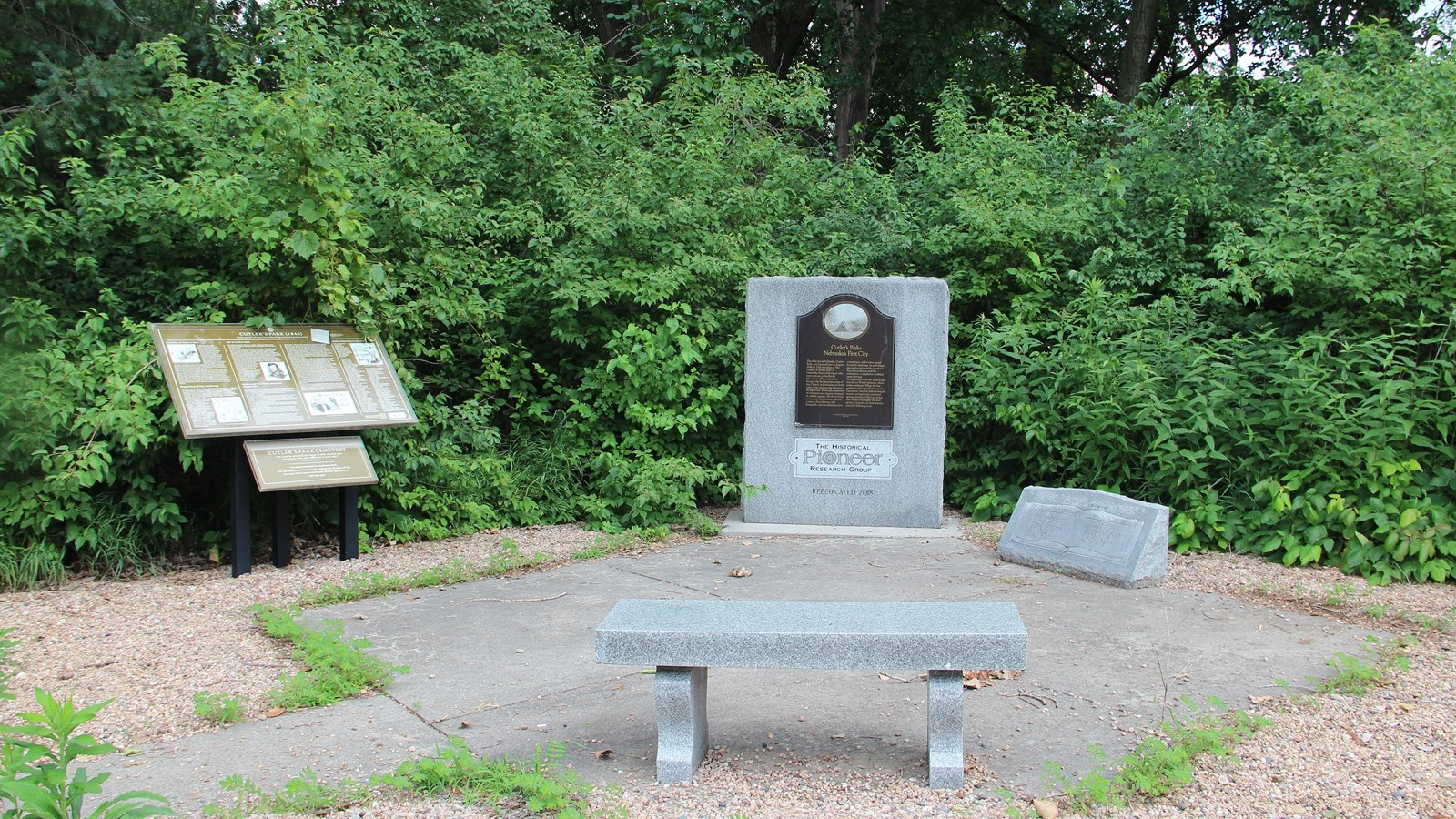
Photo/L. Kreutzer
Quick Facts
Location:
Mormon Bridge Road, north of junction with Young Street, Omaha, NE GPS 41.33258 -95.99170
Significance:
Cutler’s Park, an overwintering settlement established by Latter-day Saints in August 1846, was the first planned community in Nebraska. Due to a disagreement between the Otoe and Omaha over which tribe should be paid for use of the land, the Latter-day Saints soon abandoned the disputed area and moved to the location known as Winter Quarters.
Designation:
Historic site on the Mormon Pioneer National Historic Trail.
Amenities
4 listed
Benches/Seating, Cellular Signal, Historical/Interpretive Information/Exhibits, Parking - Auto
Latter-day Saints who reached the Missouri River under Brigham Young’s leadership in summer 1846 were in no condition to continue west that season. By Aug. 1, church leaders resolved to halt there and resume the trek the following spring. Their immediate concern was where to settle their thousands of followers for the winter: Indian lands along both sides of the river were off-limits to white settlement under the terms of the 1834 Indian Intercourse Act. But in return for mustering 500 volunteers to fight in the newly declared US war against Mexico, Young received permission from US Army Capt. James Allen to overwinter on Potawatomi lands east of the Missouri River and Omaha lands west of the river. Because Allen had no authority to grant such permission, Young negotiated extralegal agreements directly with the tribes, sent his treaties to the Office of Indian Affairs and the US president, and began settling in.
By August, thousands of emigrants had ferried to the west side. Cutler’s Park, in present-day northeast Omaha, was the first large winter encampment they established there. Cutler’s, with some 2,500 residents, was more of a town than a camp, made up of tents, wagons, and a few cabins organized along a gridwork of streets. The settlers elected a mayor and council and created police and fire departments. They constructed outdoor sod fireplaces and chimneys to divert campfire smoke, built corrals, and dug wells. But the emigrants soon found themselves at the center of a dispute between the Omaha and the Otoe over who owned the land they had built on and how much payment the Latter-day Saints owed each tribe for using it.
To avert bloodshed between the tribes, the Latter-day Saints abandoned Cutler’s Park within a month. Meanwhile, the Office of Indian Affairs affirmed permission for Young’s people to camp on Potawatomi lands on the Iowa side of the river, as that tribe already had agreed to relocate to Kansas and seemed pleased to have the Latter-day Saints nearby. However, the emigrant presence west of the river was destabilizing the tribes there and impacting the resources they needed for survival. In compliance with the Indian Intercourse Act, Indian Affairs ordered the Latter-day Saints to leave that area. The ruling put Young in a difficult position. He could not move his people farther west at this time, nor could he agree to haul thousands of men, women, and children with their wagons and livestock back over to the Potawatomi side of the river to start building anew. Instead, while continuing to argue their case in Washington, D.C., the emigrants moved several miles east of Cutler’s Park to develop Winter Quarters, under agreement with the Omaha Tribe.
Today, monuments at a roadside park in north Omaha commemorate the short-lived settlement of Cutler’s Park. Nearby at the Omaha School for Boys is a marker for more than 70 Latter-day Saints who were buried there in August-November 1846. It may be visited only by permission.
Site Information
Location ( Mormon Bridge Road, north of junction with Young Street, Omaha, NE GPS 41.33258 -95.99170)