



Last updated: May 5, 2026
Place
Conner Swale Site - Ranchería Grande
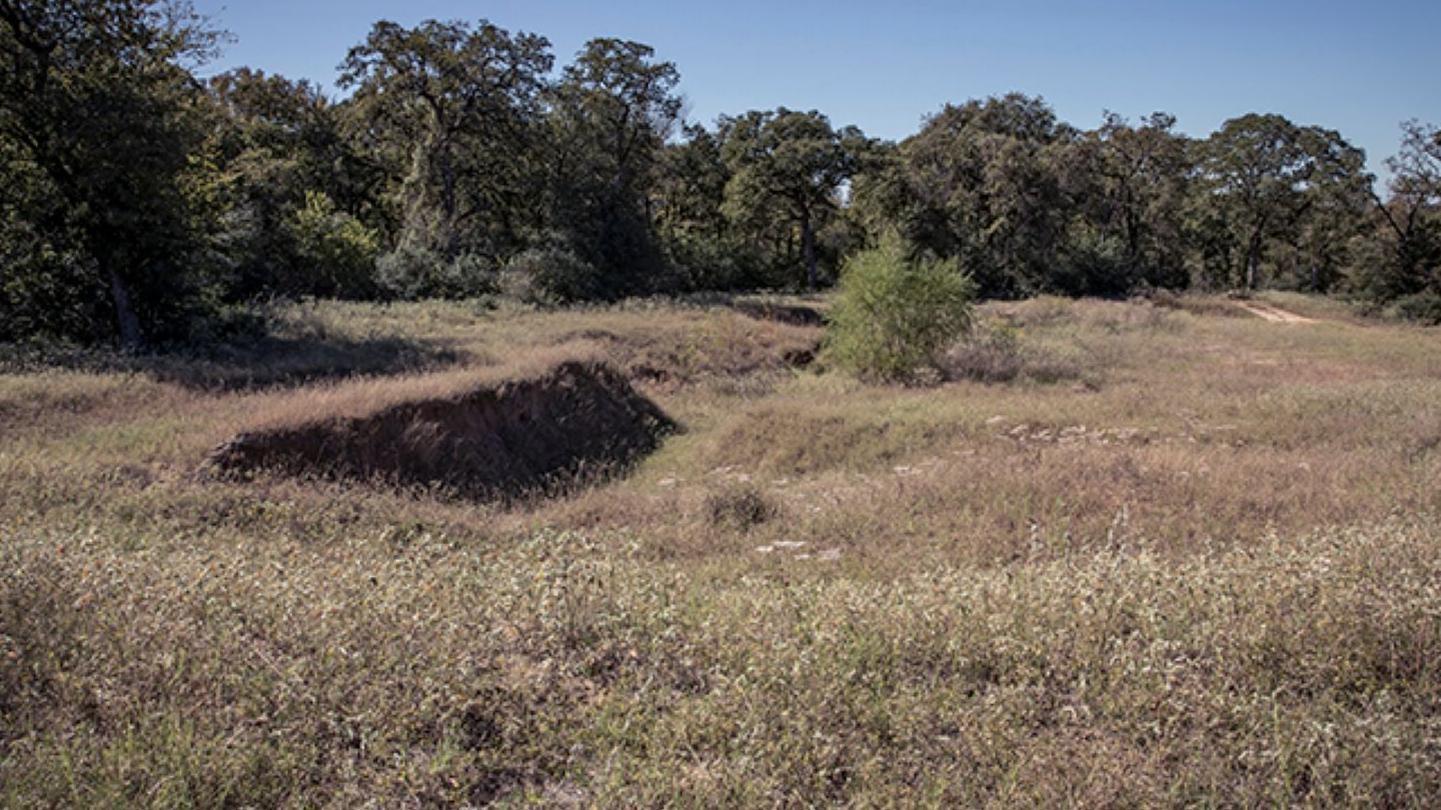
Photo/Patrick Hughey/Texas Historical Commission
Quick Facts
Location:
On private property near Gause, Milam County, Texas.
Significance:
Located near the important trading center of Rancheria Grande, the Conner Swales illustrate historical travel patterns along El Camino Real de los Tejas.
Designation:
Certified Site on El Camino Real de los Tejas NHT.
OPEN TO PUBLIC:
No
MANAGED BY:
Amenities
1 listed
Historical/Interpretive Information/Exhibits
Years of human travel by foot, horse, or cart slowly carve grooves into the earth known as swales. Over time, these depressions can become obscured by natural vegetation and overgrowth, inadvertently hiding years of history. Unearthing a new swale can be crucial to understanding where and when migration took place. In 2016, such a historic swale of El Camino Real de los Tejas was discovered on the Conner Ranch in Milam County, Texas. Stretching for hundreds of feet, the so-named Conner Swale matches the trail line found in other El Camino Real sites in the area.[1]
The ruts at Conner Swales lead to a place that Spaniards who entered East Texas in the late 17th century referred to as Ranchería Grande, or “Big Village.” Native Americans lived, traded, and traveled along the Brazos River at this site. Recently discovered archaeological remnants are nearly 10,000 years old.[2] A host of twenty-two different nations congregated seasonally in this community near present-day Cameron, Texas, to farm, trade, and raise families. The Ervipiame were the largest nation Ranchería Grande. Initial Spanish contact with this diverse community was not entirely peaceful. In a travel diary of Diego Ramón from 1707, the Spanish military officer notes that he carried out a punitive campaign against Ranchería Grande in retaliation for hostilities between Native Americans and Spanish missionaries along the Rio Grande. Ramón again raided the community in 1716 to capture apostates who had fled from Mission San Juan Bautista, where Ramón was stationed as a military commander. During this campaign, Ramón estimated that Ranchería Grande was home to over 2,000 people.
[3]Relations improved between the Spanish government and the people of Ranchería Grande in 1721 when Juan Rodriguez, an Ervipiame leader, joined the eastward expedition of the Marquis de Aguayo as a translator and guide. Rodriguez had traveled to San Antonio to request a mission for his people. In payment for his service to the expedition, Aguayo honored his request and built the mission of San Xavier de Nájera in 1722 on the outskirts of San Antonio.[4] The people of Ranchería Grande, however, resisted the missionaries’ efforts, and the community quickly became a haven for Native peoples fleeing the missions at San Antonio. Missionary Miguel de Paredes described the situation in 1729: "Not only do they impede new conversions, but they also destroy the reductions already established. . . . At present, Most Excellent Sir, since these Indians of the missions know that they have an open door, asylum, and protection in the Ranchería Grande, their flights have reached such an extreme that if their disorders are reprimanded or punished the least little bit, whether by the chiefs or by the missionaries, or if there should be any extraordinary labor—and many times without other cause than to seek their liberty—they flee to the said ranchería."[5]
By 1745, as missions continued to divert the region’s resources towards their own growth and Apache raids continued to threaten the community, the peoples of Ranchería Grande left their historic home near Sugarloaf Mountain. Bustillo y Zavallos, the Spanish governor of Texas from 1732 to 1734, noted that “there remained in my time only the name [Ranchería Grande], for their abode being the Monte Grande, they had already, because of their diminutive forces, retired to live in the distance.”[6] Over the next century, the Ervipiame joined with other local Native American groups, notably the Tonkawa, who hold Red Mountain (also known as Sugarloaf Mountain) in reverence as the site of their creation. This intermixed tribe, known now only as the Tonkawa, was forcibly removed from their ancestral lands by the United States government in the mid-1800s. Texas governor J.W. Throckmorton lobbied the Department of Indian Affairs in 1866 to return land near the sacred mountain back to the Tonkawa, but the government never granted this request. In December of 2023, however, the Tonkawa reclaimed their ancestral home after tribal leaders purchased 60 acres of land including Red or Sugarloaf Mountain. The El Camino Real de los Tejas National Historic Trail Association currently manages the property with hopes of eventually opening a museum on Tonkawa history.[7]
Visitors to the area today can arrange a guided tour of the former Ranchería Grande site. However, the Conner Swales remain on private property.
Site Information
Location/Access (this site is not open to the public)
More Site Information
Exhibit with Audio Description Available
Baumann Family Village Sites - Ranchería Grande
El Camino Real de los Tejas National Historic Trail
[1] “Association’s Rancheria Grande Archaeological Project,” El Camino Real de Los Tejas National Historic Trail Association, December 4, 2017, https://www.elcaminorealdelostejas.org/associations-rancheria-grande-archaeological-project/
[2] Andy Rhodes, “Rancheria Grande,” Texas Historical Commission, March 9, 2018, https://web.archive.org/web/20230925022436/https://www.thc.texas.gov/blog/rancheria-grande, accessed snapshot of September 25, 2023.
[3] Herbert E. Bolton, "The Founding of the Missions on the San Gabriel River, 1745-1749," The Southwestern Historical Quarterly, April, 1914, Vol. 17, No. 4 (Apr., 1914), p. 330.
[4] Robert S. Weddle, “Rancheria Grande,” Handbook of Texas Online, accessed December 04, 2023, https://www.tshaonline.org/handbook/entries/rancheria-grande.
[5] Bolton, "The Founding of the Missions," 331.
[6] Ibid.
[7] Michael Barnes, “Sugarloaf Mountain sold back to Tonkawa tribe after 140 years,” Austin American Statesman, December 28, 2023, https://www.statesman.com/story/news/history/2023/12/28/tonkawa-tribe-central-texas-sacred-sugarloaf-mountain-native-americans-herzog-milam-county/71903887007/