



Last updated: July 25, 2026
Place
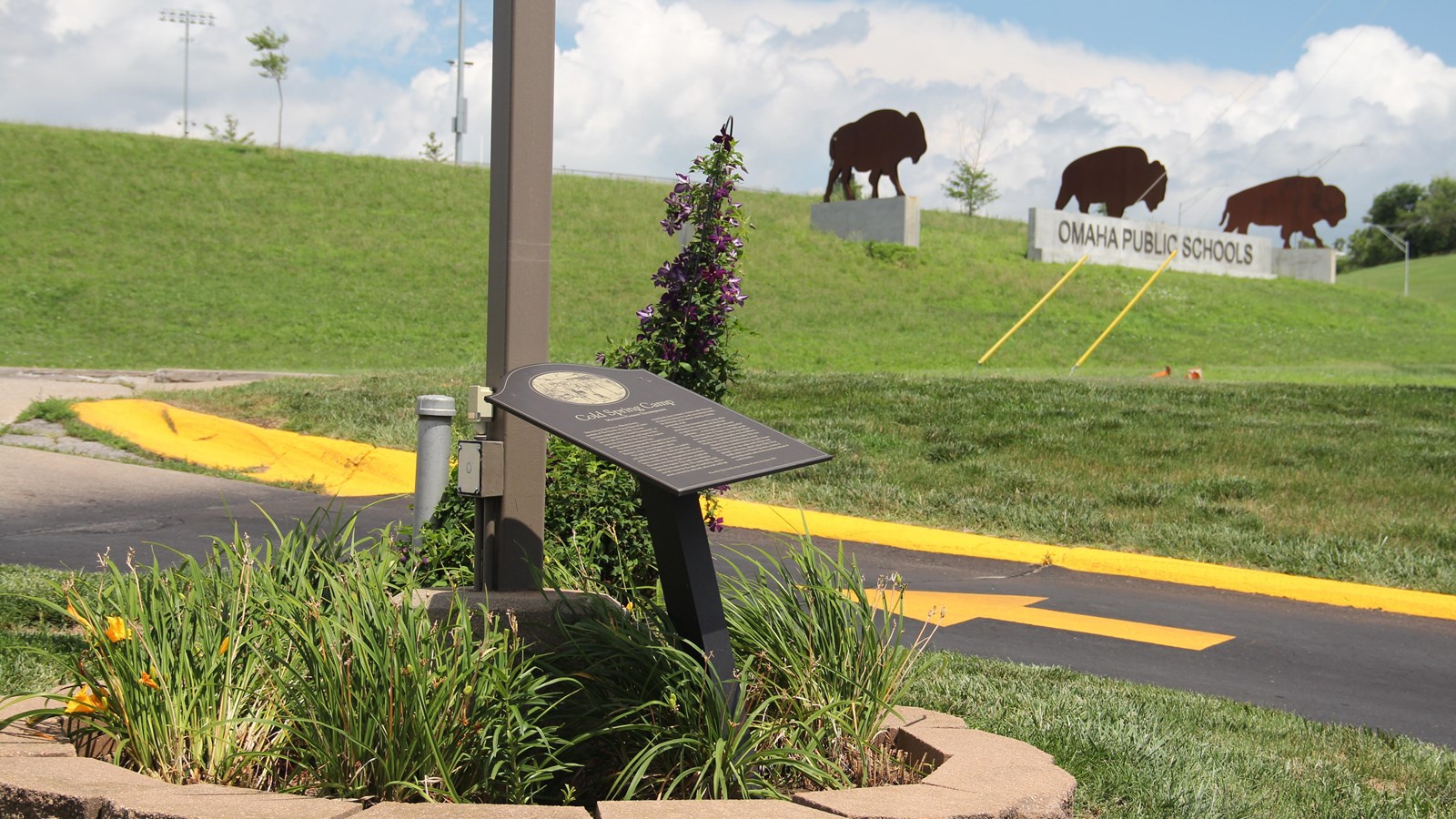
Cold Spring Camp
Photo/L. Kreutzer
Quick Facts
Location:
NW corner 60th St. and L St., Omaha, in circular median in hotel parking lot GPS 41.213018 -96.004952
Significance:
Emigrating Latter-day Saints established Cold Spring Camp on July 1, 1846, as a staging area for organizing the wagons to continue to Grand Island, Nebraska. However, they abandoned Cold Spring on Aug. 6 and moved to a new site, Cutler’s Park, to overwinter at the Missouri River.
Designation:
Historic site on the Mormon Pioneer National Historic Trail.
OPEN TO PUBLIC:
No
MANAGED BY:
Multiple, private.
Amenities
2 listed
Historical/Interpretive Information/Exhibits, Parking - Auto
Once the Middle Mormon Ferry (“First Ferry”) was completed on July 1, 1846, an advance group of Latter-day Saints families crossed the Missouri River and established camp at a large, cold-water spring, which they called Cold Spring Camp. Historians disagree on the camp’s location, but a historical marker places it near present 61st and L streets in Omaha. There the emigrants expected to begin organizing wagons to continue to Grand Island, Nebraska, which was Brigham Young’s goal for that summer. However, thousands of refugees from Nauvoo still lagged across the prairie between the Mississippi and Missouri rivers, and church leaders worried about leaving them so far behind. In addition, many of the emigrants who had reached the Council Bluffs area were ill and destitute, in need of provisions.
The leaders gathered and prayed for discernment in deciding what to do. Meanwhile, families continued crossing the river until some 2,000 people were encamped around the spring. Patty Sessions, traveling on July 7, described waiting with her wagon near the west bank of the Missouri River while men improved the wagon road to the camp. Once it was opened, she wrote, “I drove the cows part of the way and then drove a team where the bushes were higher than the wagon. The road only wide enough for the wagon to pass and as thick as they could stand. . . .no air could circulate and I sometimes felt as though I should melt but thank the Lord he carried us safe through.”
Another who joined the camp was Thomas Kane, a well-connected, non-Mormon friend who supported and aided the emigrants. He described Cold Spring Camp in detail: “It was situated upon some finely rounded hills that encircle a favorite cool spring. On each of these a square was marked out; and the wagons as they arrived took their positions along its four sides in double rows, so as to leave a roomy street or passageway between them. The tents were disposed also in rows, at intervals between the wagons. The cattle were folded in high-fenced yards outside.” By Aug. 1, church leaders had decided to overwinter in the Missouri River Valley instead of moving farther west that seasons. Scouts identified a suitable site 9 miles north, and on Aug. 6 the emigrants packed up their wagons and began leaving Cold Spring Camp, just 5 weeks after its establishment.
No visible evidence of the camp remains: the large, cold spring has been capped and piped underground, and Thomas Kane’s “finely rounded hills” were leveled during 20th century development of the area.
Site Information
Location (NW corner 60th St. and L St., Omaha, in circular median in hotel parking lot GPS 41.213018 -96.004952)