



Last updated: June 2, 2026
Place
Chariton River Crossing
NPS
Quick Facts
Location:
27601-27999 269th Ave., 0.3 mile East of 582nd St., Exline, Iowa 52555.
Significance:
On March 22, 1846, the Mormon vanguard company made a difficult crossing of the Chariton River, then struggled up a long, muddy, ridge to establish Chariton Camp. During the stay, Brigham Young imposed a hierarchical organizational scheme on the wagon company to ensure travel order during the remainder of the trip.
Designation:
Historic site on the Mormon Pioneer NHT.
MANAGED BY:
State of Iowa and private owner
Amenities
5 listed
Benches/Seating, Historical/Interpretive Information/Exhibits, Parking - Auto, Scenic View/Photo Spot, Trailhead
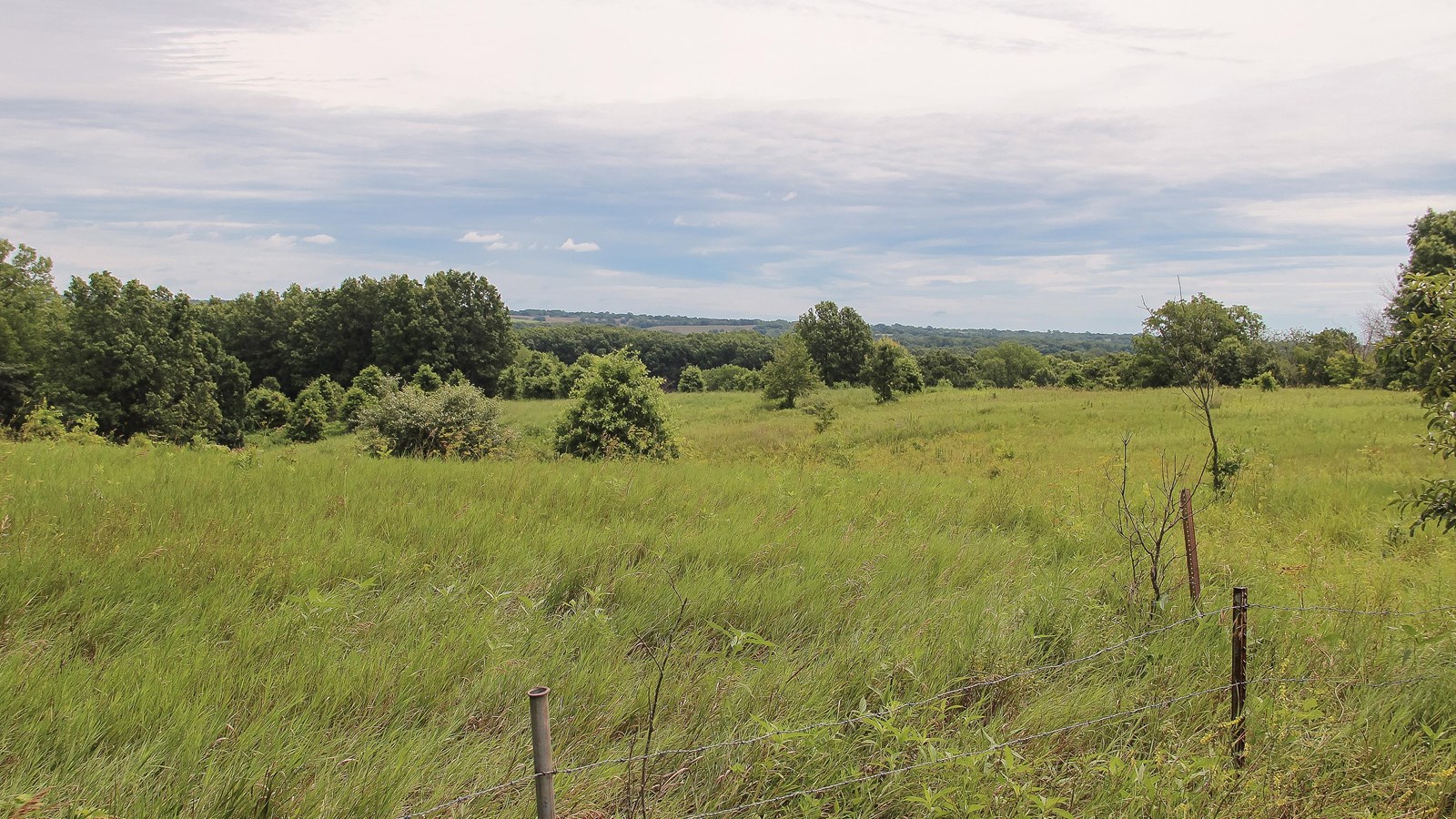
While crossing Iowa, some wagons became separated from the Mormon vanguard party and began camping apart. On March 22, 1846, the main body forded the Chariton River, a difficult crossing that required men to use ropes to lower the wagons down the steep riverbank. Once across the swift, 20-yard channel, the men used ropes to help haul the wagons up the opposite bank. The draft animals and wagons next struggled across flooded, boggy lowlands and up a steep, muddy ridge. Realizing that the rest of the day would be occupied by getting all 300 wagons to the ridgetop, the company encamped there, about a half-mile south of the river. Camp chronicler William Clayton wrote in his journal that evening, “I spent the day helping the teams till I was so sore and tired I could scarcely walk.”
The wagons stayed at the Chariton Camp, spread across nearly a mile of ridgetop, for 9 days as the emigrants waited for the rain to stop. Orson Pratt wrote on March 22, 1846,
“The heavy rains had rendered the praires [sic] impassable; and our several camps were very much separated from each other.….The heavy rains and snows, together with frosty nights, rendered our situation very uncomfortable.”
According to one chronicler, “seas of mud” churned by the hooves of livestock lay between the wagons and sagging tents. The company had been on the road from Nauvoo for three weeks and traveled about 100 miles, a distance that under favorable conditions could be covered by ox-drawn wagons in five days. They had averaged only 3 to 4 miles a day since departing Sugar Creek. During the delay at Chariton Camp, Brigham Young called in the outlying wagons and organized the emigrants into three companies of 100 families each. These were sub-divided into fifties and then tens, with each unit led by a captain tasked to maintain travel order. The wagons departed camp on April 1.
To reach the Chariton Camp area, today’s travelers drive 296th Avenue up an undulating ridge. A turnout with a National Park Service interpretive wayside exhibit lies on the north side of 269th Avenue, opposite a farm driveway. The Mormon wagons approached this area from the northeast and camped on both sides of the road. The site landowner has provided a path, which is not regularly maintained, to the river crossing site. Today, maps show the crossing as being on Pigeon Creek. This was the path of the Chariton River before it was channelized in the early 1900s.
Site Information
Location (27601-27999 269th Ave., 0.3 mile East of 582nd St., Exline, Iowa 52555.)