



Last updated: December 22, 2025
Place
Philip Sheridan Memorial
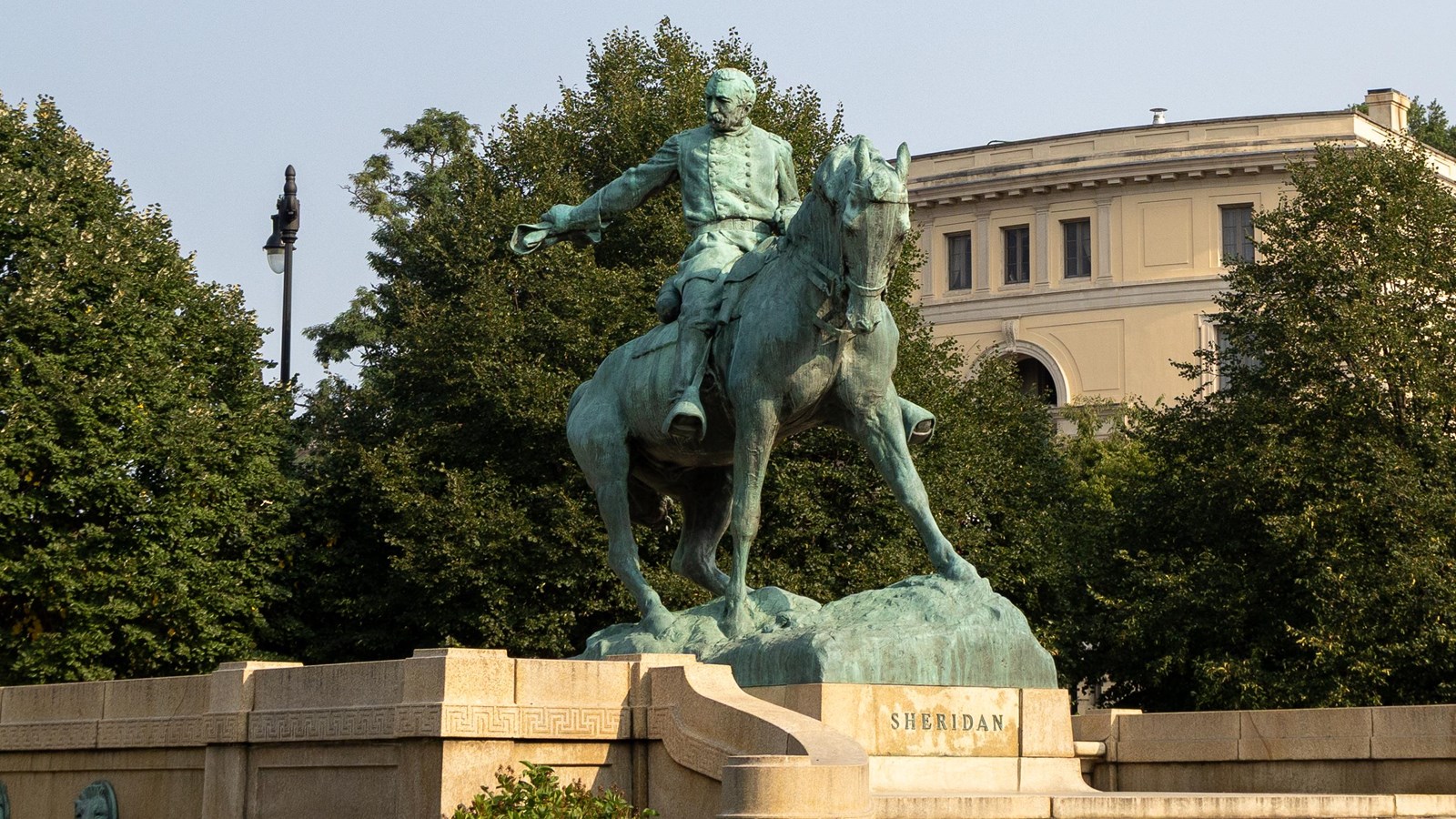
National Park Service photo by Kelsey Graczyk
Quick Facts
Location:
Washington, DC
Significance:
Civil War General
Amenities
1 listed
Historical/Interpretive Information/Exhibits
Philip Henry Sheridan (1831–1888) was one of the most influential Union commanders of the American Civil War. Born near Albany, New York, and raised largely in Ohio, Sheridan graduated from the U.S. Military Academy at West Point in 1853 and served on frontier duty before the outbreak of war. Rising rapidly through the ranks, he gained national prominence for his aggressive leadership of Union cavalry and infantry. In 1864, as commander of Union forces in Virginia’s Shenandoah Valley, Sheridan led a decisive campaign that defeated Confederate armies and destroyed their ability to use the fertile region to support the Southern war effort. His forces later played a critical role in cutting off General Robert E. Lee’s retreat, contributing directly to Lee’s surrender at Appomattox Court House in April 1865. After the war, Sheridan continued his military career during Reconstruction and on the western frontier, ultimately becoming Commanding General of the U.S. Army in 1883. He was promoted to General of the Army in 1888, shortly before his death, and is buried at Arlington National Cemetery.
The Philip Sheridan Memorial in Washington, D.C., honors this prominent military career with a dramatic equestrian statue located at the center of Sheridan Circle, where Massachusetts Avenue, 23rd Street, and R Street NW intersect. The bronze sculpture was created by American artist Gutzon Borglum, who would later achieve international fame for designing Mount Rushmore. Dedicated on November 25, 1908, the memorial depicts Sheridan on horseback in dynamic motion, hat raised and arm extended, conveying energy, command, and confidence. The statue stands on a granite base set within a landscaped plaza that originally included decorative bronze lion-head fountain spouts.
The memorial was commissioned by the Society of the Army of the Shenandoah, composed largely of Sheridan’s former soldiers. Although sculptor John Quincy Adams Ward was initially selected, his unfinished work was ultimately replaced by Borglum’s design, which was approved by Sheridan’s widow. The dedication ceremony was a major civic event attended by President Theodore Roosevelt, senior government officials, military leaders, veterans, and members of Sheridan’s family.
Today, the Philip Sheridan Memorial remains a striking example of early 20th-century commemorative art in the nation’s capital and is one of Washington’s Civil War monuments collectively listed on the National Register of Historic Places.