



Last updated: December 3, 2025
Place
Benjamin Banneker Park
National Park Service photo by Nathan Adams
Quick Facts
Location:
Washington, DC
Amenities
2 listed
Historical/Interpretive Information/Exhibits, Wheelchair Accessible
Benjamin Banneker Park in Washington, D.C., honors the remarkable life of Benjamin Banneker—astronomer, mathematician, surveyor, and one of the most accomplished free African Americans of the 18th century. Born in 1731 in Maryland, Banneker was largely self-taught. He gained early recognition for constructing a wooden clock that kept accurate time for decades, and later for publishing a series of almanacs that showcased his astronomical calculations and weather predictions. In 1791, he was recruited by Major Andrew Ellicott to assist in surveying the boundaries of the new federal capital. Banneker’s careful observations helped ensure the project’s success and linked him permanently to the early history of Washington, D.C.
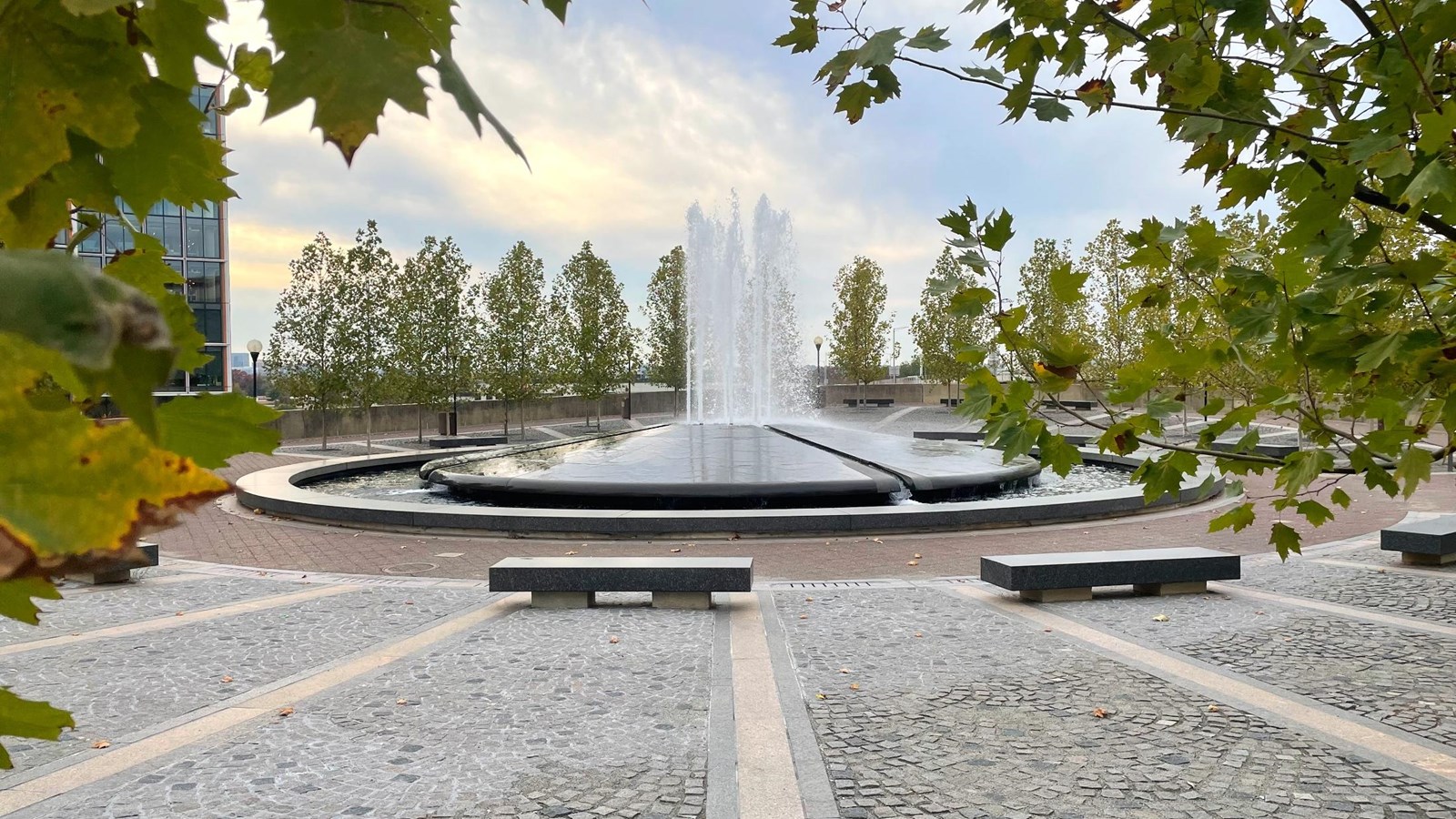
Benjamin Banneker Park occupies a prominent location at the south end of L’Enfant Promenade, overlooking the Washington Channel and forming a key connection between the Southwest Waterfront and the National Mall. The site was originally developed in the 1960s and 1970s as part of the urban renewal of Southwest D.C. Designed by landscape architect Dan Kiley, the park featured a circular plaza, terraced walls, fountains, and sweeping views of the waterfront. Intended as a dramatic gateway to the city, it also served as a central node in the monumental axis leading north toward the U.S. Capitol.
Despite its striking geometry, the park struggled with access and visibility, becoming underused over time as surrounding transportation and development patterns changed. Nonetheless, it retained its symbolic importance, particularly after it was officially named for Benjamin Banneker in 1970 to honor his contributions to the creation of the capital.
In recent years, Banneker Park has been incorporated into the larger redevelopment of the Southwest Waterfront, including The Wharf. Improvements have focused on better pedestrian access, updated landscaping, and integration with nearby public spaces. Today, the park serves as both a scenic overlook and an urban gathering spot, offering views toward the Washington Channel and a direct pathway linking the waterfront with the heart of the city.
Benjamin Banneker Park remains a meaningful tribute to a pioneering American whose scientific achievements and role in surveying the capital helped shape the landscape of Washington, D.C.