



Last updated: January 4, 2026
Person
Rutherford B. Hayes
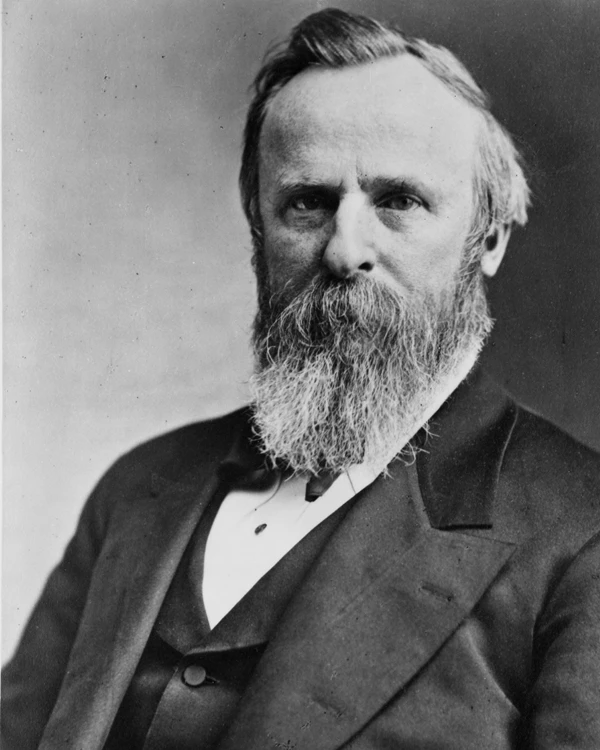
Library of Congress
Quick Facts
Significance:
19th President of the United States
Place of Birth:
Delaware, Ohio
Date of Birth:
October 4, 1822
Place of Death:
Fremont, Ohio
Date of Death:
January 17, 1893
Place of Burial:
Fremont, Ohio
Cemetery Name:
Spiegel Grove
As the 19th President of the United States (1877-1881), Rutherford B. Hayes oversaw the end of Reconstruction, began the efforts that led to civil service reform, and attempted to reconcile leftover tensions from the Civil War. Hayes fought in the war, commanding a US division during the Battle of Cedar Creek. He also held political office as Governor of Ohio and as a member of the House of Representatives.
Law & Politics
After attending school in Ohio and Connecticut, Hayes entered Harvard Law School in 1843. Upon graduation he returned to Ohio to open a law office. In 1850 he moved to Cincinnati, working as a criminal defense attorney. His clients were often formerly enslaved freedom seekers who escaped across the Ohio River from Kentucky. Hayes fought a legal battle against the Fugitive Slave Act of 1850. This abolitionist work made him a rising political star in the newly formed Republican Party. In 1859 he was elected the City Solicitor of Cincinnati.
Civil War
In June of 1861 Hayes was commissioned a major in 23rd Ohio Volunteer Infantry by Ohio's governor. Another future president, William McKinley, enlisted in the regiment as a private. After serving in Western Virginia, the unit joined the Army of the Potomac in time for the Antietam Campaign. Hayes was wounded at the Battle of South Mountain. Afterwards Hayes was promoted to Colonel. In 1864, Hayes and his soldiers joined the Army of West Virginia, commanded by George Crook, and spent the year fighting many battles in the 1864 Shenandoah Valley campaign. After the campaign ended, Hayes was promoted to Brigadier General of volunteers and was brevetted as Major General of volunteers. While serving in the army, Hayes was nominated for Ohio's 2nd congressional district seat in the House of Representatives, an election he won with an overwhelming majority.
Post War Politics
Hayes joined national politics in time to help shape Reconstruction. His beliefs mirrored the Republican Party's plan to restore the south back into the United States with adequate Civil Rights protections for the nation's newly freed African Americans. Hayes voted in support of the 14th Amendment to the United States Constitution. Between 1867 and 1876 he served several terms as the Governor of Ohio, working on social reforms in his home state.
President of the United States
Success in Ohio made Hayes a promising candidate in the 1876 presidential election. It was generally feared that growing Democratic momentum in the south would overturn the progress made by Reconstruction policies. In January of 1877 the nation learned that Hayes had won the election following months of uncertainty. An informal political deal was struck in which Hayes, and the Republican Party, were given the presidency in exchange for a promise to remove us troops from occupied districts in the south. This effectively ended Reconstruction. Without military enforcement, Democratic state governments immediately passed legislation that disenfranchised African Americans. Hayes was determined to protect black suffrage, but his attempts were ineffective and often defeated by Congress. Hayes did work to reform civil service appointments by awarding Federal jobs based on merit instead of political support. This brought him into frequent conflict with members of his own party. He served only one term, returned to Ohio, and became a strong advocate for public education.