
Black Bear

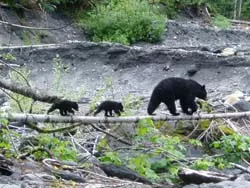
A black bear and two small cubs walk across a downed tree over a creek bed.
A black bear mother and her two cubs cross the East Fork Quinault River

Bridgett Jamison

Black bearUrsus americanus

Black bears are the only bear species found in Olympic National Park. They can be found in riparian, coastal, subapline, and forested areas. Spotting bears in the wild can be a thrilling experience, but encountering one up close or at your campsite can be dangerous. Our actions play the most cruical role in preventing bears from becoming habituated and threatening to humans.

Notify park staff if bears get food, damage property, or display any other threatening behaviors. If a bear approaches you, enters your campsite, or attempts to take your food, report the incident to a park ranger or fill out an online wildlife report.

SAFETY:

  • Do not feed bears. Secure all food, trash, and other scented items in hard sided vehicles, park provided food lockers, or park approved Animal Resistant Food Containers (ARFC).
  • Give Bears Space! Stay at least 100 feet or three bus lengths from all bears. Never approach a bear.
  • Travel in groups and make noise to avoid surprising bears. If you see a bear near the road, stay in your vehicle.
  • Supervise children and pets. Keep children between adults, pets on leash, and your group together.
  • Stay aware of your surroundings.

If you see a black bear while hiking:

  • Identify yourself as human by talking calmly and loudly so the bear knows you are not a prey animal.
  • Remain still and calm; stand your ground but slowly wave your arms. It may come closer or stand on its hind legs to get a better look or smell. A standing bear is usually curious, not threatening. Do not run or make any sudden movements.
  • Pick up small children.
  • Do not allow the bear access to your food. Getting your food will only encourage the bear and make the problem worse for others.
  • Do not drop your pack as it can provide protection for your back and prevent a bear from accessing your food.
  • If the bear is stationary, move away slowly and sideways; this allows you to keep an eye on the bear and avoid tripping. Moving sideways is also non-threatening to bears.
  • Leave the area or take a detour. If this is impossible, wait until the bear moves away. Always leave the bear an escape route.
  • Be especially cautious if you see a female with cubs; never place yourself between a mother and her cub, and never attempt to approach them. The chances of an attack escalate greatly if she perceives you as a danger to her cubs.

If a black bear charges you:

  • Stay calm, stamp your feet, make yourself as big as possible. Bears may bluff their way charging and turn away at the last second. If you have bear spray, deploy it.
  • Do not run, but if the bear follows, stop and hold your ground. Bears can run as fast as a racehorse both uphill and down. Like dogs, they will chase fleeing animals.
  • Do not climb a tree. Black bears can climb trees.

If a black bear attacks fight back. Go after sensitive areas such as eyes and noses.

Common Causes of Defensive Attacks by Bears

  • Approaching or surprising a bear, especially at close range
  • Startling a female with cubs or getting in between her and the cubs
  • Getting close to a carcass or other food source

DIET:

These creatures have an incredibly varied diet. They often feed on tree sapwood, young tree bark, and insect mounds until berries come in season. Bears can be spotted frequently in the early fall raiding the huckleberry bushes on mountain slopes. During various salmon runs in both spring and fall, bears will feed in shallow waters where they have a relatively easy time catching salmon en route to spawn, or salmon carcasses that have done so already.

ROLE IN ECOSYSTEM:

As omnivores, bears eat a little bit of everything, which helps the forest stay healthy and clean. As bears graze for nuts and seeds throughout the late summer and fall, the undigested seeds are deposited in their droppings, or scat, which then fertilizes them to grow into the giants that visitors come from around the world to see. Even as these giant trees fall, bears are there to dig through the logs in search of insects inside, helping to make a new forest floor. These new berry bushes and leafy greens attract elk and deer, as well. As these animals die off, the bears will help to eat the carcasses, providing more nutrients to the soil and building the web of Olympic life!

Updated July 2025


Last updated: May 15, 2026

Park footer

Contact Info

Mailing Address:

600 E. Park Avenue
Port Angeles, WA 98362

Phone:

360 565-3130

Contact Us