



Last updated: January 23, 2026
Article
2025 Summer Snorkel Surveys Yield Near-Record Counts of Young Salmon in Bay Area National Park Creeks
By Scientists in Parks Intern Vienna Rist, San Francisco Bay Area Network Salmonid Monitoring Program
NPS
December 2025 - At the end of September, the San Francisco Bay Area Network salmonid monitoring crew wrapped up our summer 2025 field season. During the summer, we surveyed young salmon and their habitat in Pine Gulch, Redwood, and Olema Creeks, to learn about the health of each population. Although the season wasn’t quite as smashing as anticipated, we still found some of the highest numbers of endangered juvenile coho that our crew has ever recorded!
First, Habitat Surveys
At each creek, we began by doing an inventory of available salmon habitat, called habitat typing. Habitat typing is a two-person task. Equipped with a stadia rod to check depth, a tape measure, and a tablet to record data, the duo starts at a downstream location and hikes upstream. Along the way, they classify habitat units within the stream channel. One crew member leads the survey, deciding where to call breaks between riffle, flatwater, and pool habitat. Each meter of stream is accounted for, including both mainstem and side channel areas.
As the lead surveyor delineates a unit, they count large pieces of wood (markers of good habitat) and measure stream length and width. If it’s a pool or flatwater, they also measure depth. The downstream partner records the data and keeps track of which units require additional fine-scale measurements. Habitat typing is a collaborative effort. Sometimes, fallen trees, wood jams, brush, and tricky conditions require both crew members to work together to take measurements.

NPS / Vienna Rist
The habitat-typing process allows the monitoring crew to engage with the stream from various perspectives. During these surveys, we laid out the rest of our summer season, flagging pools to return to for subsequent fish surveys. Stream pools are where most juvenile salmon spend their first year of life before migrating to the ocean. Beyond this, summer habitat typing adds to the story our data tell about the factors influencing salmonid survivorship and behavior. That's because the amount of each havitat type is variable year to year, depending on precipitation and other environmental variables. This year, surveyors found over a kilometer more pool habitat than average in Olema Creek. This means the juvenile salmon rearing in the creek have more habitat than normal to continue to grow in. As we tease out the creek’s unit-by-unit details, we work towards revealing the answer to bigger questions of the monitoring project such as whether or not habitat conditions in the streams we monitor are improving over time for juvenile salmonids.
Snorkeling Upstream
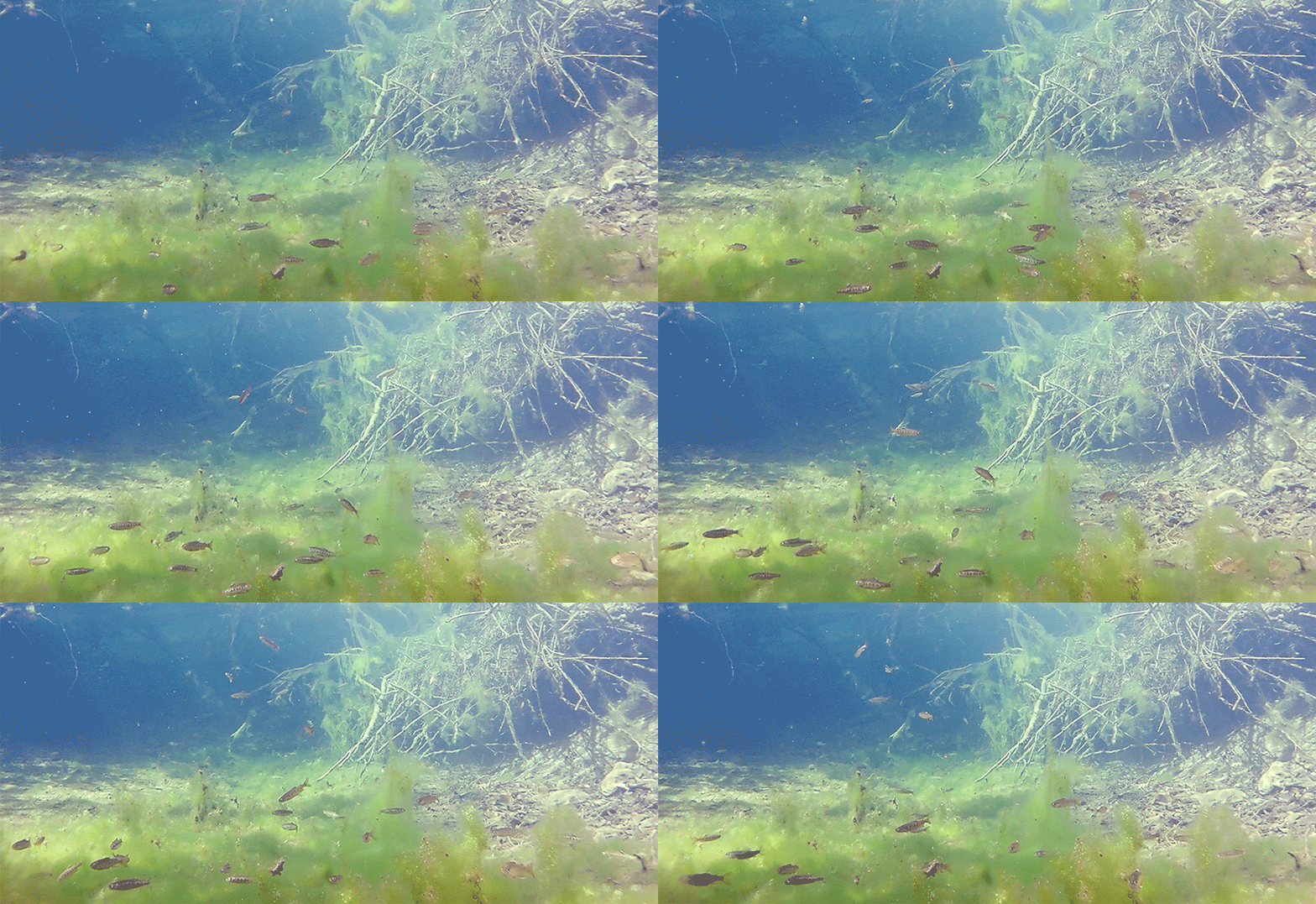
Shortly after completing habitat typing in each creek, the fisheries crew made our way back to the stream to conduct snorkel surveys. This time we came with thick wetsuits, dive lights, and our eyes peeled to count juvenile coho salmon. Stopping at each pool we flagged during habitat surveys, teams of divers slowly floated—and sometimes crawled—upstream, maneuvering through rocks and woody debris to get our eyes on the fish.

NPS / Michael Reichmuth
Snorkel surveys are tricky, as pools are home to multiple species of fish. And those fish move quickly and take cover in suspended silt, or behind rocks, wood, or vegetation. Plus, it takes effort to focus in such a cold environment. Water temperatures in the creeks are usually less than 60˚F!
While we focus on coho during snorkel surveys, we also note the relative abundance of juvenile steelhead. If other fish or aquatic species—like stickleback, sculpin, crayfish, or newts—were there, we noted that too. For example, Lead Fishery Biologist Michael Reichmuth spotted rarely-seen California giant salamander larvae during a September survey in Olema Creek. They were clustered together and appeared to have just recently hatched from their eggs. Although we often see salamanders during our surveys, none of our crewmembers had ever seen them at this stage of their life.

NPS / Michael Reichmuth
Near-Record Counts of Young Salmon
Based on our snorkel counts this summer, we estimated populations of about 2,000 coho juveniles in Pine Gulch Creek, nearly 6,000 coho in Redwood Creek, and a whopping 30,000 in Olema Creek! That we’re finding coho in Pine Gulch at all is a big deal. And, the 2025 Pine Gulch estimate is comparable to the 2022 estimate, which was the last time we saw this genetic group of fish as juveniles.

Both the Redwood and Olema Creek estimates are slightly lower than the 2022 estimates despite record numbers of adult coho last winter. It’s likely the heavy rainfall and high flows in early February resulted in redd (nest) scour and egg loss, meaning fewer juveniles than expected. Although we are still finalizing our juvenile coho results, the juvenile estimates for 2025 will likely be the second highest in our monitoring record.
On Redwood Creek we were also happy to find juvenile coho throughout the mainstem and in the lower half of Fern Creek. This is a larger distribution than we’ve seen on the creek in recent years, which should result in increased survival through the late summer and winter months. Bigger distributions reduce competition and lessen the chance of localized environmental conditions affecting the majority of the population. Another surprise on Redwood Creek this season was the observation of juvenile Chinook salmon. The only other time that we counted juvenile Chinook salmon was during the summer of 2022.
Last Up, Measuring and PIT-Tagging
The final phase of our summer monitoring involved capturing coho via seine nets. Handling the coho lets us measure lengths and weights for a proportion of them and implant passive integrated transponder (PIT) tags to track their growth and survival.
Our program previously relied on electrofishing to capture juveniles for summer measuring and tagging, but this year we updated our protocol to use wide, mesh seine nets instead. During seining/tagging surveys, two crew members catch fish by pulling the net upstream through suitable pools. Two passes with the net usually yields enough juvenile coho to measure and tag.
This year in Olema Creek, we noticed many of the coho young-of-year (fish less than one year old) were smaller than in previous summers. We suspect these juveniles could be the result of late spawners. Our crew documented some new coho redds later than normal, into mid-February. It would make sense that younger fish from February spawning would be smaller. They would have had less time to grow compared to juveniles from redds established in late December.
Because PIT-tagging coho as smolts in the spring has been found to delay their seaward migration, we now deploy tags in the summer. This creates a longer recovery period for the fish and also allows us to collect data on overwinter survivorship and fish migration in Olema and Redwood Creeks.
This summer, our crews were able to PIT tag ~400 juvenile coho in Redwood Creek and an additional ~600 in Olema Creek. With these tags deployed, we hope to better monitor smolt outmigration during spring 2026. If we’re lucky, we could even see some of the tagged coho return to spawn in winter 2027. For now, as the winter hopefully brings some needed rain, we look forward to the return of winter 2025-26 spawners!
For more information
- San Francisco Bay Area Network Salmonid Monitoring webpage
- Pacific Coast Science & Learning Center Coho & Steelhead webpage
- Contact Fishery Biologist Michael Reichmuth

See more from the Bay Area Nature & Science Blog
The National Park Service shall not be held liable for improper or incorrect use of the data described and/or contained herein. These data and related graphics (if available) are not legal documents and are not intended to be used as such. The information contained in these data is dynamic and may change over time. The National Park Service gives no warranty, expressed or implied, as to the accuracy, reliability, or completeness of these data.