



|
Santa Monica Mountains study is the longest-running bobcat study ever conducted
You are viewing ARCHIVED content published online before January 20, 2025.
Please note that this content is NOT UPDATED, and links may not work. For current information,
visit https://www.nps.gov/aboutus/news/index.htm.
National Park Service
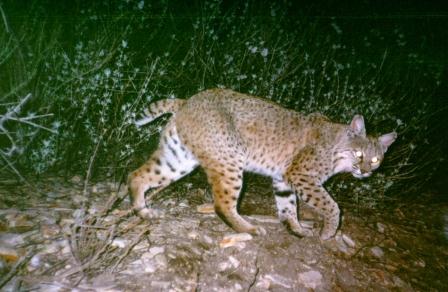
Contact: Kate Kuykendall, 805-370-2343 Contact: Seth Riley, 805-370-2358 THOUSAND OAKS, Calif. - National Park Service biologists recently captured the 300th bobcat as part of the longest-running bobcat study ever conducted. Started in 1996, the study examines the behavior, ecology and conservation of bobcats, in particular how urbanization has affected the bobcat population in the Santa Monica Mountains and Simi Hills. "The benefit of this kind of long-term research is that it gives us the chance to observe changes and trends in the population that may not be seen over a few years," said Joanne Moriarty, an ecologist for Santa Monica Mountains National Recreation Area. "One of the most striking findings from this study is the discovery of a deadly mange epidemic, as well as a correlated exposure to anti-coagulant rat poisons." Researchers from Santa Monica Mountains National Recreation Area, a unit of the National Park Service, first detected the disease in 2001. Mange, caused by a microscopic parasitic mite, is a severe skin condition that can lead to death. The disease peaked between 2003 and 2006 in the Simi Hills area, during which time more than 50 percent of radio-collared bobcats died as a result of the condition, overtaking vehicular collisions as the leading cause of death among the local population. Recently, 10 years after the start of the epidemic, bobcat numbers seem to be on the uptick, especially in areas where local populations had essentially been wiped out. Researchers continue to search for the underlying cause of the correlation between exposure to anti-coagulant rodenticides and severe mange. As part of the study, biologists capture and sedate the bobcats, affix radio collars, record measurements and take blood and tissue samples for analysis. Researchers also minimize the potential for stress or injury to animals through the use of remote cameras and scat surveys. Most of the 300 bobcats in the study were captured in the communities of Thousand Oaks, Westlake Village and Agoura Hills. Bobcats (lynx rufus) are small, spotted cats that inhabit most of North America, including all of the United States, most of Mexico and southern Canada. Often mistaken for mountain lions in southern California, bobcats are much smaller and have a short tail, ear tufts and a pronounced facial ruff, similar to a beard. They typically weigh between 12 and 25 pounds. Santa Monica Mountains National Recreation Area (SMMNRA) is the largest urban national park in the country, encompassing more than 150,000 acres of mountains and coastline in Ventura and Los Angeles counties. It comprises a seamless network of local, state, and federal parks interwoven with private lands and communities. As one of only five Mediterranean ecosystems in the world, SMMNRA preserves the rich biological diversity of more than 450 animal species and 26 distinct plant communities. Learn more at www.nps.gov/samo. ### |

Last updated: August 1, 2019