



|
You are viewing ARCHIVED content published online before January 20, 2025.
Please note that this content is NOT UPDATED, and links may not work. For current information,
visit https://www.nps.gov/aboutus/news/index.htm.
Contact: John Golda, 415-464-5143
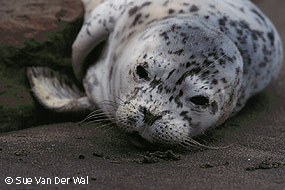
© Sue Van Der Wal. Point Reyes National Seashore has the largest mainland breeding concentration of harbor seals in California. Resting and pupping harbor seals come onshore in various parts of the park particularly in Tomales Bay, Tomales Point, Double Point, Drakes Estero, and Bolinas Lagoon. Each year, several thousand seals congregate within the Seashore especially to give birth on the sand bars and remote beaches. From March 1 through June 30, an annual closure of Drakes Estero is implemented to protect the harbor seals during this most sensitive time of year. The closure applies to kayak and canoe usage but is applicable to surfers, windsurfers, abalone divers, recreational fishing, and other water sport users around harbor seal colonies in the area. The National Park Service asks park visitors to avoid disturbing seals to ensure a successful pupping season. Last year, almost 4,000 harbor seals were counted, 1,302 of which were pups. The number of seals breeding at Point Reyes represents around 20% of the California mainland population estimate. The Seashore staff is conducting long-term monitoring to gain further scientific knowledge on this species and to guide management in their protection. The east side of Hog Island in Tomales Bay is also a terrestrial resting site for harbor seals and seabirds year round. Harbor seals haul out on the sand bar at Hog Island throughout the year but are most abundant during the winter months when their preferred prey, Pacific herring, spawns in Tomales Bay. During the spring months, females with pups may also haul out there. To ensure that harbor seals are not disturbed, visitors are asked to stay at least 100 yards (300 feet) away from resting seals. Visitors should never pick up a seal that may look abandoned. Although harbor seals may appear abandoned, they are most likely waiting for their mother to return. Pups are about two feet long and weigh about 24 pounds and are weaned 30 days after birth. If you are concerned about a particular seal, please contact park staff at one of the Visitor Centers. A few species of seabirds roost on Hog Island including brown pelicans and double-crested cormorants, which occur in Tomales Bay during the summer and fall months of the year. They forage on various species of small schooling fish that congregate in Tomales Bay, and cormorants nest on the island in the spring and summer. Harbor seals are protected under the Marine Mammal Protection Act of 1972 and therefore, it is unlawful to disturb them while they are resting onshore. -NPS- |

Last updated: June 29, 2025