



|
You are viewing ARCHIVED content published online before January 20, 2025.
Please note that this content is NOT UPDATED, and links may not work. For current information,
visit https://www.nps.gov/aboutus/news/index.htm.
Contact: Brannon Ketcham, 415-464-5192 Contact: John Dell’Osso, 415-464-5135
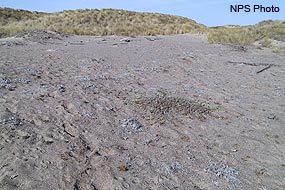
During early December, the National Park Service will conduct a pilot restoration project in the coastal dune area near Abbotts Lagoon to test different restoration methods. The project intends to remove invasive European Beachgrass (Ammophila arenaria) to restore natural dune process. This plant species, introduced to the coastal dunes at Point Reyes in the 1940s has taken over much of the dunes along the Great Beach and Limantour. The Seashore has embarked on a program of restoring its native dune systems and creating resilience to a critical and vulnerable ecosystem through removal of European beachgrass and iceplant, two species that impede natural dune movement and displace native dune plants and animals. These invasive species cover more than 1,500 acres of the coastal dune features along the Point Reyes peninsula. Restoration of the coastal dune habitats at Point Reyes will directly benefit five federally listed species. The proposed project activities will test production rates and effectiveness of different mechanical treatment methods associated currently considered for large-scale removal of invasive European Beachgrass from the coastal dune habitat. This work coincides with a larger scale restoration project to be conducted in Summer 2010. Public review and environmental compliance for the proposed project activities have been completed on this project. A Finding of No Significant Impact was signed in June 2009. More information is available on our Coastal Dune Habitat Restoration Project page. -NPS- |

Last updated: May 27, 2024