National Park Service LogoU.S. Department of the InteriorNational Park ServiceNational Park Service
National Park Service:  U.S. Department of the InteriorNational Park Service Arrowhead
Petrified Forest National Parkpetrified wood scatter, Photo by Marge Post/NPS
view map
text size:largestlargernormal
printer friendly
Petrified Forest National Park
Fossils
 
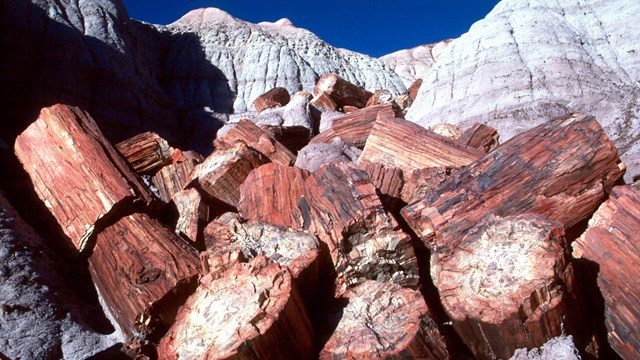
large sections of a petrified log

Photo by Marge Post/NPS

Petrified wood represents trees once alive over 200 million years ago.

Fossils are clues to the past, allowing researchers to reconstruct ancient animals and plants. Together with the surrounding rocks, fossils tell the stories of ancient ecosystems.

Petrified Forest has plant and animal fossils representing the Late Triassic, going back over 200 million years. The Triassic Period is sometimes referred to as the "Dawn of the Dinosaurs" because it is the time before the Jurassic Period when dinosaurs ruled the earth.

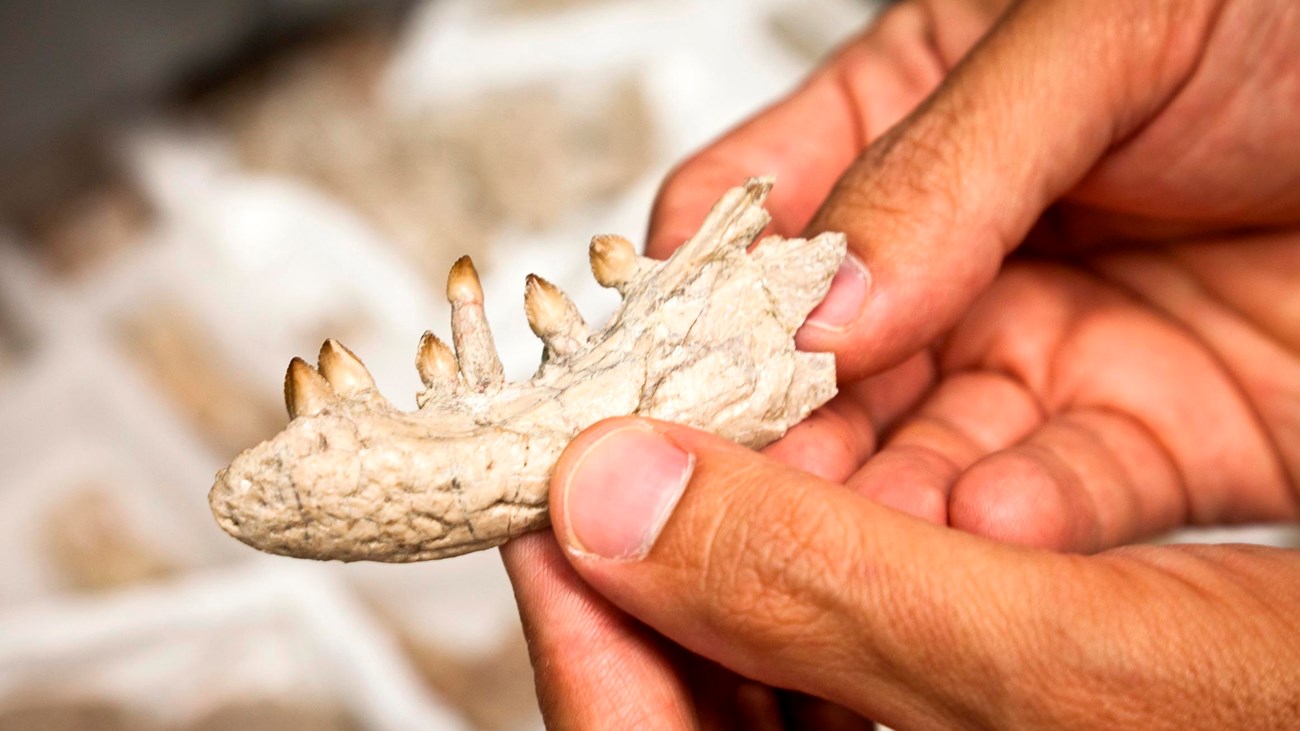
Fossils can be big - some petrified logs found in the park measure over 190 feet - or small - a single tooth less than an inch long may contain the definitive characteristic of a new species.

 
clam fossils

Photo by Marge Post/NPS

Clam fossils from the Triassic Period indicate a waterway within the ancient environment.

Every fossil found is like a piece in a jigsaw puzzle. Imagine putting together a jigsaw puzzle without knowing what the completed puzzle will look like. That would be hard, but what if you also didn't have all the pieces?

Context is very important with fossils. Where a fossil is found, what else it is found with, and how it was preserved are clues just as important as the fossil itself. Every fossil found in the park is important because of its context. The context tells its story.

When visiting the park, enjoy the petrified wood, but leave it where you find it. The park loses several tons of petrified wood each year through the acts of thoughtless visitors.


As part of the Petrified Forest National Park Learning Center, a monthly lecture series is held the first Wednesday of each month. Presentations will feature paleontology, geology, archeology, and other topics. Lectures are free and open to the public.

For more information on fossils, including educational resources for K-12 teachers, check out The Paleontology Portal website.

For more in-depth educational and scientific information about fossils visit the Society of Vertebrate Paleontology website, representing professionals, students, artists, preparators, and others interested in vertebrate paleontology.

 
scattering of shell fossils

NPS Photo

Mollusc shell fossils.

Fossils are clues to the past, allowing researchers to reconstruct ancient environments. During the Late Triassic Period, the climate was very different from that of today. Located near the equator, this region was humid and tropical, the landscape dominated by a huge river system. Giant reptiles and amphibians, early dinosaurs, fish, and many invertebrates lived among the dense vegetation and in the winding waterways. New fossils come to light as paleontologists continue to study the Triassic treasure trove of Petrified Forest National Park.

Petrified Wood

Imagine a large basin with numerous rivers and streams flowing through the lowland. A lush landscape with coniferous trees up to nine feet in diameter and towering almost two-hundred feet into the sky surround you. Galleries of trees, ferns, and giant horsetails grew abundantly along the waterway, providing food and shelter for many insects, reptiles, amphibians, and other creatures. In the slightly dryer areas a short distance from the water there were cycads, bennettitaleans, ginkgoes, and coniferous trees.

Over time, trees died or were knocked down by wind or the action of water. Rivers and streams carried the trees downstream, breaking off branches and roots along the way. Many tree trunks came to rest on the banks of the rivers while others were buried in the stream channels. Most of the trees decomposed and disappeared, but some of the trees were petrified, becoming the fossilized logs we see today. Many of the fossilized logs are from a tree called Araucarioxylon arizonicum. Two others, Woodworthia and Schilderia, occur in small quantities in the northern part of the park. All three are now extinct.

Some logs were buried by sediment before they could decompose while volcanoes to the west spewed tons of ash into the atmosphere. Winds carried ash into the area where it was incorporated into the thickening layers of sediment. Ground water dissolved silica from the volcanic ash and carried it through the logs. This solution filled the cells and sometimes replaced the cell walls, crystallizing as the mineral quartz. The process was sometimes so exact the resulting fossils show many details of the logs’ original surfaces and, occasionally, the internal cell structures. Iron and other minerals combined with quartz during the petrification process, creating the brilliant rainbow of colors. Sometimes crushing or decay left cracks in the logs. Here the growth of quartz crystals was not limited and larger crystals of clear quartz, purple amethyst, yellow citrine, and smoky quartz formed.

This area has endured many changes. As time passed, the Chinle Formation was buried by a thick sequence of younger rock. About 60 million years ago the region was uplifted as part of the massive Colorado Plateau. Over time, many rivers and storms eroded the land, removing the younger layers of rock until parts of the Chinle Formation were exposed. Now fossilized logs that were once embedded in the Chinle Formation lie strewn across the clay hills and are exposed in cliff faces. But all the logs are broken into segments. Because the sections are still in order, we know that the logs fractured after they were buried and the petrification process was complete. Since petrified logs are composed of quartz, they are hard and brittle, fracturing easily when subjected to stress. Some researchers believe that such stress may have been produced by earthquakes or the gradual uplifting of the Colorado Plateau.

Other Plant Fossils

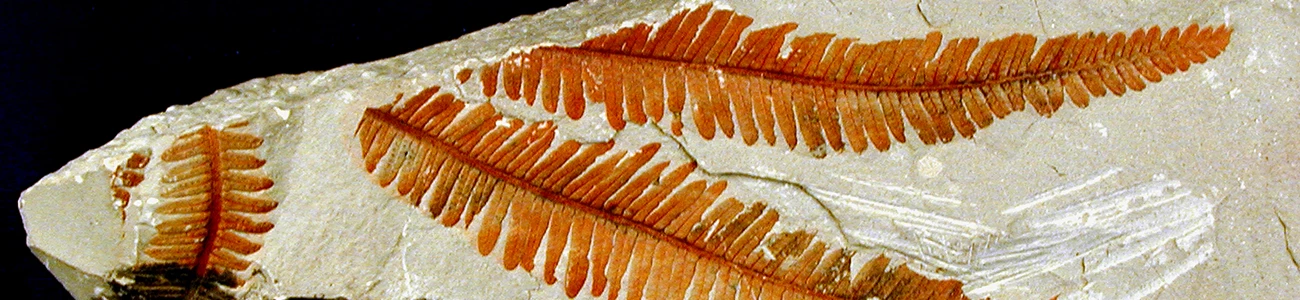
While the park is best known for its petrified trees, the Chinle Formation is full of different kinds of fossils and is considered one of the richest Upper Triassic fossil plant deposits in the world. Over 200 fossil plant taxa are known from the Chinle Formation, including silicified wood, compressed leaves, stems, cones, pollen, spores, and amber. Plant groups represented in the park include lycopods, ferns, cycads, conifers, ginkgoes, bennettitaleans, and several forms that are currently unclassified.

Triassic Animals

Rauisuchians ranked as the top terrestrial predators of the Late Triassic, thanks to huge skulls armed with powerful biting jaws and 3 inch (7.6 cm) long serrated teeth. Species of rauisuchians found in the park include Postosuchus kirkpatricki and Poposaurus gracilis. Some rauisuchians could grow up to 20 feet (6 m) in length.

Phytosaurs were crocodile-like reptiles, some species reaching lengths up to 40 feet (12 m). Nostrils located strategically on top of the head just in front of the eyes allowed it to lurk in the water. Bony plates protected its body and jaws filled with sharp teeth made it a fearsome predator. Living in and near the water, phytosaurs had a diverse diet of fish, amphibians, and reptiles. Several species have been found in Petrified Forest National Park, including Leptosuchus (Smilosuchus) gregorii and Pseudopalatus pristinus.

Placerias hesternus
was a dicynodont therapsid. Therapsids were large reptiles that possessed many mammalian characters including a “cheek” bone, enlarged canine teeth, pelvis, and a specialized attachment of the skull to the spine. This massive plant-eater was up to 9 feet (2.7 m) long and might have weighed as much as two tons. Placerias had a short neck, barrel-shaped body, small tail, and a beak-like skull with large tusk-like bones protruding from its upper jaw. The beak-like jaws helped them pull up and tear tough plants and roots. While Placerias is represented in the park by isolated elements, it is common throughout Arizona, particularly near St. Johns, just southeast of the park. As many individual fossils have been found at the St. Johns’ site, it is thought that these animals may have lived in herds.

Aetosaurs
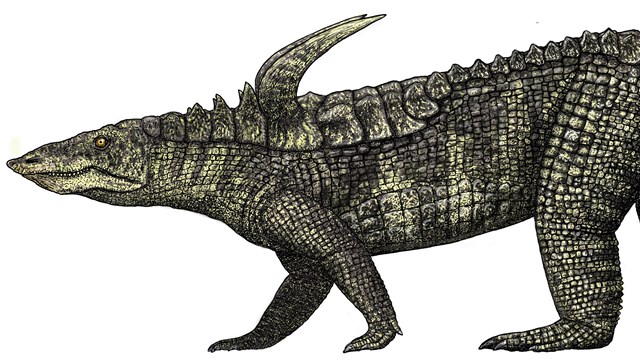
were 10-15 foot (3-4.5 m) long reptiles with broad flat bodies protected by plate-like scutes. Some species had large spikes on their sides or back that were possibly used for defense. Aetosaurs had short limbs and small skulls with a pig-like snout for rooting in soil for plants and roots. Desmatosuchus haplocerus or Stagonolepis wellesi are two of the aetosaurs found in Petrified Forest National Park.

Coelophysis
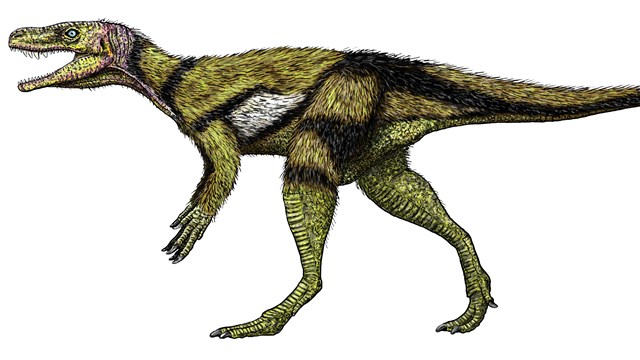
was an early dinosaur. It was about 8 feet (2.4 m) long and could weigh 50 pounds (23 kg). The long slender jaws lined with sharp, flattened teeth indicate it was carnivorous. This agile animal probably walked on its hind limbs and used its forelimbs to catch and hold prey. Large eye sockets suggest keen eyesight. Fossil evidence indicates that it may have eaten its own kind. 

Metoposaurs
were giant amphibians that grew to be 10 feet (3 m) long and weighed up to half a ton. They used their cavernous mouths to sieve water for small fish using sharp teeth to trap them. Like most amphibians, metoposaurs had lungs instead of gills and possibly detected vibrations in the water for hunting. Short weak legs indicate they spent most of their time in the water where they may have waited on the muddy bottom for prey. Two species have been found at Petrified Forest, Buettneria perfecta and Apachesaurus gregorii.

Two types of fresh water sharks lived in the waters of the Petrified Forest area. Lissodus humblei was a blunt-toothed shark about 6-9 inches (15-23 cm) long. The blunt teeth indicate it survived on clams and clam shrimp and was probably a bottom dweller. “Xenacanthus” moorei was a 3 foot (1 m) long prong-toothed shark that fed on smaller fish, aquatic reptiles, and amphibians. It had a slender body with large jaws that were lined with three pronged teeth.

The lungfish, Arganodus dorotheae, was a heavy, slow-moving fish up to 3 feet (1 m) in length and weighing up to 70 pounds (32 kg). It had comb-shaped teeth used as crushing plates for clams. Some lungfish living today are able to leave the water for periods of time and breathe air. 

The coelacanth, Chinlea sorenseni, was a large fish reaching up to 5 feet (1.5 m) long and weighing up to 150 pounds (68 kg). Its jaws were equipped with large, sharp teeth for catching and holding prey. A slim tail and lobed fins enabled it to move quickly through the water.

Horseshoe crabs
have been identified by their fossilized tracks (Kouphichnium arizonae), originally left in the soft sediments at the bottom of fresh water lakes and streams. These invertebrates probably ate worms, soft mollusks, plants, and dead fish.

Various fresh water bivalves have been found in the Chinle Formation, some species forming vast colonies in the muddy beds of the ancient lakes and rivers. Antediplodon thomasi is one of the clam fossils found in the park.

colorful petrified wood
Petrified Wood
Formation of a colorful fossil.
more...
prong toothed shark
Triassic Period
200 million years ago this place was a lot different!
more...
coelophysis
Dinosaurs
General information and species list.
more...
scientific papers
Published Research
List of published scientific papers about park paleontological resources.
more...
red badlands  

Did You Know?
Standing on the edge of a vast badlands landscape, a Spanish explorer is rumored to have named the area "El Desierto Pintado" (The Painted Desert) because the hills looked like they were painted with the colors of the sunset.

Last Updated: August 09, 2009 at 15:48 EST