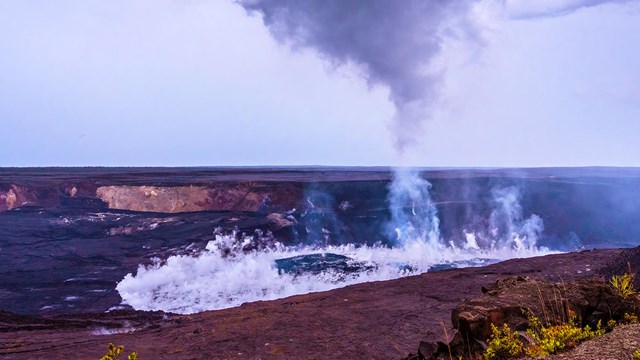
• Halema`uma`u Just Before Dawn

    Hawai'i Volcanoes

    National Park Hawai'i

What's Going on With the Volcano?

May 16, 2013

 
Click for full size image

View from Kīlauea Overlook

NPS Photo

The best and closest place to observe a volcanic eruption within Hawai'i Volcanoes National Park at present is from Jaggar Museum overlook, and other vantage points at the summit of Kīlauea that provide views of Halema'uma'u Crater.

During daylight, the robust plume of volcanic gas is a constant and dramatic reminder of the molten rock churning in a lava lake beneath the crater floor. After sunset, Halema'uma'u continues to thrill visitors and park staff with a vivid glow that illuminates the clouds and the plume as it billows into the night sky.

The park has increased staffing at Jaggar Museum to assist the many visitors drawn to Halema'uma'u, which has been erupting consistently since the crater became active again in March 2008.

Halemaʻumaʻu web cam (opens in new window).

 
Click for full size map

April 23, 2013 Lava Flow Map - click image for full size map

Map Courtesy USGS - Hawaiian Volcano Observatory

Middle east rift zone vents: This map shows the active Peace Day flow, carrying lava to the ocean, and the inactive Kahaualeʻa flow northeast of Puʻu ʻŌʻō, as of April 23, 2013. Widening of both flow fields between April 8 and April 23 is shown in bright red, while the extent of the flow fields before April 8 are shown in pink. Older lava flows are labeled with the years in which they were active. Episodes 1-48b (1983-1986) are shown in gray; episodes 48c-49 (1986-1992) are pale yellow; episodes 50-55 (1992-2007) are tan; and episodes 58-60 (2007-2011) are pale orange. The Peace Day lava tube is shown by the yellow line.

May 16, 2013 - There were two sets of lava flows outside Pu'u 'Ō'ō cone: the Kahauale'a II lava flow continued to spread out and advance to the north from the base of Pu'u 'Ō'ō cone. To the southeast, the Peace Day pali breakout continued with scattered activity across the coastal plain while the main branch of the Peace Day flow continued to enter the ocean at 1 main location just outside the Hawai'i Volcanoes National Park boundary with another entry producing a weak, intermittent plume just inside the boundary.

R2USGS Mobile cam 2.


Lava may often be viewed from the established County Viewing Area in Kalapana

 
Click for full size image

Viewing the lava tube flows coming down the pali (cliff) at the county public viewing area in Kalapana

NPS Photo - 12/5/2012


Please note: The Kalapana public viewing area is outside of Hawaiʻi Volcanoes National Park and is managed by Hawaiʻi County. There is no fee to enter the viewing area. Currently the viewing area is open from 3:00 p.m. to 9:00 p.m. with the last vehicle allowed in at 8:00 p.m. To hear a recorded message of updated viewing conditions, call 808-961-8093.


Map to the Kalapana public viewing area (pdf-469KB)

County of Hawai'i Press Release - Kalapana Lava Viewing Area Remains Free - Feb 12,2013 (pdf-169KB)

 
Click for full size image

Kalapana parking area

NPS Photo - 12/5/2012

The end of Highway 130 at Kalapana.

Park here and hike the short distance to the public viewing area.

 
End of Chain of Craters Road

The End of Chain of Craters Road

NPS Photo

Surface flowing lava is at times accessible from the end of Chain of Craters Road within Hawai'i Volcanoes National Park. When it is, and if you plan to hike out to it, you should be prepared for an extremely arduous, advanced and challenging hike that should only be attempted by the most physically fit people. It is roughly 13 miles round trip from the end of Chain of Craters Road, with an estimated time to complete of 6 to 8 hours. Hiking across lava fields requires continous awareness and concentration. The lava is uneven, jagged and very sharp. All skin should be covered. If you decide to do this hike, you should have:

  • 3 liters water minimum
  • rainjacket
  • gloves
  • long pants
  • long sleeve shirt
  • first aid kit
  • good shoes
  • one flashlight per person
  • compass (recommended)

Please view this four minute video - "Plan for Safe Viewing of Lava Flows"

HAZARD ALERT: Lava entering the ocean builds lava deltas. The lava delta and adjacent areas both inland and out to sea are some of the most hazardous areas on the flow field. Frequent delta/bench collapses give little warning, can produce hot rock falls inland and in the adjacent ocean, and can produce large local waves. The steam plume produced by lava entering the ocean contains fine lava fragments and an assortment of acid droplets that can be harmful to your health. The rapidly changing conditions near the ocean entry have been responsible for many injuries and a few deaths.

 
Click for full size image

Kīlauea Summit Lava Lake via Webcam

Photo courtesy USGS - Hawaiian Volcano Observatory

View of the lava lake in Halema'uma'u via webcam on October 22, 2012.

On Tuesday, October 23, 2012, the high mark was measured using a laser rangefinder at 100 feet (31m) below the crater floor, the highest level since the vent opened up in March 2008.

Tuesday, January 15, 2013 - After a period of the lava lake returning to more normal levels, the lake level rose to a new height of around 80 feet (25m) below the crater floor before dropping again.

Friday, March 8, 2013 - The lava lake level continues to fluctuate in response to summit deflation-inflation cycles, ranging between about 80-200 ft (25-80 m) below the floor of Halema'uma'u.

Friday, May 10, 2013 - The lake level rose over the past week and was about 165 ft (50m) below the floor of Halema'uma'u on Thursday, May 9, 2013.

The webcam is positioned at the old Halema'uma'u lookout that was destroyed when the vent exploded open in March 2008. This area is not accessible to the public, however the view from the Jaggar Museum and the Kīlauea Overlook (pictured at the top of this page) is pretty spectacular.

Link to Halema'uma'u Overlook webcam


The lava lakes in the Puʻu ʻŌʻō crater and Halemaʻumaʻu crater, as well as other views may be viewed on webcameras made available by the scientists at USGS Hawaiian Volcano Observatory. Daily updates by staff that monitor Hawaiʻi's volcanoes provide visitors with the most recent observations on volcanic conditions.

 
Halema`uma`u vent - June 2, 2011 - web cam view

Webcam view of the lava lake within the summit vent in Halemaʻumaʻu on June  2, 2011.

USGS Webcamera

Links to More Information:

USGS Hawaiian Volcano Observatory
Scientist's Daily Updates
Webcams
Air Quality Monitors
Earthquakes - Hawaiʻi
Earthquakes - Worldwide
Multimedia/Photos/Videos


If you are interested in more information about the Kīlauea east rift zone, we invite you to watch the video cast of USGS Hawaiian Volcano Observatory geophysicist Mike Poland from our After Dark in the Park presentation on August 23, 2011. Mike discusses the volcanic history of the area. It's one hour in length and can be viewed here

 
Pu`u `O`o view from Pu`u Huluhulu before the collapse
Scott Rowland of The University of Hawaiʻi captured this shot of Puʻu ʻŌʻō from the Puʻu Huluhulu lookout the evening before Puʻu ʻŌʻō collapsed and the west flank eruption began on August 3rd 2011.


The following links are to NPS informative posters regarding the Kamoamoa eruption.

March 5, 2011: New Changes in the Eruption of Kīlauea (pdf-604KB)
March 9, 2011: Dynamic Forces Transform the Landscape (pdf-663KB)

Did You Know?

`Ohi`a tree with lehua blossoms.

The `ohi`a lehua (Metrosideros polymorpha) is a pioneer plant on new lava and a dominant tree in most mature Hawaiian forests.  Honeycreepers, like the `apapane and `amakihi, are often seen sipping sweet nectar from its flowers. More...