



The Continuing Story of Grand Teton National Park
By the end of the 1930's, the future of the Jackson Hole valley was still undecided. Grand Teton National Park still included only the mountain range and the small lakes at the foot of the range. The anti-park faction had gained the upper hand, and park expansion plans had come to a standstill. Without the support of Wyoming's congressman, it would not be possible to enlarge Grand Teton National Park through Congress. The National Park Service began considering a last -resort effort: the creation of Jackson Hole National Monument. (1)
On November 27, 1942, John D. Rockefeller, Jr., informed Secretary of the Interior Harold Ickes that unless the government accepted his land gift, he would consider disposing of it by other means. The letter activated an already well-developed plan. The idea of asking the president to establish Jackson Hole National Monument by proclamation had been considered since the early 1930's.
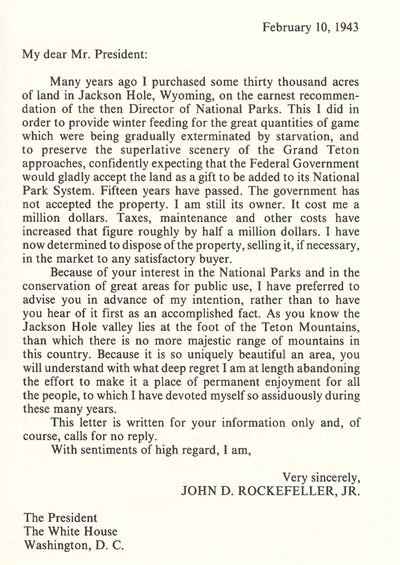
In 1943, Rockefeller wrote a letter to President Franklin Delano Roosevelt. (The letter's text is located at the end of this post).
 (2, pg 207)
Was the letter's threat real? Would Rockefeller have sold the land as he implied?
Author Robert Righter speculates on Rockefeller's intentions in Crucible for Conservation:
"Because we are dealing with conjecture, it might be well to give weight to the views of Laurance Rockefeller, who perhaps knew his father's proclivities and character as well as anyone. When asked if the Ickes letter indicated that his father's patience had run out, Laurance replied: "No… I would just like to feel that this was probably a good way of putting a little pressure on the people in Washington…" Laurance believed his father had no thought of dumping the land on the open market, and the letter "was undoubtedly more of a bit of maneuver and pressure kind of thing than [an] indication of a change of purpose or policy." (1)
Whether or not Rockefeller's letter was a bluff, the results remain the same. On March 5, 1943, Ickes presented a memorandum on the subject to the president, along with a proclamation to create Jackson Hole National Monument. Roosevelt signed the proclamation and decreed 221,000 acres as the Jackson Hole National Monument on March 15, 1943, using his presidential power to circumvent obstacles created by Congress and the Wyoming delegation.
The story of Grand Teton National Park does not end here, however…
-DL
Sources:
Righter, Robert W. "Crucible for Conservation: The Creation of Grand Teton National Park." Colorado Associated University Press.
Ernst, Joseph W. Worthwhile Places: Correspondence of John D. Rockefeller, Jr. and Horace M. Albright. Fordham University Press. 1991.
Daugherty, John. "A Place Called Jackson Hole: The historic resource study of Grand Teton National Park." Grand Teton National Park. 1999.1982.Grand Teton National Park. The Creation of Grand Teton National Park. https://www.nps.gov/grte/historyculture/upload/5-2_Creation_of_GRTE.pdf
Letter Text:
February 10, 1943
My dear Mr. President:
Many years ago I purchased some thirty thousand acres of land in Jackson Hole, Wyoming, on the earnest recommendation of the then Director of National Parks. This I did in order to provide winter feeding for the great quantities of game which were being gradually exterminated by starvation, and to preserve the superlative scenery of the Grand Teton approaches, confidently expecting that the Federal Government would gladly accept the land as a gift to be added to its National Park System. Fifteen years have passed. The government has not accepted the property. I am still its owner. It cost me a million dollars. Taxes, maintenance and other costs have increased that figure roughly by half a million dollars. I have now determined to dispose of the property, selling it, if necessary, in the market to any satisfactory buyer.
Because of your interest in the National Parks and in the conservation of great areas for public use, I have preferred to advise you in advance of my intention, rather than to have you hear of it first as an accomplished fact. As you know the Jackson Hole valley lies at the foot of the Teton Mountains, than which there is no more majest range of mountains in this country. Because it is so uniquely beautiful an area, you will understand with what deep regret I am at length abandoning the effort to make it a place of permanent enjoyment for all the people, to which I have devoted myself so assiduously during these many years.
This letter is written for your information only and, of course, calls for no reply. With sentiments of high regard, I am,
Very sincerely,
JOHN D. ROCKEFELLER, JR.
The President
The White House
Washington, D.C.