




NPS/ Sydney Stover Exploring Great Sand Dunes National Park and Preserve on horseback or with pack animals can be fun and rewarding, but requires some preparation on your part. We want you, your animals, and other visitors to have a great experience! Here are answers to frequently asked questions about bringing horses to Great Sand Dunes:
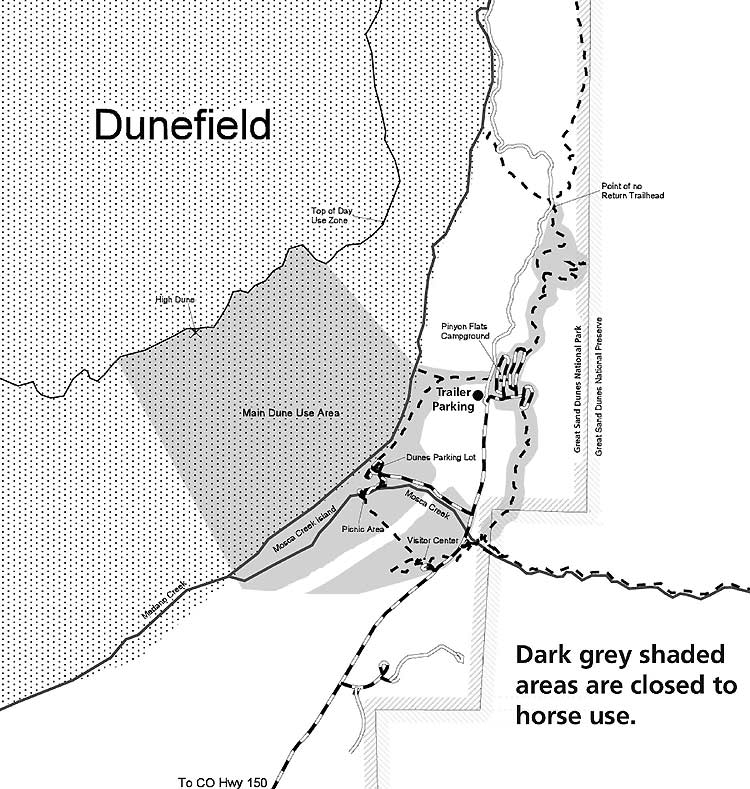
NPS/Patrick Myers Where can we ride our own horses?Most of the national park and the entire national preserve are open to horse use. For closed areas, please refer to the Map of Areas Closed to Horse Use (.jpg file, 130 KB). The following areas are closed to horseback riding:- Piñon Flats campground - Visitor Center parking area, area, or Sand Sheet Loop Trail - Mosca Creek picnic area, near Dunes Parking Lot (Note: riders may access the southern and western portions of the dunefield through a permitted corridor than runs between the Visitor Center and picnic area. Please see map for location of this corridor.) - Dunes Parking Lot and the area directly west of the Dunes Parking Lot, as far as the High Dune. This area is for pedestrians only. - Wellington Ditch Trail - Montville Nature Trail, except for the southern section required to access the Mosca Pass Trail. Please lead your horses on this section of the nature trail. - any paved roads, except when crossing - the Sand Ramp Trail between the campground and Point of No Return. Use Medano Primitive Road instead. Where can we leave our trailer?Use the horse trailer parking area at the beginning of the Medano Pass Primitive Road. If full, use the amphitheater parking lot nearby. Please clean up all manure before and after your trip. Horse trailers may not be parked elsewhere within national park boundaries. For national preserve access from the east side of the Sangre de Cristos, you may leave your trailers at trailhead parking areas in the San Isabel National Forest, including Mosca Pass, Rainbow Trail, and Grape Creek Campground parking areas. Northern park access: Hikers, horses and pack animals may use the Liberty Gate trailhead to access the national park and national forest lands in this area. Wagons or other horse drawn equipment are not permitted to enter the park. The park map has directions to Liberty Gate. Where can we camp with our horses?All national park horse camping areas are in the wilderness, away from roads. Camping with your horses is not permitted along roadsides, parking lots, or the Piñon Flats Campground in the national park. When accessing the backcountry through the main national park entrance on Highway 150, a backcountry camping permit is required. Camping in the National PreserveThe national preserve includes higher forested areas above the dunefield; see a park map for boundaries. Obtain a free parking and camping permit from the Visitor Center during business hours the first day of your trip. Follow the minimum impact guidelines below. In designated sites along the Medano Pass Primitive Road, horses must be picketed or highlined at least 100 feet from tent areas. Camping in the National ParkThe national park includes the dunefield and some of the foothills around it; see a park map for boundaries. To camp in the dunefield or designated foothills campsites, you will need to reserve a permit in advance online. Get information and link to make a reservation on our Backpacking page. In the national park, you may camp with horses at: - Little Medano, Aspen, Cold Creek, and Sand Creek backcountry campsites. - The Great Sand Dunes Wilderness, beyond the first high ridge of dunes. As you reserve a permit online through recreation.gov, you will need to request a parking change from Dunes Parking Lot to Horse Parking. Request this change in the comment section. What animals are considered pack animals?Horses, mules, burros, donkeys or asses, alpacas and llamas may be used in the national park and preserve as pack animals. Where can we find guided horseback trips in the park?There are currently no approved horseback trip concessioners in the national park and preserve. Visitors may bring their own horses to ride. What are the minimum impact guidelines for horse day use and overnight pack trips?Always try to minimize the impact you and your animals have on the landscape, vegetation, and water. -To limit the spread of non-native weeds, horses must be fed weed-free hay for 24 hours before entering the national park or national preserve. All feed and hay you take with you must be certified weed-free. A list of Colorado weed-free hay providers is available online. - Dogs are not permitted in the national park backcountry or wilderness, and must be on a leash at all times in the national preserve. - Free-trailing horses is not permitted. - Hikers should yield the trail to horseback riders. Please slow your horses to a walk when passing hikers. - If you ride cross–country, please spread out to minimize impact on vegetation and soils. - No camping within 300 feet of lakes and 100 feet of streams. - In the national park, groups may include no more than 6 people and up to 6 horses. In the national preserve, groups may include up to 15 people and additional horses to equal a total of 25 (people and horses counted together). - When picketing or highlining your horses, select a dry spot at least 100’ from the camping area. If camping for more than one night, move your picketing or highlining area every night to disperse the impacts on vegetation and soils. Picket or highline at least 100 feet from the brown post in Little Medano, Aspen, Cold Creek and Sand Creek designated sites, at least 100’ from water, and in a way that prevents them from damaging trees or pawing around tree trunks. In Medano Pass roadside campsites, picket or highline at least 140 feet from campsites. - Scatter manure away from campsites to prevent flies from gathering and speed decay. - Please shovel accumulated manure from parking areas into your trailer before your ride, and after you load your horses back into your trailer. - Wood fires are not permitted in the national park backcountry, except for Sand Creek backpacking camp site. Use stoves instead. Wood fires may be built in the national preserve, but gas stoves are preferred to prevent fire scars. If you build a fire, try to find an existing fire ring. Burn dead and down wood less than 4" in diameter only. - Bury human waste at least 6" deep, and at least 100’ from water. Pack out all trash and toilet paper. - Steep dune faces are loose and potentially dangerous for horses. As a hunter with livestock, how do I reserve the Cold Creek drainage?Due to overgrazing, there is a limit on pack animals permitted in the Cold Creek drainage. No more than two hunting parties with a combined maximum of six (6) head of livestock may establish campsites and maintain their livestock within the watershed drainage of Cold Creek at any one time during hunting season. Any one hunting party is limited to four (4) head of livestock. Each hunting party with livestock must have a permit to camp and/or hunt in the Cold Creek drainage. Please call ahead three (3) months or less in advance to check if your animals are within the limit, and to reserve pack animal use in Cold Creek; call 719-378-6395 between 9:00-4:00. Learn more about hunting in Great Sand Dunes National Preserve. I have other specific horse and pack animal use questions. What number should I call or who should I email?Please call the Chief Ranger at 719-378-6321 or send an email. Enjoy your trip!
NPS Photo |
Last updated: May 1, 2025