



The Great Sand Dunes, and most of the forests, lakes and peaks of Great Sand Dunes National Preserve, are designated wilderness. These areas can be explored by day hikes or overnight backpacking trips.
NPS/Patrick Myers Dunes ExplorationNo Trails

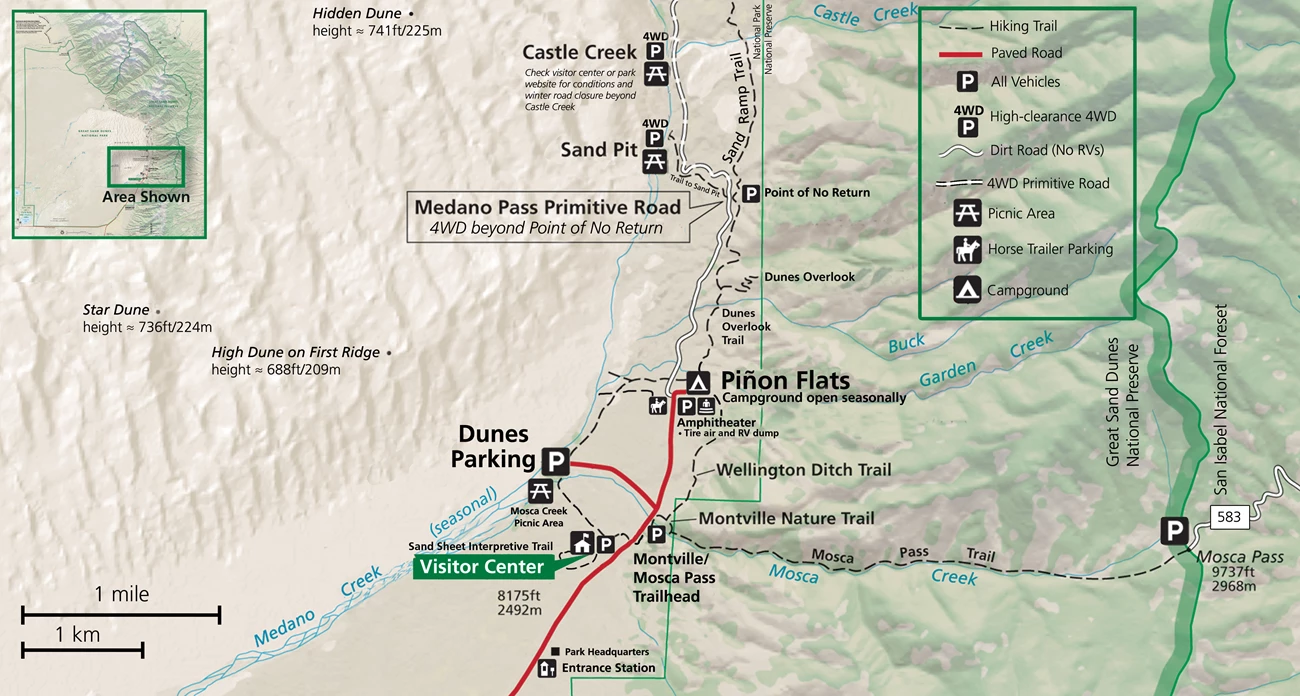
NPS/Scott Hansen High Dune on First RidgeThe high dune on the first ridge is neither the highest in elevation nor the tallest in the park, but it looks that way from the main parking lot. This is the most common destination in the dunefield, providing a great view of the entire dunefield. It is about 688 feet (209 m) from base to top. Cross a half-mile (1km) of the Medano Creek bed, then zigzag up along ridgelines to reach it. There are no trails in the dunefield. 
NPS/Patrick Myers Hidden Dune (tallest dune in North America)Hidden Dune is the tallest dune in North America at 741 feet (225 m). 
NPS/Patrick Myers Star DuneStar Dune is currently the second tallest dune in North America. It is a majestic dune now measuring 736 feet (224 m) from base to summit. While it can be hiked from the summit of High Dune on First Ridge, it's more direct, and less up and down, to access it via its base along the Medano Creek bed. From the Dunes Parking Lot, hike about 2 miles (3.2 km) south down the Medano Creek bed until the massive pyramid-shaped Star Dune comes into view. Follow a ridge to its summit. 
NPS Photo Eastern Dune RidgeBy high clearance 4WD vehicle, drive to Sand Pit or Castle Creek Picnic Areas. Or, with 2WD vehicle, drive to Point of No Return, then hike 3/4 mile (1.3km) to Sand Pit or 1.5 miles (2km) to Castle Creek. Castle Creek Picnic Area offers an impressively tall, steep dune face. Both areas have access to Medano Creek, which usually flows gently through the months of fall in this area. 
NPS/Patrick Myers Forested TrailsMontville Nature Trail In summer, keep this hike as an option for afternoon as an escape from the heat of the dunes. Walk along a shady forested trail named for a late 1800s settlement, comprising 20 houses in its heydey. Rest near the trail's highpoint, where you'll find outstanding views of Mt. Herard, the dunes and the valley. (Please be aware that hunting is permitted during legal seasons in Great Sand Dunes National Preserve, the higher mountainous areas above the dunes. Primary rifle seasons are in fall months. Check with a park ranger for details.) This trail follows a small creek to the summit of a low pass in the Sangre de Cristo mountains, winding through aspen and evergreen forests. Allow 2-3 hours to reach the pass; the trail is 3 1/2 miles (5.7 km) one way. Native Americans and early settlers used this route for travel into the valley. Sand Ramp Trail This 11-mile trail is most commonly used as an access to various backpacking sites along the foothills, rather than as a destination trail for scenery, since it stays at the same elevation along the base of the mountains. Begin hiking the Sand Ramp Trail in Loop 2 of the campground or at Point of No Return Parking area. After the first two miles, much of this trail is sandy soil or pure sand, up and down along the foothills, so this hike can be grueling. Allow for more time than the mileage indicates. Driving this road requires high-clearance 4-wheel drive (not recommended for small sport utility vehicles). A scenic drive any time of the year, it is especially spectacular in late September and early October when fall colors are at peak. Creek crossings can be hazardous in spring, and the road is closed when winter conditions create hazards. Check current road conditions and detailed information before travel. For those without a 4WD vehicle, check the Commercial Tours and Jeep Rentals page for options. 
NPS/Kris Illenberger Alpine TrailsMedano Lake and Mount Herard Medano Lake Trailhead is accessed from the Medano Pass 4WD road. Beginning at 10,000' elevation, the trail climbs 2000' through lush meadows and forests, ending at an alpine lake at timberline. For advanced hikers, continue on to the summit of 13,297' Mount Herard for a spectacular aerial view of the dunes. Music Pass, Sand Creek Lakes, and Other Alpine Peaks Round Trip Hiking Mileages from Music Pass Trailhead Lower Sand Creek Lake or Upper Sand Creek Lake: 8 miles (13 km) 
Driving Route from Great Sand Dunes Visitor Center to Music Pass TrailheadDrive south on CO 150 to US 160. Turn left (east), and continue toward La Veta Pass. About 2 miles before La Veta Pass, look for the sign for Pass Creek Pass on the left (north). This all-season dirt road goes uphill for one mile, then down into the Wet Mountain Valley. When you arrive at a T intersection at a paved road, turn right toward Gardner. At Gardner, turn left (north) on CO 69. At 4.5 miles south of Westcliffe, turn off Highway 69 to the west at the sign for Music Pass and South Colony Lakes Trailhead. At the "T" junction, turn left onto South Colony Road. At the end of the ranch fence on the right, you'll see another sign for Music Pass. 2WD drivers should park where the Rainbow Trail crosses Music Pass Road. From here, walk 2.5 miles to Music Pass Trailhead. 4WD drivers may drive another 2.5 miles to the end of the road at Music Pass Trailhead. Accessing Sand Creek Drainage from the WestSand Creek and Sand Creek Lakes are also accessible from the west side of the Sangre de Cristo Mountains, but require long hikes. From Liberty Gate Trailhead, south of the town of Crestone on the north side of the national park, it is a 7 mile hike just to reach the lower part of Sand Creek where it flows around the dunefield. From there, it is an additional 10 miles hiking up the Sand Creek drainage to reach either of the Sand Creek Lakes, with 3,500 ft. elevation gain. The Sand Creek Trail crosses Sand Creek a few times as it ascends the drainage; in years of average to high streamflow, Sand Creek makes the trail uncrossable in early summer, generally the entire month of June. 
NPS/Patrick Myers Grasslands and ShrublandsThe spacious grasslands and shrublands of the national park are the least visited area, yet they contain spectacular wildlife, migrating dunes, panoramic mountain views, and intricate beauty. See details on accessing grasslands in and around the national park. 
NPS/Patrick Myers WetlandsWetlands abound in the San Luis Valley, providing refreshing oases for wildlife and people in this high mountain desert. See details on accessing the wetlands in and around Great Sand Dunes National Park.
Visit our keyboard shortcuts docs for details
This short video takes you from wetlands to alpine tundra, showing the tremendous natural diversity of the park and preserve. |
 |
|
Last updated: July 28, 2025