National Park Service LogoU.S. Department of the InteriorNational Park ServiceNational Park Service
National Park Service:  U.S. Department of the InteriorNational Park Service Arrowhead
Great Basin National ParkBaker Creek rapids
view map
text size:largestlargernormal
printer friendly
Great Basin National Park
What is Climate Change?
 
The terms global warming and climate change are often used interchangeably, but the two phenomena are different.
 
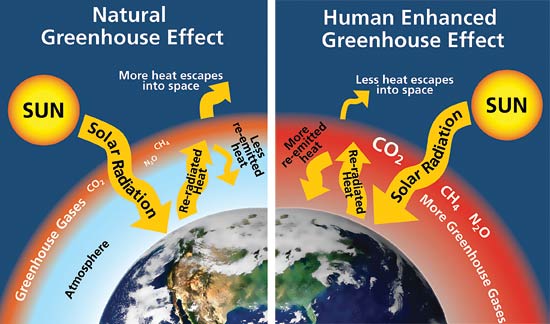
Global warming is the rise in global mean temperature due to an increase of heat-trapping greenhouse gases such as carbon dioxide and methane in the atmosphere (see figure below). Based on surface and atmospheric temperatures from thousands of locations, and from satellites worldwide, scientists have determined that the global mean temperature has risen 0.8 degrees C, since 1880.
 
Climate change is a more general term that refers to changes in many climatic factors (such as temperature and precipitation) from the global to the local scale. These changes are happening in response to global warming and other factors at different rates and in different ways. For example on a large scale, the United States has become wetter over the 20th century, while the Sahel region of central Africa has become drier. In California, global warming and associated climate change is decreasing the Sierra snow pack and melting it sooner, causing water shortages across the state.
 
Greenhouse effect graphic
Will Elder, NPS


Left - Naturally occurring greenhouse gases—carbon dioxide (CO2), methane (CH4), and nitrous oxide (N2O)—normally trap some of the sun’s heat, keeping the planet from freezing.

Right - Human activities, such as the burning of fossil fuels, are increasing greenhouse gas levels, leading to an enhanced greenhouse effect. The result is global warming and unprecedented rates of climate change.


Climate Change in National Parks brochure
Climate Change in National Parks
Download this brochure to learn more about climate change in your national parks
more...
Mountain Lion  

Did You Know?
Great Basin National Park's mountain lions feed primarily on mule deer but also include porcupines, rabbits, bighorn sheep, beaver, elk, marmots, and small rodents in their diets.

Last Updated: February 21, 2009 at 12:26 EST