The Formation of Lehman Caves
|
By looking closely at the cave system, geologists are able to better understand what created Lehman Caves
NPS PHOTO
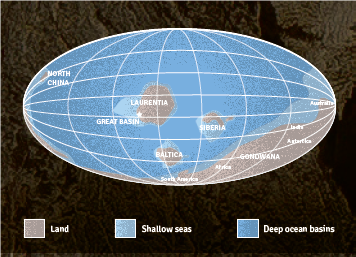
Speleogenesis: The Creation of Lehman Caves Water working slowly over the ages is the sculptor of Lehman Caves. According to geologists, the beginning off Lehman Caves can be traced back to approximately 600 million years ago, in the early Cambrian period. Much of what is now Nevada and western Utah was covered by a warm, shallow, inland sea. During this time, many thick layers of sediment accumulated on the sea bottom. Some of the layers were composed of silt, some were sand, and still others were made up of limy substance that originated from decomposed bodies of minute shell creatures. One of these limy layers was to become the limestone in which Lehman Caves was formed. This limy layer was compacted greatly by the weight of latter sediments deposited upon it. Under this pressure, the limy layer slowly turned to limestone rock. Later, as pressure and heat increased, some of the limestone turned into a low-grade marble. Later, great forces under the earth's crust caused the layers of the rock to buckle. This mountain range (the buckle) rose gradually until its peaks were thousands of feet above the valley floor. The rock layers cracked and fractured from the stresses of the uplift. In the future, the pattern of these fractures would help determine the floor plan of the cave. Acidic ground water came from melting snow and rain. Pure water could not dissolve limestone and marble. This water absorbed carbon dioxide from the air and decaying vegetation in the soil, which generated carbonic acid. This weak acid dissolved out cavities in the bedrock. Eventually, the water level dropped, leaving air-filled passageways ready for the next stage of cave development. Seeping water continues to enter the cave at a slow rate. The weak acid dissolves some of the bedrock above the cave and redeposits the mineral (calcite) on the floors, ceilings, and walls of Lehman Caves in the form of cave decorations. Many of the beautiful formations in Lehman Caves are still growing, and as a result are very fragile.
The lost river passage of Lehman Caves shows the carving nature of the water NPS PHOTO Lehman Caves is a solution cave. Solution caves form in a rock that dissolves in acidic water. Limestone, dolomite, gypsum, salt, and marble are all examples of rocks that form solution caves readily. The bedrock of Lehman Caves contains some low-grade marble, but is mostly limestone. This Pole Canyon Limestone was deposited under a shallow sea during the Cambrian Period (over 500 million years ago). Limey ooze and hard, calcium-rich parts of sea life settled on the seas floor in a layer that was over 1,000 feet thick in some places. With time and pressure, these sediments solidified into limestone. Limestone is made of the mineral calcite, which is a form of calcium carbonate (CaCO3). Caves in limestone form by the chemical dissolution of the rock. Water is always the agent for cave development. Very rarely does physical abrasion by gravel in moving water play a role in cave formation. Lehman Caves formed mostly by chemical means. The calcite in the limestone can dissolve in water, if the water is weakly acidic. The acid at work in Lehman Caves is carbonic acid. Carbonic acid is familiar to all of us. It is in soda pop. But where did this acid come from? The carbonic acid forms when water combines with carbonic dioxide. The carbon dioxide might come from the air or from biological activity and decay of organic material (roots, leaves, etc.) in the soil. The carbon dioxide levels in air in soil can exceed ten percent, which is 300 times higher than the carbon dioxide concentrations in the air we breathe. The acid forming reaction is: H20 + CO2 --> H2CO3 (carbonic acid)
The solution of water and carbonic acid then seeps down into the limestone. The acid reacts with the calcite to dissolve it in the liquid.
CaCO3 + H2CO3 --> Ca+2 + 2(HCO3-) (calcium bicarbonate solution)
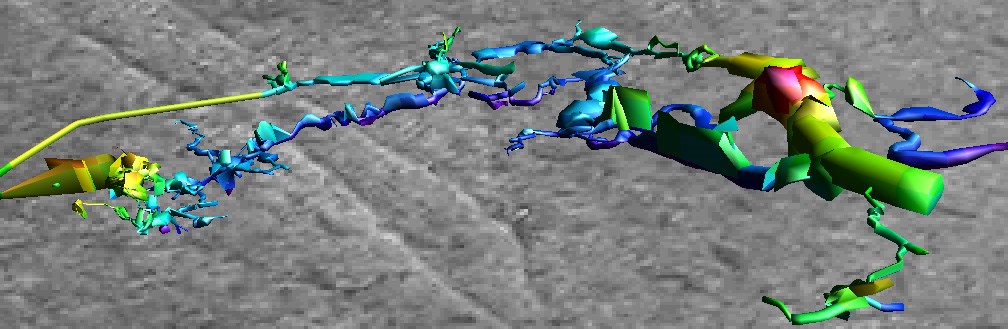
Computer generated model showing the passages of Lehman Caves
NPS IMAGE
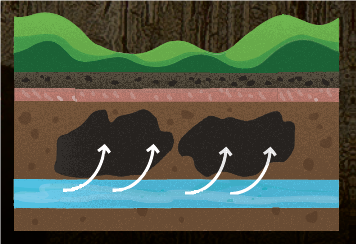
Factors Related to The Rate of Cave Growth Many factors influence the amount of limestone that a body of water can dissolve. Temperature and carbon dioxide content are a few of the more common factors. Most dissolution of limestone happens in the aerated zone (vadose zone), where the acidic water first contacts the limestone. This is just below the soil zone. It does not form caves, but instead dissolves the rock from the top down. This can contribute to the karst topography that often characterizes limestone regions. Karst topography refers to land that has many sinkholes, caves, sinking streams, and limestone pillars. It is often found in areas of soluble rock with a high rainfall. Some sinkholes are collapsed caves. The water that dissolves the top layer of rock may quickly be saturated with calcite. It may seem surprising that the same water can travel downward and dissolve more limestone to form caverns underground when it mixed with other water. The next location of high dissolution of limestone is at, or just below, the surface of the water table. This is the place where most caves form. There are three main reason for this:
Water continues to play a role in the formation of Lehman Caves NPS PHOTO Because of these factors, cave passages will develop at about the level of the water table, or just below it, if the water remains at a relatively constant height for a long time. This is why Lehman Caves is relatively level, even though the bedrock is inclined at a great angle. Lehman Caves from by this process of a weak carbonic acid dissolving away the rock. The groundwater was probably only slowly moving (no raging underground whirlpools), so the chemical process completely formed the cave passages. Physical erosion, or scouring, did not play a role in the formation of Lehman Caves. No one know how long it took the cave to form. Caves often tend to be in the range of hundreds of thousands to a few million years old. Lehman Caves is probably more than a few millions years old, at oldest. It is also not known when the water drained out of the cave. This could have happened because of uplift of the mountain range, climate change, and/or down cutting of surface streams. Dating the cave, especially in relation to key regional geologic events, could shed some more light on the specifics of how the cave formed. Even today the water seeping through the soil above the cave forms carbonic acid. The acidic water dissolves a little of the bedrock above the cave passages. Most of the limestone is dissolved at the boundary of the rock and soil. This probably does not weaken the cave substantially, until the surface wears down to intersect a cave passage, forming an entrance. The calcite stays in solution until the water reaches the air of the cave passage. At this point the water usually redeposits some or all of the calcite it contains in solution. The reasons for this vary slightly. |
Did You Know?
The Sagebrush, a very common resident of Great Basin National Park, is well adapted to the area. The Big Sagebrush root system can extend as much as 90 feet in circumference. This adaptation allows the plant to collect as much water as possible during infrequent rains.