
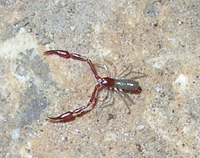
NPS Photo InsectsA wide variety of insects live in Great Basin National Park. Insects have 3 body segments, a head, thorax, and abdomen, along with 3 pairs of legs. All insects go through “life stages” where they metamorphose, changing from one form into another. A great example of this is the change of a caterpillar into a butterfly.
Insects in the park consist of those that live on land and in water. Land insects include butterflies, moths, beetles, ants, grasshoppers, crickets, dragonflies, bees, flies, and more. Over 100 species of butterflies have been identified, and these include only those in the park between May and August. After three years of studying beetles, park staff have found over 50 different kinds, but these were only collected from sagebrush and pinyon-juniper habitats. Other insects have not been studied systematically, but a large and diverse assortment can be found.
Many insects live in streams, eating phytoplankton and providing food for fish. The most common aquatic insects are blackfly larvae, which look like little bowling pins attached to the underside of rocks; stonefly larvae with two tails; mayfly larvae with three tails; and caddisfly larvae which often make a casing about an inch long of small gravel, pine needles, or even snail shells.
Although 99% of insects are beneficial, some can cause problems. Bark beetles are tiny insects that move underneath the bark of the tree, creating interesting looking galleries. Their activity may cause the tree to die, affecting the health of entire forests. A caterpillar called a fall webworm will eat large number of leaves and make a silken web or tent in the branches of a host tree. It can damage the host tree, but is rarely responsible for killing it. Evidence of the fall webworm can be found along the Snake Creek drainage. For more information, see the Winter 2006 edition of The Midden.
Current insect projects in the park include:
A good website for more information about insects is: http://www.utahbugclub.org/
Spiders and RelativesSpiders are different from insects in that they have 8 legs, and only two body parts, the cephalothorax (head and thorax fused) and abdomen. They also have no antennae and no wings. Very little is known about the spiders that live in Great Basin National Park. Some spiders that have been seen around the park include wolf spiders, cat-faced spiders, and black widow spiders.
Scorpions also have eight legs, lack antennae and wings. Scorpions are a separate order from spiders and grouped in the Order Scorpiones because they possess a stinger. They also have elongated pincers called pedipalps in front of their four pairs of legs that they use to catch insects and spiders. It is unclear how many species of scorpions live in the park, but they do exist here and are often hard to spot since they are typically nocturnal. Scorpions rarely sting people, but use caution when lifting boards or stones and disturbing wood piles because they will sting quickly when disturbed.
Several close relatives to true spiders have been identified as part of the Cave Invertebrate Inventory.
CentipedesCentipedes have segmented bodies with a pair of legs attached to each segment. They are carnivorous and feed on other arthropods, earthworms, and snails. They can be found by looking for their prey in damp places under leaves, rotten logs, and rocks. Many are nocturnal.
A systematic search for centipedes was conducted in selected caves as part of the Cave Invertebrate Inventory, and one was found in Ice Cave. Further caves are currently being studied.
MillipedesMillipedes are similar to centipedes, but instead of one set of legs from each segment, they have two. Millipedes are herbivores feeding mostly on decaying vegetation. They can usually be found crawling along forest floors where it is damp and there is plenty of humus (decomposed plants) to eat.
Millipedes have been found in several caves in the park, including at least one new species to science which is currently being described by a taxonomist. The cave millipedes appear to have adapted to their environment, losing all pigmentation. |
Last updated: September 18, 2021