




NPS Photo Bristlecone pines are said to be the oldest known living trees. They have many tricks that help them survive, like growing in twisted shapes at high altitude, and an adaptation called "sectored architecture". Sectored architecture means that the tree has roots that feed only the part of the tree directly above them. If one root dies, only the section of the tree above it dies, and the rest of the tree keeps living. You will often see bristlecone pines at high elevations with only one or two living sections, stripes of bark growing on an otherwise skeletal tree. Bristlecone pines can endure a lot. In the summer of 1964, a geographer by the name of Donald R. Currey was doing research on ice age glaciology in the moraines of Wheeler Peak. He was granted permission from the United States Forest Service to take core samples from numerous bristlecone pines growing in a grove beneath Wheeler Peak, so he could try to find the age of the glacial features those trees were growing on top of. Currey was studying the different widths of the rings inside these bristlecone pines, which were believed to be over 4,000 years old, to determine patterns of good and bad growing seasons in the past. Because of their old age, these trees act as climatic vaults, storing thousands of years of weather data within their rings.This method of research is valuable to the study of climate change. Currey found a tree in this grove he believed to be well over 4,000 years old. This tree was known by local mountaineers as Prometheus. There are several accounts of how Prometheus met its end. Some say Currey's increment borer, the tool used to take core samples, broke off in the tree. Others say he did not know how to core such a large tree, or that the borer was too short. Yet others say Currey felt he needed a full cross section to better examine the rings of the tree. We may never know the true story of what happened to Prometheus, but we do know one thing for certain: Currey had permission from the Forest Service to have the tree cut down. Counting the rings later revealed that Prometheus contained 4,862 growth rings. Due to the harsh conditions these trees grow in, it is likely that a growth ring did not form every year. Therefore, Prometheus was estimated to be 4,900 years old, the oldest known tree of its time. At the time, Prometheus was the oldest tree ever dated, the runner-up being a bristlecone pine in the White Mountains of California. It was only 4,847 years old. It wasn't until 2012 that an older tree was found - another bristlecone in the same area, proved to be 5,065 years old. There is a good chance there are older bristlecone pines that have not yet been dated. According to ancient Greek myths, Prometheus was an immortal who brought fire (a symbol of knowledge) to humans. Prometheus the bristlecone pine also imparted a lot of knowledge to humans. Information gained by studying this significant tree added to the knowledge of carbon dating (which is valuable to archeologists and paleontologists) and climate data. Bristlecone pines are now protected on federal lands. The stump of Prometheus is all that remains of the ancient tree within the grove. If you would like to travel through history by counting the rings of Prometheus, you can do so at the Great Basin Visitor Center.
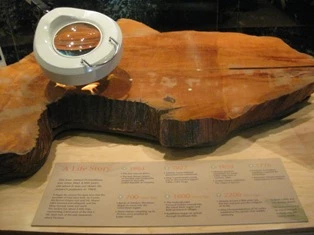
NPS PHOTO |
Last updated: January 5, 2021