

The model 1840 heavy dragoon saber was manufactured by N.P. Ames in Springfield, Massachusetts although many were made in Prussia. Blades are slightly less than 36 inches long and about 1 1/4 inches wide. The saber knot is lightweight white buff leather 1 inch wide and 18 inches long over-all. For centuries the weapon considered most essential to cavalry had been the saber. Oddly enough, the US Army, from its beginning, rarely saw fit to emphasize the training of its mounted men enough to make them sufficiently proficient with the saber to be deadly swordsmen in battle. Of course there were saber exercises in the dragoon and mounted riflemen regiments, but these were hardly on a level with the training European cavalrymen experienced. In spite of the general disenchantment with the saber as an effective cavalry weapon, all the mounted units of the US Army, from the Continental Dragoons to the modern cavalry, were armed with one type of saber or another, until that weapon was finally discontinued as a cavalry weapon in 1934. The 1840 saber had the nickname, "Old Wristbreaker," because it was fairly easy for the soldier to break his wrist in combat if he held the saber wrong, The proper way to hold the saber was inverted and away from your body. Sabers were not sharpened because they were intended to be a thrusting weapon not a slashing weapon. The saber was used exclusively from horseback in close combat. The saber knot would be used as a strap and wrapped around the wrist to prevent the saber from being lost if it should be dropped in battle. 
Two flintlock pistols issued to the dragoons and carried in a saddle holster were the S. North Model 1819 army flintlock pistol and the Johnson Model 1836 army flintlock pistol. Both were .54 caliber pistols; both were smoothbores with brass sights and pans and iron mounts. The North had a 10 inch round smoothbore, while the Johnson had an 8.5 inch smoothbore. Both had a swivel ramrod which prevented the dragoon from dropping the ramrod when reloading on horseback. The US Model 1842 percussion pistol was issued to all dragoon units by 1845 and by the late 1840s some of the dragoons may have been issued Walker-Colt revolvers pictured above on the right. The Colt revolver eventually replaced all of the older "horse pistols" and was issued to all dragoons and mounted riflemen. (The mounted riflemen were formed in the late 1840s to patrol the Oregon Trail. Two companies of mounted riflemen were stationed at Fort Scott from 1852-53.) The flintlock system of ignition was not replaced by the percussion lock until about 1845 on dragoon pistols, in spite of the fact that the dragoons were armed the first year with the very first percussion firearm to be adopted by the US Army-the Hall breech-loading carbine. Dragoons, until late in the Mexican War, used single shot pistols, when a few may have been issued Colt revolvers. It is a fact though, that at least part of the Regiment of Mounted Riflemen received Colt revolvers late in 1847. 
The US Model 1833 Hall carbine made by Simeon North in Middletown, Connecticut was the first breech-loading rifle to be used in the United States mounted service. It was a smooth bore weapon and was a .58-caliber. The barrel is 26.125 inches in length, and all metal parts were browned with a lacquer finish for protection. Made specifically to arm the Regiment of Dragoons authorized in 1833, it was fitted with a sliding bayonet. In 1836 Hall, at Harpers Ferry, brought out a somewhat heavier carbine that was made up with rifle components. Also a percussion arm, it had the rifle’s offset sights that have misled many into considering the arm a conversion from an original flint lock carbine. Barrel length is 23 inches long, with a rod-bayonet. Beginning in 1840, North delivered Model 1840 carbines, which are characterized by an improved opening device (either an elbow lever or fishtail lever), and a 21-inch barrel with a conventional rod, which was used for cleaning the bore. In 1843 North brought out the most common of the Hall models, the Model 1843 side-lever carbine, still with the 21-inch barrel and rod. To complete the tally, there is a Model 1842 carbine made at Harpers Ferry which can be recognized by its brass fittings; butt plate, trigger guard, and barrel bands. It had a fishtail opening lever similar to North’s Model 1840 fishtail-lever arm. All carbines were delivered to the government as smoothbore weapons; later, during the Civil War, many carbines of all models were rifled. 
To prime the piece, one would use a percussion cap, the percussion cap was like a small top cap with an explosive inside called fulminate of mercury. The cap was placed on the nipple of the gun, and when the trigger was pulled, the hammer would strike the cap. This action would cause the explosive inside the cap to go off, which would create a spark. The spark would go through the venthole and ignite the blackpowder in the barrel. The Halls' carbine has a couple of flaws. One was that it in the rigors of battle, it experienced mechanical failure. Another is that the breech of the gun had a gap that tended to widen over time, causing smoke to pour out the rear of the gun. So in 1847, the army went to the musketoon, a muzzle loader-like the infantry's musket-but was still a percussion weapon with a shorter barrel-like the carbine. 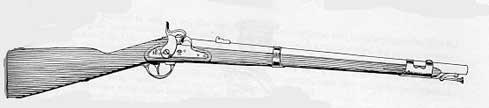
Information on this page was taken from The Horse Soldier, 1776-1943, Vol. 1 by Randy Steffen. Copyright © 1977 by the University of Oklahoma Press. Reprinted by permission. No further copying permitted.
|
Last updated: July 30, 2016