

NPS photo Everglades National Park encompasses about 1.5 million acres of which 1.3 million acres are designated as the only subtropical wilderness in the continental United States. Non-native (exotic) plants are a significant threat to the native plant communities of Everglades National Park. Approximately 1,000 plant species have been recorded in the park. Of these, more than 220 species are non-native. Because of limited funding, only a small number of these exotic plant species can be targeted for treatment. The most commonly targeted exotics are: Brazilian pepper (Schinus terebinthifolius) Estimates from 2013 digital mapping revealed that Brazilian pepper occurs on more than 41,707 acres, melaleuca occurs on more than 5,452 acres, Australian pine occurs on about 1,306 acres, and Lygodium occurs on more than 9,945 acres. However, these estimates were based on aerial surveys and are believed to underestimate the actual distribution of the species monitored; they do not capture species that cannot be seen from the air. Overall, exotic plant species are estimated to occur on approximately 200,000 to 300,000 acres of the park. View a map showing the distribution of the most common exotic plants in Everglades National Park. 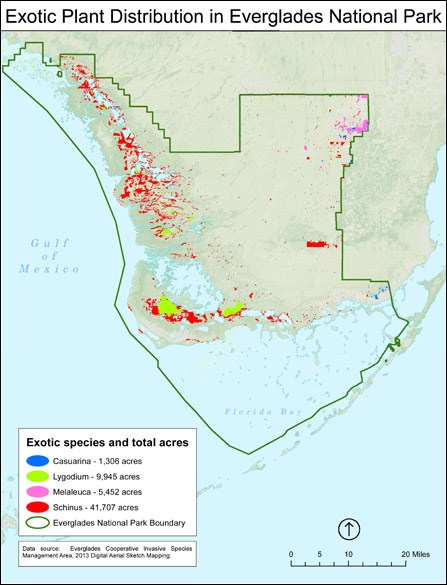
NPS map by Caryl Alarcon |
Last updated: August 5, 2021