
National Park Service LogoU.S. Department of the InteriorNational Park ServiceNational Park Service
National Park Service:  U.S. Department of the InteriorNational Park Service Arrowhead
Denali National Park and PreservePolychrome Rest Area
view map
text size:largestlargernormal
printer friendly
Denali National Park and Preserve
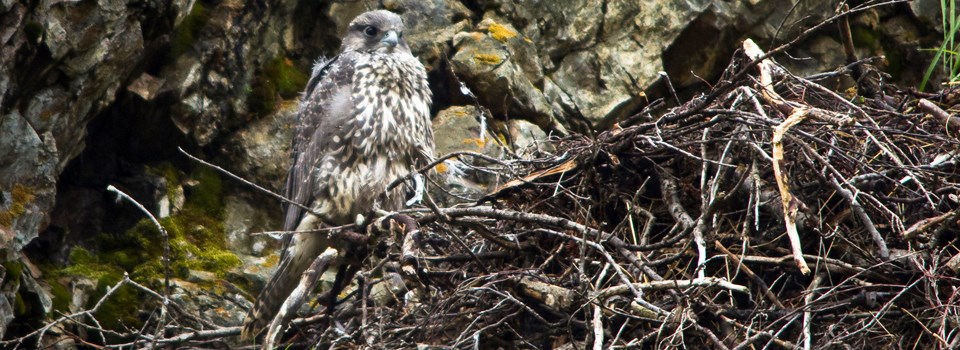
Gyrfalcon
Gyrfalcon

Tom Mangelson

Gyrfalcon.

Elusive, powerful, and well-adapted for life in northern latitudes, gyrfalcons are the largest falcon in the world. However, we understand little about their ecology due to the remoteness of their northern breeding areas. Gyrfalcons are one of the few diurnal raptors that are year-round residents in Denali. From late February through October, gyrfalcons share the Denali skies with a large breeding population of golden eagles.

Gyrfalcons are true arctic birds. They breed across the circumpolar north and leave only when food is scarce. They are extremely powerful fliers and can chase down prey such as ptarmigan with apparent ease. During the breeding season, gyrfalcons prey heavily on arctic ground squirrels and ptarmigan, and occasionally on snowshoe hare. During winter they rely heavily on ptarmigan.

Gyrfalcons don’t build their own nests. Instead, they often use the stick nests of other raptors to raise their young. In Denali, gyrfalcons often use stick nests in golden eagle territories for their own use. The presence of two large, territorial aerial predators in close proximity to one another often leads to spectacular aerial dogfights.

Gyrfalcons lay eggs in March, when daily temperatures rarely rise above freezing. Like other early nesting raptors, gyrfalcons must endure late winter and early spring snowstorms during incubation. The nestlings, usually one to four individuals, grow rapidly and fledge by mid to late July.

Denali’s scientists are studying the population ecology of gyrfalcons and are monitoring their reproductive success. They have also used satellite radio-telemetry to monitor the movements of juveniles.

Storms sweep in small amounts of pollution from around the Northern Hemisphere  

Did You Know?
Small amounts of airborne pollutants from around the world arrive in Denali every year. Remoteness alone cannot protect the park's clean air. As global human population grows, it is likely that increasing global emissions will affect Denali's air quality.

Last Updated: October 17, 2006 at 13:50 EST