
NPS 
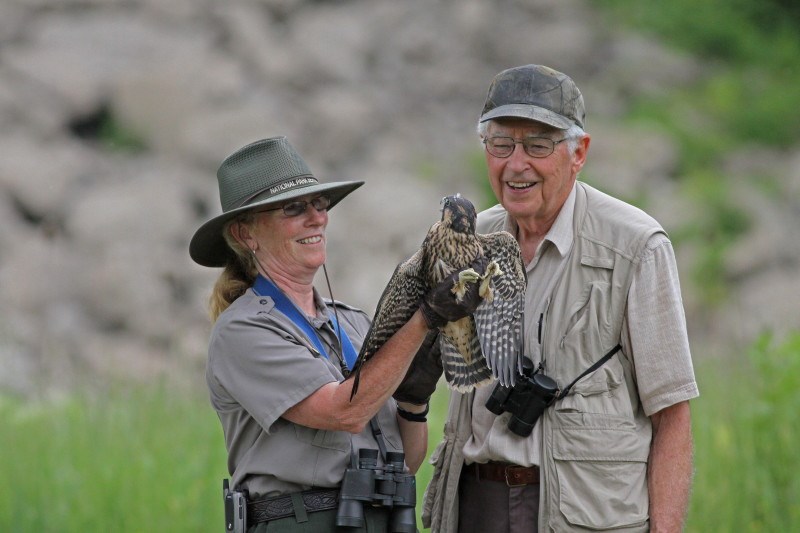
© C. Saladin "Gatewood" and "Trailblazer"A pair of peregrine falcons, "Trailblazer" and "Gatewood", have been known to nest beneath the high level I-80 Turnpike Bridge over the Cuyahoga River in Boston Township. This pair of falcons can be seen year round in the area south of the Boston Mill Visitor Center. "Ferris" and an Unnamed Male Join the ParkIn March 2017 a new pair of peregrine falcons began showing some interest in nesting beneath the high level Rt. 82 bridge at Station Road. This was the first peregrine nesting activity at the bridge since a young pair nested under the bridge in 2011. Our peregrine enthusiasts identified the female, "Ferris", by her leg bands. "Ferris" was banded near Toronto, Canada when she hatched in 2015. The male is unbanded and his previous whereabouts are unknown. 
© C. Saladin About Peregrine FalconsThe peregrine falcon's scientific name is Falco peregrinus, which means "falcon wanderer." It is about the size and weight of a crow and normally grows to 15 inches in length with a 40-inch wingspan. The speed of a peregrine falcon has been said to reach 175 miles per hour or more. Breeding InformationPeregrine falcons usually begin breeding at about two years old. The nest itself is little more than a shallow scrape, shaped by the birds in soil or accumulated debris. The nest holds three or four eggs (slightly smaller than those laid by chickens) that are mottled with a dark, reddish-brown pigment. Both adults incubate the eggs, and eggs hatch in about 33 days. 
© C. Saladin Eggs to EyasA young falcon in the nest is called a nestling or an eyas (pronounced I-es). It is covered by white down when hatched, which is replaced by feathers in three to five weeks. Both the adult male and female help care for the nestlings. Nestlings eat an incredible amount of food. They double their weight in only six days and at three weeks will be ten times birth size. Learn MoreVisit the Ohio Department of Natural Resources peregrine falcon page to learn more. |
Last updated: December 3, 2021