

NPS Photo Interviews by Park Ranger Susan Fauntleroy , 1992 We are at the home of Mr. Lambie Benner of Sharpsburg, Md. He is joining us today with his friend Boogie Grove. Both of you live in Sharpsburg and Mr. Grove and Mr. Benner are going to talk to us today about some of their recollections about the C&O Canal. First of all, Mr. Benner, when were you born? 1914, and that makes you how old? Mr. Grove, how about you? I'm born in 1908. I'm going on 85, March the 24th. Mr. Benner, let me start with you. Can you tell me anything about your early years and your canal family? Was your Dad a worker on the C&O Canal? You had to sing as you walked down the towpath? Did you get to ride the mules? (Boogie) Sometimes you'd run all night. Boated all night. There's a lot a boatsmen on there boated night and day. But I never got to that. We boated till about 9:00. Tied up. But you wouldn't more than get in bed. 'For you was up. Soon as you pull them harness off them mules, let 'em down and let 'em roll, they was ready to go! Us kids would no more than get to sleep, you'd hear our daddy say, " All right, boys, let's go! Bout 3:00 or 4:00 in the morning. Sometimes we'd run till 11:00 or 12:00 at night. How did you do school-wise? Barefooted all the time. Them old stones down in Point of Rocks, ballast stones off the railroad. Canal company would get 'em, put 'em on the towpath, build the towpath up and all. Boy, they was rough on your feet! It was a rough life for a kid. It really was. It wasn't too bad for them old boatsmen, for most of 'em drank! They lay on the deck and sleep. Go to Washington and Cumberland, they was in the saloons all the time! Yeah, that's true. You know what you'd do here in Sharpsburg? Here in Sharpsburg, all the boatsmen, all of 'em drank, pretty near. They'd take what money they got off the canal, see, be in these bar rooms half the time. But we always had plenty to eat, see. We had gardens and little homes had gardens...raised them, yeah. We'd steal coal off the Canal Co!!! When you boated on the canal you got $15 a trip. I boated for different peoples after my daddy left the canal. And we'd get $5 of it. Course the man you was boatin' for, he kept it, and give you $2 in Cumberland and $2.50 in Washington. That's what you'd get. 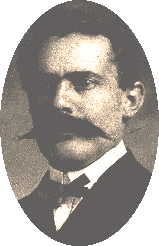
{Augustus Hebb pictured} NPS Photo I'll tell you a fella who can tell you a lot about the canal. But he's in Frederick. He's 87. Theodore Hebb. He owned a place here in Sharpsburg. See several Hebb Family Photographs. (Ted) Mr. Hebb. Yes Mam. Your father was a boat captain during the operating period. How old were you before your dad, whose name is Augustus Hebb (pictured at right), how old were you before he began to take you on the boat with him? All four pulling at once? How long could they pull then before they had to take a rest? (Ted) One thing after the 23rd, on November the 23rd they'd generally close up about around Thanksgiving. Ya see, the canal would freeze hard; you couldn't move. And then they'd draw all of the water out of it. And the boats would set there on the bottom of the canal until next spring. Well this time they would come in like that, they'd take their teams ... they would take the majority of them up to the Four Locks above Williamsport along the canal. And that's where they would keep them over the winter, feed 'em and all. And also some of them in Sharpsburg, down below Sharpsburg, had what they call a big farm down there. And he would take so many and keep 'em until next spring. So they boarded the mules then over the winter? What was Cumberland like? You saw people killed? The canal people a rough lot? Did they do some drinking? Well, between Cumberland and Georgetown which was the better place? Did you eat well on the canal? Did you eat any of the critters that you could catch along the canal? You ate EELS? How'd you cook 'em? (Lambie and Boogie) What was so dangerous about Great Falls? Oh, well, the towpath was so narrow down there. And then the water, a lot of water down there! Yeah! You remember Widewater? It used to be deep in down there. Is it still that way? (Ted) Ted, in the years that you were boating, were there places on the canal that were your favorite; or were there places that were real dangerous that you didn't like at all? Did any boats ever break loose? (Ted) And were you there when it closed? |
Last updated: December 15, 2020