



|

NPS Photo The Mighty Sea TurtleEvery year a cycle of life occurs on the Cape Hatteras National Seashore when female sea turtles return to the beaches where they were hatched to deposit eggs into a nest dug into the sand which will hatch to start the next generation of sea turtles. The sea turtle emerges from the ocean to make her way ponderously up the beach where, after crawling to a place she deems appropriate, she digs a hole with her back flippers to lay her eggs. Once she covers the nest, this majestic reptile slowly makes her way back to the ocean using light cues. The nesting process can take between 1-3 hours to complete. A couple of months later, the nest seems to boil over as tiny turtles struggle out of their shells, out of their nest, and, out across a beach full of hazards by the light of the moon to their new home - the ocean. Sea turtles, some of the largest living reptiles, are long-lived, cold-blooded, air breathing, migratory, and spend almost their entire lives in the sea. They range in size from the smallest species weighing 75-100 pounds to the largest species weighing almost 2,000 pounds. Visitors can tell the difference between a land or pond turtle and a sea turtle by their front limbs. Sea turtles have flippers, whereas land and pond turtles have feet with claws. There are five species of sea turtles found along the Cape Hatteras National Seashore - the leatherback, hawksbill (rarely seen), Kemp's ridley, loggerhead and green. While all five of these sea turtle species can be found in Seashore waters throughout the year, it is the female loggerhead and green turtles—and occassional leatherback and Kemp's ridley turtles—that nest on these beaches, which are considered to be the extreme northern limits of their nesting grounds. Hawksbills were documented nesting on Cape Hatteras for the first time in 2015, with two nests laid by a single female. Nesting HabitsThe primary nester at the seashore is the loggerhead turtle along with a few green turtles and an occasional leatherback, Kemp's Ridley, Hawksbill sea turtle. All species of sea turtles exhibit delayed maturity and recent studies on loggerhead turtles estimate that they do not reach sexual maturity until 30+ years of age. Although sea turtles live most of their lives in the ocean, adult females will return to land to lay their eggs. They often migrate long distances between foraging grounds and nesting beaches. Loggerhead's nest every two to three years and will lay an average of four clutches per year. Sea turtles nest on sandy beaches at night with the majority of nesting occurring from May through September. The 100 or so eggs in the nest will incubate for approximately 60 days with the temperature of the sand determining the gender of the hatchlings - warmer sand will develop mostly females, cooler sand produces mostly males. As a result of this, our coastline produces a large portion of the male population for the entire North-Atlantic subpopulation, which extends from the Florida/Georgia border to Virginia. While eggs are incubating the nests are highly vulnerable to weather events and predators. Once the eggs hatch, the hatchlings use a combination of cues to find the ocean when they emerge from the egg cavity including slope of the beach and the reflection of the moon or starlight off the water. They will often move towards the part of the horizon that is at the lowest angle of elevation from the turtle's position. Visual cues will guide hatchlings to the sea. Near shore, turtles will orient into the waves and in deeper water they utilize magnetic orientation for offshore migration. . Once they reach the water, the tiny hatchlings will swim for twenty-four to thirty-six hours to reach the Gulf Stream and the seaweed "nurseries" where they will be protected for the next ten years. It is estimated that only one in 1,000-10,000 hatchlings survives to maturity. The park's beaches have been monitored since 1987. Nest numbers here have fluctuated greatly in the last 30 years with the fewest in 1987 at eleven and the peak of 473 in 2019. The number of sea turtle nests laid annually has grown from an average of 77.4 sea turtle nests from 2000-2007 to an average of 192.2 nests from 2008-2016. 
NPS Photos Sea Turtles at the Seashore Click below to learn about the five types of sea turtles found in the Outer Banks.
Scientific Name: Caretta caretta Description: Loggerheads are the most common species of sea turtle in the waters surrounding Cape Hatteras. They are also the Seashore’s most common nesting turtle. Head is very large with heavy strong jaws. Reddish brown coloration on head, flippers, and top-part of shell. Yellowish-brown to white coloration on lower-part of shell. Front flippers are short and thick with 2 claws and the rear flippers can have 2 or 3 claws. Hatchling/young coloration ranges from dark brown to light brown above and whitish to yellowish below. Size: Diet: Loggerheads are omnivorous (consume both plants and animals). Invertebrates seem to be the most important food source, and the loggerhead’s large head and massive jaws are well adapted for crushing hard-shelled prey. Prey consumed includes: sponges, jellyfish, marine worms, squid, conchs, whelks, various species of bivalves, shrimp, various species of crab, sea urchins, various species of starfish, and various species of algae and sea grass. Habitat: The loggerhead wanders widely throughout its range. It enters bays, lagoons, salt marshes and creeks, and the mouths of large rivers. Hatchlings and juveniles seek shelter and food in floating mats of Sargassum (a type of seaweed). Nesting: Nest at intervals of 2, 3, or more years. They can lay 1 to 7 nests per season, approximately 11-15 days apart. Each nest laid can contain between 50-130 eggs. Eggs have an incubation period of 49-76 days. The Cape Hatteras National Seashore is near the edge of the northern limit of their nesting range. Range: Found in all temperate and tropical waters throughout the world. The loggerhead turtle nests farther from the tropics than any other marine turtle! Status: Population Estimate: around 44,560 nesting females (male population numbers are unknown).
Scientific Name: Chelonia mydas Description: The head is small and blunt with a serrated jaw. The color of the top shell varies from pale to very dark green and plain to very brilliant yellow, brown and green with radiating stripes. The bottom shell ranges from white to yellowish. All flippers have 1 visible claw. Green’s can be distinguished from all other sea turtles by the single pair of scales on the front of the head. Hatchlings are dark brown, but become much paler by the age of 6 months. Size: Diet: Changes significantly during its life. When less than 8 to10 inches in length, they eat worms, young crustaceans, aquatic insects, grasses, and algae. Once green’s reach 8-10 inches in length, they mostly eat sea grasses and algae. Green’s are the only species of sea turtle that is strictly herbivorous as an adult. Their jaws are finely serrated which aids them in tearing vegetation. Habitat: Greens are found mainly near the coastline in shallow, sandy flats covered with seagrasses or in areas where seaweeds can be found. Scattered rocks, bars, and corals are used as nighttime sleeping sites. They are rarely observed in the open ocean. Nesting: Greens nest at intervals of 2, 3, or more years, with a wide year-to-year fluctuations in numbers of nesting females. They can nest between 1 to 7 times per season, approximately 12 to 14 days apart. Each nest can contain between 100 to 120 eggs. Incubation can take between 30 to 90 days. The Cape Hatteras National Seashore is at the extreme northern limit for nesting. Range: The green sea turtle is found in parts of the Atlantic, Pacific and Indian Oceans, primarily in the tropics. Status: Population Estimate: around 88,520 nesting females (male population numbers are unknown).
Scientific Name: Dermochelys coriacea Description: The highly specialized leatherback is the largest of the sea turtles and can reach the size of a Volkswagen! Leatherbacks are have one of the longest migrations in the world and ventures into the cold waters of the Arctic to hunt large jellyfish (their primary food source). Hatchlings are marked be white stripes and the front flippers are as long as the shell. Adults have a smooth, scaleless black to brown shell raised into seven narrow ridges that extend the length of the back. The limbs, head and back are often marked by white, pink or blue blotches. Unlike other sea turtles, the leatherback has no claws on its flippers. The coloration of the leatherback, dark above and lighter below. Size: Diet: Leatherbacks have scissor-like jaws that are shaped like a W. Their jaws are made of soft skin, and can be damaged by anything other than a diet of soft-bodied animals, so they feed almost exclusively on jellyfish. Jellyfish are an energy-poor food source because they are mostly water, so it is remarkable that a large, active animal can live on this diet. Many leatherbacks die from ingesting plastic debris mistaken for jellyfish. Habitat: Leatherbacks are primarily found in the open ocean, as far north as Alaska and as far south as the southern tip of Africa. Occasionally enters shallow waters just offshore and may enter bays and estuaries. Known to be active in water below 40 degrees Fahrenheit and is considered to be the only reptile known to remain active at such low temperatures. Nesting: Leatherbacks nest at intervals of 2 to 3 years, but recent research has indicated they can nest every year based on their environment and how healthy they are. These turtles can nest between 6 to 9 times per season, with an average of 10 days between nesting. Eggs will incubate in the sand for 50 to 78 days before hatching. Unlike other sea turtle species, leatherback females may change nesting beaches, though they tend to stay in the same region. The Cape Hatteras National Seashore is at the extreme northern limit for nesting (with only a handful of nests over the last twenty years). Range: Leatherbacks are the most widely distributed of all sea turtles. Found world wide, with the largest north and south range of all sea turtle species. With its streamlined body shape and the powerful front flippers, a leatherback can swim thousands of miles over open ocean and against fast currents. Status: Of all the species of sea turtles, leatherbacks are generally thought to be the ones most at risk for extinction despite their global population. Threats include loss of nesting habitat, poaching, fisheries interactions, trash ingestion, global climate change, and others. Population Estimate: around 35,860 nesting females (male population numbers are unknown).
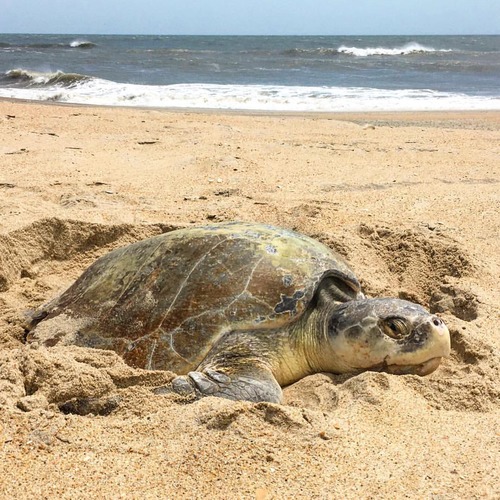
Scientific Name: Lepidochelys kempii Description: The Kemp’s is the rarest of the sea turtles. It’s a small turtle with a circular to heart-shaped keeled top shell that is almost as wide as it is long. Head is moderate and triangular in size. Front flippers have 1 claw, while the rear flipper has 1 or 2 claws. Adults have a dark grey green top shell with a white or yellowish bottom shell, while the hatchlings are jet black. Size: Diet: Have powerful jaws that help them to crush and grind crabs, calms, mussels, and shrimp. Habitat: Prefer shallow areas with sandy and muddy bottoms. Nesting: Kemp's ridleys nest more often than other species, every 1 1/2 years on average. They also nest in mass synchronized nestings called arribadas (Spanish for "arrival"). Only the olive ridley also nests this way. Kemp's ridleys nest 2 - 3 times each season. They lay an average of 110 eggs in each nest and the eggs incubate for about 55 days. Kemp’s do not nest on CAHA’s beaches, but juveniles and adults are found off the shores and in the sounds. Range: Adults are mostly limited to the Gulf of America. Juveniles range between tropical and temperate coastal areas of the northwest Atlantic Ocean and can be found up and down the east coast of the United States. Status: Population Estimate: More than 2,500 nesting females (male population numbers are unknown). The overall population in thought to be increasing.
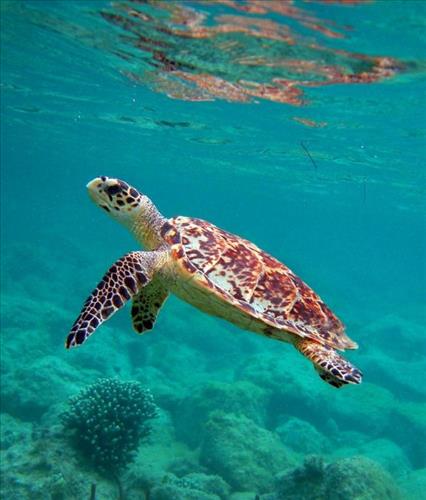
Their head is narrow and has 2 pairs of scales in front of its eyes. Jaw is not serrated and hawk-like in appearance. Top shell is bony without ridges and has large, over-lapping scutes (scales) present. Bottom shell is elliptical in shape. Flippers have 2 claws. The top shell is orange, brown or yellow and hatchlings are mostly brown with pale blotches on scutes. Diet: The hawksbill's narrow head and jaws shaped like a beak allow it to get food from crevices in coral reefs. They eat sponges, anemones, squid and shrimp. Habitat: Typically found around coastal reefs, rocky areas, estuaries and lagoons. Nesting: Nest at intervals of 2, 3, or more years. Nests between 2 to 4 times per season. Lays an average 160 eggs in each nest. Eggs incubate for about 60 days. Hawksbill’s do not nest on CAHA’s beaches, but juveniles and adults are found off our shores and in our sounds. Range: Most tropical of all sea turtles. Tropical and subtropical waters of the Atlantic, Pacific and Indian Oceans. Status: Population Estimate: 22,900 nesting females (male population numbers are unknown). Why Protect Sea Turtles?
|




Last updated: February 11, 2025