



Last updated: July 28, 2026
Lesson Plan
Water Bottle Filtration
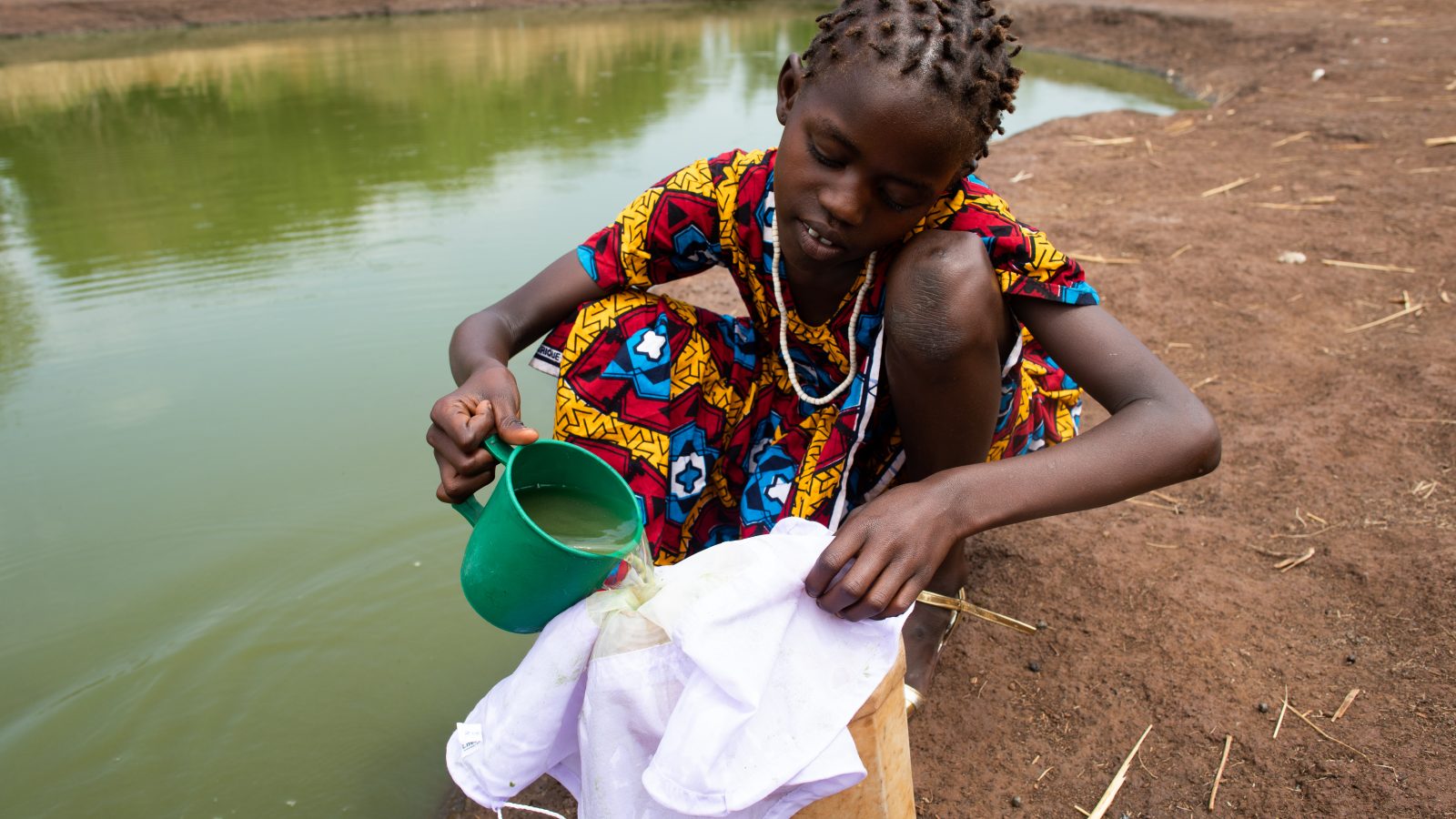
Kurujwok Okoth Oriew, 10, of Wichini village, pours pond water through a household filter into a pail in Gog, Ethiopia.
The Carter Center
- Grade Level:
- Middle School: Sixth Grade through Eighth Grade
- Subject:
- Science,Social Studies
- Lesson Duration:
- 30 Minutes
- State Standards:
- Grade 4: S4E3a-b
Grade 6: S6E3a
Grade 7: SS7G2a, SS7CG2a
Earth Systems: SES3a-b
Environmental Science: SEV4a
World Geography: SSWG5b
World History: SSWH22c - Additional Standards:
- Activity can be modified to meet Georgia Standards of Excellence for a variety of grades and subjects.
- Thinking Skills:
- Understanding: Understand the main idea of material heard, viewed, or read. Interpret or summarize the ideas in own words.
Essential Question
1. Why is access to potable water a global issue, and how do simple innovations help eradicate waterborne diseases like the Guinea worm?
2. How do we measure whether water is safe, and how effective are basic filtration methods at improving water quality indicators like pH?
Objective
Students will be able to:
- Analyze the effects of unsafe drinking water on populations.
- Analyze a map to make generalizations about human activities.
- Design and engineer a water filtration device.
Background
These are a few ways this activity can be adjusted for exceptional learners, gifted learners, or extended to fit a longer class period:
-
Instead of providing materials for your students to choose from, give the students the flexibility of selecting their own materials to use. This may require some extra time for gathering materials.
-
Prior to the water filtration activity, read a story about water scarcity to students. One example you may use is Nya's Long Walk: A Step at a Time by Linda Sue Park.
-
Other water quality tests can be used to evaluate the cleanliness of the water such as total alkalinity, ammonia, carbon dioxide, dissolved oxygen, nitrate, phosphate, salinity, and total hardness. These tests can be purchased through a science kit distributor such as Carolina Biological Supply.
A third water sample such as bottled water or filtered tap water can be used to compare to.
Preparation
|
Items needed for this activity are:
|
Materials
Lesson Hook/Preview
|
Safe and reliable water is an important resource for life. However, approximately 2 billion people around the world do not have access to clean water. In many third-world countries, people must travel great distances to have access to water. Even then, the water that people have access to is not always potable. Parasites, such as the Guinea worm, often contaminate their water sources. Since 1986, The Carter Center has worked with countries affected by Guinea worm disease to teach communities the importance of filtering all drinking water and to provide medical assistance to those affected by the disease. Through this work, the Center has provided millions of personal and household water filters to protect people from swallowing the larvae carrying fleas and has almost completely eradicated all cases of the Guinea worm. For additional information on the Guinea Worm Disease and the work The Carter Center has done, click on the following link: Guinea Worm Eradication Program at The Carter Center |
Procedure
In this lesson, students will create their own filters to try and make water cleaner. It is important that no student drinks any of the water used in this activity, no matter how clean it looks.Begin the lesson by showing students maps of water scarcity and ask students what trends they see and what they can infer about human activity from the maps. Possible maps to use are located at the end of this lesson in Appendix 1. Discuss the lack of potable water that many third-world countries face and the risk of contaminated water. Show students the Guinea worm specimen and discuss the impact it has on populations. Tell students about the work of The Carter Center and its eradication of the Guinea worm. Show a video of the impact of The Carter Center such as this video. Show students the pipe straw that is distributed for personal water filtration. Prior to class, you should create a “contaminated” water sample by mixing water with dirt and debris. You want the water to appear as dirty as possible. Show students the “contaminated” water and ask them how they can make it clean. Allow students to brainstorm ideas and come up with possible solutions. If students do not suggest it, lead them to the idea of creating a water filter. Show students the materials they can use to create a water filter. This can be a set number of materials you provide, or students can bring their own materials to utilize. Give students time to construct their water filters. The body of the filter can be created by cutting a water bottle in half and placing the top portion inside of the bottom portion upside down. Students will place their filtering materials in layers in the top portion of the bottle.Once students have engineered their filtering devices, it is time to test them. Prior to testing any water filters, take measurements of the pH and turbidity of the “contaminated” water sample. To do this, use the Vernier probes for pH and turbidity. These values will be your baseline to compare to. Students should record the results on the data table. A sample data table is located at the end of this lesson in Appendix 2. Now have students filter water through their devices. It is important that no student drinks any of the water used in this activity, no matter how clean it looks. Once students have a sample of filtered water, they should use the probes to take the pH and turbidity values of their sample. Record the values on the data table.
Vocabulary
Water Scarcity: A severe lack of sufficient, usable water resources to meet the needs of a population or region.
Potable: Safe and clean enough for humans to drink without risk of illness.
Pollutants: Harmful materials or substances introduced into an environment—often through human activity—that cause damage or disruption.
Contaminants: Any foreign substances, chemicals, or living organisms that make a material or liquid impure, dirty, or unsafe. Note for students: A contaminant is anything that makes something impure. A pollutant specifically causes harm or damage.
Guinea Worm: A parasitic worm (Dracunculus medinensis) contracted by drinking water contaminated with infected water fleas, causing a painful tropical disease.
Larvae: The active, immature early life stage of an insect or parasite that hatches from an egg and looks different from its adult form.
Filtration: The process of removing solid particles or organisms from a liquid or gas by passing it through a porous barrier or mesh.
pH: A scale from 0 to 14 measuring how acidic or basic (alkaline) a liquid is, where 7 is neutral, below 7 is acidic, and above 7 is basic.
Eradicate: To completely destroy, eliminate, or wipe out a disease or problem so it cannot return.
Assessment Materials
The instructor can conduct a formative assessment by evaluating the students as they work with their water filters as well as through their class discussion. Student data on pH and turbidity can be used to assess the effectiveness of the water filters.