



Last updated: June 8, 2026
Lesson Plan
War on the Home Front: Measure of a Man
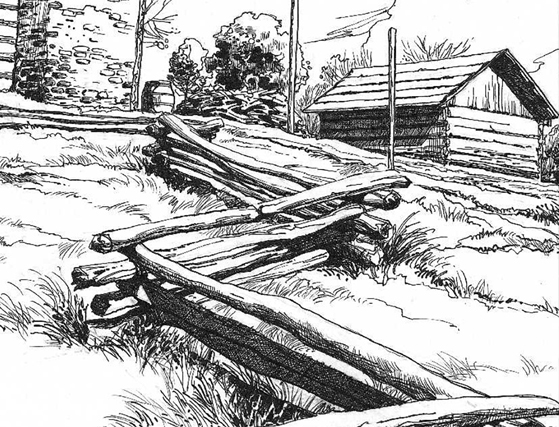
An illustration depicting the cabin area Booker T. Washington spent his early years.
NPS/Illustration
- Grade Level:
- Upper Elementary: Third Grade through Fifth Grade
- Subject:
- Social Studies
- Lesson Duration:
- 60 Minutes
- State Standards:
- • Grade 4: Virginia History – VS.1a, VS.4a and d, VS.7b and g, VS.8a, b, and c, English – Developing Skilled Readers a, c, and d, RV.1a, RI.1a, RI.3a, C.1a.
• Grade 5: US History – USI.4d, USI.5c, USI.9a, e and f, English – Developing Skilled Readers a, - Thinking Skills:
- Remembering: Recalling or recognizing information ideas, and principles. Understanding: Understand the main idea of material heard, viewed, or read. Interpret or summarize the ideas in own words.
Essential Question
How did the American Civil War and its outcomes change the lives of people, both free and enslaved, on the Burroughs Plantation from 1850-1865?
Objective
• Develop an understanding of how the Civil War transformed daily life for both enslaved individuals and the Burroughs family at this plantation site.
• Students study national debates on slavery and regional differences between the North and South.
• The program includes analysis of primary sources, such as the Emancipation Proclamation, and discussion of its impact on Washington and his family.
• Students also compare Washington's family's experiences to those of other freed families.
Background
This activity is based on the life and legacy of Booker T. Washington.
Preparation
Materials: Pencil, Graphic Organizer, Measure of a Man Video (found online at www.nps.gov/bowa)
Materials
Review of park video found on the park's website at www.nps.gov/bowa
Download War on the Home Front: Measure of a Man
Lesson Hook/Preview
Comprehension of main themes of park video
Procedure
- Show the video “Measure of a Man”
- Option: As students watch the video they will complete a 3,2,1
- Discuss video and responses from 3,2,1
Vocabulary
VOCABULARY
- plantation: a large farm where a cash crop is planted and grown to sell
- "big house": the house where the owners of the plantation lived
- emancipation: freedom, especially of the slaves in the United States
- slavery: the owning or keeping of slaves as a practice or institution; slaveholding
- cash crop: plants that are grown to sell for a profit
- grapevine telegraph: an oral form of communication in slave culture in which news spread rapidly among slaves from plantation to plantation
- agrarian: relating to the land; relating to the cultivation or ownership of land
- property: something that is owned by someone
- casualty: a soldier who is lost during active service, especially through being killed, wounded, or captured
- indentured servitude: a contract to work for a person for a certain number of years, usually to pay for passage to the New World; at the end of the contract these servants are free
- industrial: having to do with industries; relating to factories or the work, products, or people within
- insurrection: a rising up against established authority; rebellion; revolt
- territory: a part of the United States having its own legislature but without the status of a State and under the administration of an appointed governor
- secession: the withdrawal of 11 states from the United States of America in 1860 and 1861; being about the Confederate States of America and the American Civil War
- Flash cards
- Jeopardy
- Who Wants to be A Millionaire
- Paragraph Writing
- Web Quest
- Slaveholder: an owner of another human being who is used as personal property
- Abolitionist: a person who works toward ending slavery in the United States
- John Rolfe: English colonist who introduced tobacco to the settlers of Jamestown
- Nat Turner: American leader of a slave rebellion in Southampton, Virginia
- Abraham Lincoln: the sixteenth President of the United States; also President during the American Civil War who issued the Emancipation Proclamation
- John Brown: American abolitionist leader who seized Harpers Ferry, Virginia in 1859
- Alexander Stevens: Vice President of the Confederate States of America
- American Civil War (1861 – 1865): the war fought between the Union and the Confederacy
- Emancipation Proclamation: the document issued by President Lincoln, which became official on January 1, 1863, that was supposed to free the slaves in the Confederate states
- Underground Railroad: an organized system of “conductors” and safe houses that helped runaway slaves escape to the North
- 13th Amendment: the amendment to the Constitution in which slavery is ended
- Union: the side of the United States during the Civil War; the North