



Last updated: January 7, 2026
Lesson Plan
Tradesmen of the Springfield Arsenal in the American Revolution
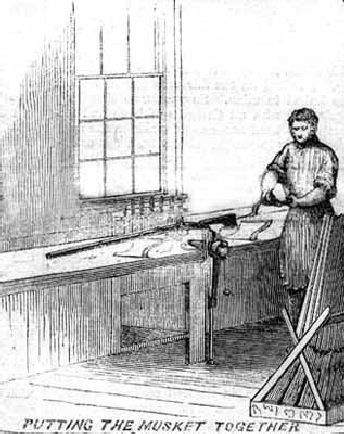
Working on musket.
none none
- Grade Level:
- Middle School: Sixth Grade through Eighth Grade
- Subject:
- Social Studies
- Lesson Duration:
- 60 Minutes
- State Standards:
- Massachusetts State Standards
Grade 3, Topic 6: Massachusetts in the 18th century through the American Revolution (3.T6)
Grade 5, Topic 2: Reasons for Revolution, the Revolutionary War, and the Formation of Government (5.T2)
(Middle School / Grade 8 / U - Additional Standards:
- Learning Standards Alignment (U.S. Common Core/Social Studies):
● CCSS.ELA-LITERACY.W.4-5.3 – Write narratives to develop real or imagined experiences
● CCSS.ELA-LITERACY.SL.4-5.4 – Report on a topic or text in an organized manner
● Social Studies (Histor - Thinking Skills:
- Understanding: Understand the main idea of material heard, viewed, or read. Interpret or summarize the ideas in own words. Analyzing: Break down a concept or idea into parts and show the relationships among the parts. Evaluating: Make informed judgements about the value of ideas or materials. Use standards and criteria to support opinions and views.
Essential Question
How did skilled tradesmen at the Springfield Arsenal contribute to the success of the American Revolution?
Why were different trades and apprenticeships necessary to keep the Continental Army supplied and prepared for war?
Objective
Students will learn about the roles and skills of various tradesmen who worked in the Springfield Arsenal during the American Revolution and understand their importance to the war effort.
Background
Begin with a short lecture/discussion and preview of the vocabulary.
- The Springfield Arsenal, established in 1777 in Massachusetts, was one of the most important weapons manufacturing centers during the American Revolution.
- It provided muskets, cannons, ammunition, and equipment for the Continental Army.
- The Arsenal relied on skilled tradesmen—craftsmen who made and repaired tools, weapons, and transportation equipment.
Preparation
none
Materials
Download Meet the Other Tradesmen
Procedure
Activity 1: Meet the Tradesmen (15–20 minutes)
Step 1: Read the WANT AD aloud to the groupStep 2: Role CardsPass out “Tradesman Role Cards” that describe each of the following: 1 card per student- keep the trades as evenly assigned as possible.- Blacksmith – shapes iron into parts for weapons
- Gunsmith – assembles and repairs muskets
- Cooper – makes barrels for storing gunpowder, food, etc.
- Wheelwright – builds and repairs wagons and wagon wheels
- Tinsmith – makes canteens and utensils
- Foundry Worker – casts cannonballs and other metal parts
Activity 2: Arsenal Town Hall (20-25 mins)
Students pretend it’s 1778 and the war needs more supplies. Each tradesmen group presents to the class in character, explaining:“Why their trade is essential to the Revolution and why their group needs more apprentices” Students will then hold a "Town Hall Meeting" where each group speaks, and then students vote on which trades need the apprentices.Step 1- Have the students get into groups based on what trade they are in. Hand out Town Hall Prep sheet- 1 per student Step 2- Give each group 5 minutes to fill out their sheets and then 10 minutes to discuss and come up with their best arguments on why they should get more apprentices. Step 3- Each trade group should select 1 spokesperson to present the group's reasons. Step 4- After each group has presented you can choose an option below.- Have all students vote on which group should get the help
- The teacher decided which group based on who they thought made the best arguments
Wrap-Up & Reflection (5–10 minutes)
Discuss as a class:- What would have happened without these tradesmen?
- How are these jobs similar or different from jobs today?
Vocabulary
Key Vocabulary:
- Arsenal
- Apprentice
- Blacksmith
- Gunsmith
- Cooper
- Wheelwright
- Tinsmith
- Foundry
- Arsenal A place where weapons and military equipment are made or stored.
- Apprentice A person, usually young, who learns a job or skill by working with someone who is very good at it.
- Blacksmith A person who makes and fixes things out of iron or steel, like horseshoes or tools.
- Gunsmith A person who makes, repairs, or works with guns.
- Cooper A person who makes or fixes wooden barrels and casks.
- Wheelwright A person who makes or repairs wooden wheels for carts and wagons.
- Tinsmith A person who makes or fixes things out of tin, like cups, plates, and small containers.
- Foundry A place where metal is melted and shaped into different objects.
Assessment Materials
Wrap Up and ReflectionDiscuss as a class:
- What would have happened without these tradesmen?
- How are these jobs similar or different from jobs today?
Name one trade from the Springfield Arsenal and describe why it was important.