



Last updated: January 7, 2026
Lesson Plan
Supplying a Revolution: Decision-Making and Logistics at the Springfield Arsenal, 1777–1778
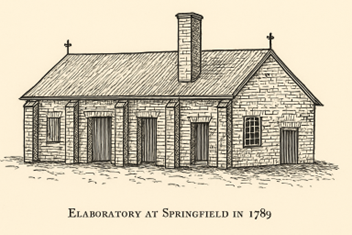
Laboratory at Springfield in 1789
None None
- Grade Level:
- High School: Ninth Grade through Twelfth Grade
- Subject:
- Social Studies
- Lesson Duration:
- 60 Minutes
- State Standards:
- Massachusetts State Standards (Included)
USI.T1.2 Roles of Revolutionary leaders; USI.T1.6 Military strategies & key battles; USI.T1.7 Geography’s role in war; USI.T1.8 How the Continental Army obtained weapons, ammunition, and supplies. - Additional Standards:
- Additional Standards (C3 Framework)
D2.His.1, 4, 6, 9, 10, 14 (historical context, causation, sourcing, evidence); D4.1–4.3 (constructing and presenting arguments and explanations using evidence). - Thinking Skills:
- Understanding: Understand the main idea of material heard, viewed, or read. Interpret or summarize the ideas in own words. Applying: Apply an abstract idea in a concrete situation to solve a problem or relate it to a prior experience. Analyzing: Break down a concept or idea into parts and show the relationships among the parts. Creating: Bring together parts (elements, compounds) of knowledge to form a whole and build relationships for NEW situations. Evaluating: Make informed judgements about the value of ideas or materials. Use standards and criteria to support opinions and views.
Essential Question
Compelling Question
How did logistical decision-making at the Springfield Arsenal influence the success of the Continental Army during the American Revolution?
Supporting Question
How did choices about location, layout, staffing, and resource management affect the Arsenal’s ability to supply troops?
Objective
•Evaluate the advantages and disadvantages of different armory locations using geographic and strategic evidence.
•Analyze how construction design and infrastructure choices influenced safety, efficiency, and long-term production.
•Apply budget constraints to make staffing decisions based on worker skills, costs, and production value.
•Calculate production outcomes by combining resource availability with labor capacity to meet historical supply demands.
Background
Brief Background: The Battle of Saratoga (1777)
The Battle of Saratoga was fought in two major engagements on September 19 and October 7, 1777, in upstate New York. British General John Burgoyne led an army south from Canada with the goal of dividing New England from the rest of the colonies by controlling the Hudson River corridor.
American forces, commanded by General Horatio Gates and supported by leaders such as Benedict Arnold, successfully halted Burgoyne’s advance. After suffering heavy losses, shortages of supplies, and an inability to receive reinforcements, Burgoyne surrendered his army on October 17, 1777.
Saratoga is widely considered a turning point of the American Revolution because it convinced France that the American cause was viable. Shortly afterward, France entered the war as an ally, providing money, supplies, troops, and naval power—support that proved essential to eventual American independence.
Why Logistics Mattered at Saratoga
While Saratoga is often remembered for battlefield leadership and tactics, the outcome was deeply shaped by logistical realities:
-
British forces were operating far from secure supply lines and struggled to move food, ammunition, and reinforcements through difficult terrain.
-
American forces benefited from shorter supply routes, local knowledge, and the ability to repair and resupply weapons.
-
Shortages of gunpowder, muskets, wagons, and food directly affected troop morale and combat effectiveness on both sides.
Victory at Saratoga was not only a military achievement—it was a logistical success.
How This Lesson Connects to Saratoga
This simulation places students in the role of decision-makers responsible for supplying the Continental Army at a critical moment in the war. By focusing on the Springfield Arsenal, students explore how:
-
Strategic location decisions affected transportation speed and security
-
Infrastructure choices influenced safety, efficiency, and long-term production
-
Skilled civilian labor supported soldiers on the front lines
-
Scarcity and uncertainty shaped wartime planning
The final round of the simulation challenges students to meet a historical supply invoice connected to Saratoga, reinforcing the idea that battlefield success depended on the ability to produce, repair, and deliver weapons and ammunition on time.
Instructional Importance
This lesson helps students:
-
Move beyond a battlefield-only view of the American Revolution
-
Understand war as a complex system involving civilians, labor, geography, and resources
-
Analyze cause-and-effect relationships between decisions and historical outcomes
-
Recognize the national significance of the Springfield Armory
By linking local history to a major national turning point, the lesson demonstrates how decisions made far from the battlefield helped determine the course of the Revolution.
Teacher Takeaway
Saratoga shows that wars are not won by tactics alone. This lesson allows students to experience the pressures, trade-offs, and uncertainties faced by Revolutionary leaders—and to see how logistics helped secure American independence.
Preparation
Materials & Supplies Needed
Required (Core Lesson)
-
Printed simulation packets (1 per student or group)
-
Budget tracking sheets (included in packet)
-
Worker role cards (gunsmiths, blacksmiths, carpenters, powdermakers)
-
Maps of New England and key Revolutionary War locations
-
Dice (1–2 per group) or a digital randomizer
-
Pencils and scrap paper
Recommended (Enhances Experience)
-
Projector or smartboard for:
-
Maps
-
Primary source excerpts
-
Budget tracking example
-
-
Calculators (or multiplication reference sheets)
-
Student vocabulary handout
-
Graphic organizers for pros/cons and decision-making
-
Timer or clock to manage rounds
Optional (Ranger- or Museum-Led Setting)
-
Replica objects or images (musket, cartridge box, tools)
-
Laminated maps or decision cards
-
Whiteboard or chart paper for whole-group tracking
Teacher Preparation (Before the Lesson)
Essential Prep (15–30 minutes)
-
Review the simulation rounds and outcomes.
-
Decide whether students will work individually or in small groups.
-
Print and organize all handouts and cards.
-
Review vocabulary terms, especially for ELL or younger students.
Recommended Prep (30–45 minutes)
-
Preview maps and identify key geographic features (rivers, routes).
-
Decide how much historical background to provide vs. discover during the simulation.
-
Identify where you may simplify or shorten the lesson if time is limited.
Optional Prep (If Time Allows)
-
Pre-teach vocabulary or Saratoga background as a short warm-up.
-
Prepare sentence frames or discussion prompts.
-
Assign group roles in advance (facilitator, recorder, calculator, spokesperson).
Classroom Setup Suggestions
-
Arrange desks for small-group collaboration.
-
Keep materials for each round grouped together.
-
Display the compelling question prominently.
Notes on Timing & Pacing
-
The lesson works best when rounds are clearly timed.
-
Encourage decisions within limits—uncertainty is part of the learning.
-
Reflection is essential; protect time for discussion.
Teacher Takeaway
No specialized materials are required. The lesson relies on decision-making, discussion, and evidence-based reasoning rather than props or technology, making it flexible for classrooms, outreach, and ranger-led programs.
Materials
Step by step instructions.
Download Description of Jobs with pictures
Lesson Hook/Preview
Teacher Action:Introduce the scenario: “It is 1777. The American Revolution is underway, and the Continental Army desperately needs weapons and supplies.” Display a map showing British-controlled territory and the Connecticut River.
Student Action:Students respond to a quick prompt: What does an army need to keep fighting besides soldiers?
Purpose:Activate prior knowledge and frame war as a logistical challenge, not just a battlefield event.
Procedure
2. Framing the Challenge (5 minutes)
Teacher Action:Explain the role of the Springfield Arsenal and introduce the compelling question. Review the simulation structure and budget constraints.Student Action:Students read the scenario overview and examine the starting budget.
Purpose:Establish historical context and clarify expectations.
3. Round 1 – Determining the Arsenal’s Location (10 minutes)
Teacher Action:Distribute Henry Knox’s correspondence and location options. Guide students to analyze geography, transportation, and security.Student Action:In small groups, students discuss pros and cons and select a location. They record their decision and adjust their budget accordingly.
Check for Understanding:Ask groups to justify their choice using evidence from the text and map.
4. Round 2 – Designing the Arsenal Layout (10 minutes)
Teacher Action:Introduce Thomas Dawes and construction challenges. Review safety concerns related to powder storage.Student Action:Students evaluate three construction options, choose one, and apply budget consequences.
Purpose:Highlight cause-and-effect relationships between infrastructure decisions and outcomes.
5. Round 3 – Staffing the Arsenal (10 minutes)
Teacher Action:Explain worker roles and values. Emphasize trade-offs between skill, cost, and production capacity.Student Action:Students hire workers within their remaining budget and calculate total production value.
Purpose:Demonstrate labor specialization and early industrial organization.
6. Round 4 – Manufacturing for Saratoga (10 minutes)
Teacher Action:Provide historical context for the Battle of Saratoga. Explain the dice-based resource availability system.Student Action:Students roll for resources, calculate production totals, and attempt to match Ezekiel Cheever’s historical invoice.
Purpose:Reinforce uncertainty, scarcity, and risk in wartime supply chains.
7. Reflection & Argumentation (5–10 minutes)
Teacher Action:Facilitate a whole-class discussion using reflection questions.Student Action:Students respond in writing or discussion, citing evidence from their decisions and outcomes.
Key Reflection Questions: - Which decision had the greatest impact on your Arsenal’s effectiveness? - What did this simulation reveal about supplying an army during the Revolution? - How would you defend your decisions using historical evidence?
Assessment
Formative:- Group discussions and decision justifications - Budget and calculation accuracySummative (Optional):- Written argument responding to the compelling question - Exit ticket explaining one key logistical challenge
Vocabulary
- ArsenalA place where weapons, ammunition, and military supplies are stored, repaired, or made.
- LogisticsThe planning and organization needed to supply an army with food, weapons, transportation, and equipment.
- Continental ArmyThe army formed by the American colonies to fight for independence during the American Revolution.
- GeographyThe physical features of a place, such as rivers, landforms, and location, that affect decisions.
- InfrastructureThe buildings and facilities needed for operations, such as workshops, magazines, roads, and storage areas.
- MagazineIn the 1700s, a storehouse for military supplies, including gunpowder and weapons.
- GunpowderA powerful material used to fire muskets and cannons. It can be dangerous if not handled carefully.
- Primary SourceAn original document or object created during the time being studied, such as letters, maps, or invoices.
- Skilled Labor / TradeWork that requires special training, such as gunsmithing, blacksmithing, carpentry, or powder making.
- ScarcityWhen there are not enough resources to meet everyone’s needs.
- BudgetThe amount of money available to spend, requiring choices and trade-offs.
- ProductionThe process of making goods, such as weapons or ammunition.
- Cause and EffectThe relationship between an action (cause) and what happens as a result (effect).
·
How to Use These Words
- Use vocabulary when explaining your decisions.
- Look for cause-and-effect relationships.
- Support your ideas with evidence from the simulation.
Supports for Struggling Learners
English Language Learner (ELL) Supports & Scaffolds
These supports are designed to help multilingual learners fully engage with the Supplying a Revolution program while building academic language.1. Vocabulary Scaffolds
- Pre-teach vocabulary using images, gestures, and real objects when possible.
- Pair each vocabulary term with a simple icon (river = geography, coin = budget).
- Provide a bilingual glossary when available.
- Limit new vocabulary per section and reuse terms frequently.
2. Sentence Frames & Starters
Use these to support speaking and writing:- “We chose ___ because ___.”
- “This decision affected our supplies by ___.”
- “One problem we faced was ___.”
- “Our evidence from the simulation shows ___.”
3. Simplified Language & Chunking
- Break instructions into short, numbered steps.
- Use clear, consistent phrasing for repeated tasks.
- Avoid idioms or explain them explicitly (e.g., “roll of the dice”).
4. Visual & Contextual Supports
- Use maps, diagrams, and images at every decision point.
- Model one full example decision before independent work.
- Point to visuals while speaking.
5. Collaborative Supports
- Pair ELL students with supportive peers.
- Assign roles that reduce language load (calculator, mapper, recorder).
- Allow discussion in home language when appropriate before sharing in English.
6. Flexible Response Options
- Accept verbal, drawn, or labeled responses.
- Allow short phrases instead of full sentences when appropriate.
- Focus assessment on reasoning, not grammar.
7. Cultural & Background Connections
- Connect logistics to familiar experiences (shopping, shipping, school supplies).
- Acknowledge that war and migration may be sensitive topics for some students.
8. Assessment Adjustments
- Reduce reading load with summarized texts.
- Provide extra time for discussion and reflection.
- Use oral check-ins to assess understanding.
ELL-Friendly Closing Question
“How did your choices help or hurt the army’s ability to fight?”Goal: Build historical understanding while supporting language development.Enrichment Activities
Enrichment Activities for Advanced Learners
Lesson: Supplying a Revolution – Springfield Arsenal Simulation
These enrichment options are designed for students who complete the simulation quickly, demonstrate strong reasoning skills, or need additional challenge. Activities emphasize higher-order thinking, synthesis, and historical argumentation.
1. Counterfactual Decision Analysis
Task:
Have students choose one major decision (location, layout, staffing) and redesign it differently.
Challenge Prompt:
How might this alternative decision have changed the Continental Army’s ability to fight at Saratoga?
Extension:
Require students to identify at least one benefit and one unintended consequence of their alternative choice.
2. Evidence-Based Defense Memo
Task:
Students write a short memo (1–2 pages) defending their final decisions as if reporting to George Washington or the Continental Congress.
Requirements:
-
Clear claim
-
Evidence from the simulation
-
Acknowledgment of trade-offs or weaknesses
Skills Targeted: Historical argumentation, persuasive writing
3. Compare & Contrast: Springfield vs. Another Arsenal
Task:
Research another Revolutionary-era arsenal (e.g., West Point, Carlisle, or Watertown).
Challenge Prompt:
How did geography, resources, or leadership shape differences in production and effectiveness?
Product Options:
-
Short presentation
-
Comparison chart
-
Written analysis
4. Logistics Map Analysis
Task:
Students annotate a map showing supply routes from Springfield to Saratoga.
Challenge Prompt:
What geographic obstacles or advantages would affect transportation speed and safety?
Extension:
Have students propose improvements using 18th-century technology only.
5. Quantitative Optimization Challenge
Task:
Students re-run staffing and production decisions to maximize output under fixed constraints.
Challenge Prompt:
What staffing combination produces the best results given scarcity?
Skills Targeted: Strategic thinking, applied math, optimization
6. Historical Perspective Shift
Task:
Students analyze the simulation from a different perspective:
-
British supply officers
-
Civilian workers
-
Massachusetts legislators funding the arsenal
Challenge Prompt:
How would priorities and constraints differ from those of Continental leaders?
7. Modern Connection: Logistics Today
Task:
Students connect Revolutionary logistics to a modern example (military, disaster response, supply chains).
Challenge Prompt:
What problems remain the same across time, and what has changed?
8. Create-Your-Own Scenario
Task:
Students design an additional simulation round (e.g., fire, supply raid, political pressure).
Requirements:
-
Clear rules
-
Budget or resource impact
-
Historical plausibility
Skills Targeted: Systems thinking, creativity, historical reasoning
Teacher Note
These enrichment activities can be used as:
-
Independent extensions
-
Small-group challenges
-
Capstone or assessment alternatives
They align well with C3 inquiry, advanced learners, and honors-level expectations.