



Last updated: July 14, 2026
Lesson Plan
A Few Good Colonists
Download Lesson Plan
65KB
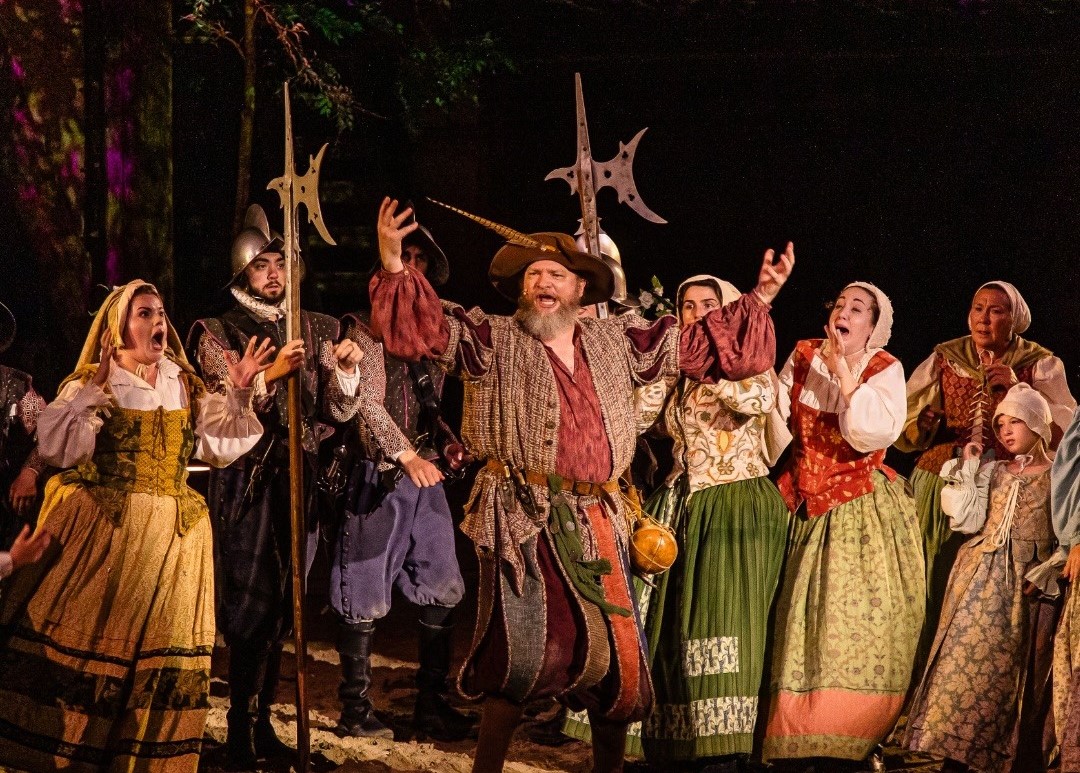
A man addresses a crowd of Elizabethan men and women
Roanoke Island Historic Association/The Lost Colony
- Grade Level:
- Upper Elementary: Third Grade through Fifth Grade
- Subject:
- Literacy and Language Arts,Social Studies
- Lesson Duration:
- 60 Minutes
- Common Core Standards:
- 4.RI.3, 4.RI.7, 4.RL.1, 4.W.1.b, 4.W.2, 4.W.2.b
- State Standards:
- 4.H.1.4 Summarize the role North Carolina has played in major conflicts and events throughout the history of America.
4.G.1.3 Summarize the reasons for forced and voluntary migration to, from, and within
North Carolina. - Additional Standards:
- 4.H.1.5 Use primary and secondary sources to compare multiple perspectives of various
historical events in North Carolina.
I.1.10 Construct responses to compelling questions with specific claims and information from
teacher-provided sources. - Thinking Skills:
- Understanding: Understand the main idea of material heard, viewed, or read. Interpret or summarize the ideas in own words. Evaluating: Make informed judgements about the value of ideas or materials. Use standards and criteria to support opinions and views.
Essential Question
Why do countries colonize other lands?
Objective
The student will be able to: a) discern the differences between wants and needs, b) identify abilities of the ideal colonist, c) create a persuasive handbill to recruit colonists, and d) prioritize and justify their answers.
Background
The 16th-century voyages to Roanoke Island, and the associated human losses, were among England’s first steps, and failures, in the European race to increase power and wealth by capitalizing on the unknown resources of the New World in hopes of determining the course of Europe’s political and economic power.
While explorers Amadas and Barlowe reported positive impressions of the land and the native people, Ralph Lane’s attempt at building a colony was not so positive. The area was suffering a drought, the English didn’t have adequate supplies, and the friendship between the groups soon soured as the Algonquian began to refuse to supply the colony with food.
Queen Elizabeth and Sir Walter Raleigh had a vision of what they wanted from the New World including a base to attack Spanish ships sailing for home laden with gold, natural resources that would help England develop new markets in Europe, and treasures similar to what Spain had found in its colonies in South and Central America. What skills and trades would ensure the colony’s survival long enough to reap the rewards?
Preparation
- Teachers will need to print out the material for each student, including the Part 1: Wants and Needs activity, Handbill Examples, Part II: Who are Colonists, Part III: Create a Handbill, and Part 4 Concluding Questions. Teachers should also review the website 1587: The Lost Colony on the Fort Raleigh website.
Materials
Divide students into groups of 3-4. Each group will develop a list of needed and wanted abilities/skills that the colonists should have.
Download Needs and Want activity
Groups will decide on the number of men, women, and children they will need to have and explain how they came up with the numbers. They will choose the top three skills/trades they are looking for.
Each team will design three handbills for each trait they chose to value. Each handbill should include where the colony will be located, some information about WHY it will be established, the type of people you want as colonists, the number of men, women, and children, and an illustration to hook volunteers.
This is the last activity for the students to do with their concluding questions about the colonists they picked and how they would value traits, personalities, and skills for the colonists.
Examples of actual handbill advertising for colonists from the 17th century. Review the Handbill Examples created for other colony efforts. Explain that they are advertisements trying to draw people towards the colony.
Lesson Hook/Preview
Trying to learn about colonization of North America? This activity will make the students think about the skills, traits, and personalities needed to make a successful colony and how they would try to construct their own colony. Will they follow in the pathway of the Lost Colony or will they learn from that story and follow a different pathway?
Procedure
The sequence for this lesson is to have the students examine the baseline reasons for colonization by Sir Walter Raleigh and then they will try to determine what the colony would need to succeed on the voyage of the Lost Colony.
- Review the reasons for English colonization with the students from the article on the Fort Raleigh Website about the First Voyage sent by Sir Walter Raleigh. The major reasons are listed below:
- Take land before France or Spain can claim it
- Give English Sailors a base to attack Spanish ships
- Find natural resources to England, like gold, silver, wood, furs, etc
- Bring more people into the English Protestant religion
- Allow English citizens to acquire new land to build a new home and village.
- Brainstorm as a class a couple basic needs and wants for the colonists. This can be valuable traits, skills, or professions the colonists should have. Examples would be courage, leadership, kindness, carpenter, blacksmith, farmers. (5-10 mins)
- Divide students into groups of 3-4. Each group will develop a list of needed and wanted abilities/skills that the colonists should have. (Part 1: Needs and Wants Activity) (10-15 min)
- Groups will decide on the number of men, women, and children they will need to have and explain how they came up with the numbers. They will choose the top three skills/trades they are looking for. (Part 2: Who is a colonist) (5-10 min)
- Review the Handbill Examples created for other colony efforts. Explain that they are advertisements trying to draw people towards the colony. (Handbill Examples) (5-10 mins)
- Each team will design three handbills for each trait they chose to value. Each handbill should include where the colony will be located, some information about WHY it will be established, the type of people you want as colonists, the number of men, women, and children, and an illustration to hook volunteers. (Part 3: Create a Handbill) (20-30 min)
- Students can then complete the conclusion questions. (Part 4: Concluding Questions). (10-15 min)
Vocabulary
- Handbill: A small, printed advertisement or other notice distributed by hand.
- Trade: a particular craft or occupation.
- Colonist: A person who migrates to and settles in a foreign area as part of a colony
- Hardship: Difficult or unpleasant conditions of life
- Natural resources: Something that is found in nature and can be used by people for another purpose.
- Characteristics: A feature or quality belonging typically to a person, place, or thing and serving to identify it.
- Need: Require (something) because it is essential or very important.
- Want: Have a desire to possess or do (something); wish for.
- New World: a term describing most lands in the Western Hemisphere, particularly the Americas, and sometimes Oceania.
Assessment Materials
Concluding QuestionsAnswer the questions in complete sentences. Use examples to justify your answers.
Part 4: Concluding Questions (Independent)
Answer the questions in complete sentences. Use examples to justify your answers.
Answer the questions in complete sentences. Use examples to justify your answers.
1. Why do you think Sir Walter Raleigh wanted men, women, and children in the colony?
2. What is your top want for the colony?
3. How does the look of a handbill help to attract colonists to the colony? Does a better-looking handbill always mean the colony will be better?
4. What do you think would be the most difficult part of migrating to a new land would be? Why would it be so hard? What skills could you have that would make it easier?
Rubric/Answer Key
Concluding QuestionsGrading Rubric
Use the following scale to score your students work on each of the sections with a score from 1 to 4, with four being the highest.
| Rubric: | |1. | |2. | |3. | |4. |
|---|---|---|---|---|
| 1. List of Needs and Wants is complete (Part 1: Group) | ||||
| Number of men, women, and children is listed and explained (Part 2) | ||||
| Colonists' 3 traits are listed and clearly justified and explained (Part 2) | ||||
| Handbill meets all listed requirements and is neatly created (Part 3) |
Enrichment Activities
Enrichment Activities:
Students will choose 2 colonists to draw or color copied images (or a combination of both) performing some of the needed tasks for a successful colony. When complete, all drawings could be put together as a display of colonial life.
Websites for coloring sheets: http://www.usa-printables.com/Events/Early-American-Life/
http://thelostcolony.org/wp-content/uploads/2015/05/Coloring-Book.pdf
Additional Resources
Website for coloring sheets:
USA-Printables: Early American Life Coloring Pages - Early America tradition and culture coloring pages
Additional Resources Websites:
Fort Raleigh National Historic Site (U.S. National Park Service)
Roanoke Voyages | The Lost Colony
Handbill Exhibit at the Bodeliean Library